by Asad Mirza
The Supreme Court’s concerns over Talaq-e-Hasan highlight communication flaws, prompting renewed debate on Islamic divorce practices and the need for reforms, clearer procedures, witness presence, and informed religious-legal guidance to protect women’s dignity

On November 19, a Supreme Court bench questioned the legality and social impact of Talaq-e-Hasan as practised by Indian Muslim men. It particularly objected to husbands using lawyers to issue divorce notices and indicated the matter may be sent to a Constitution Bench.
The bench questioned why lawyers or other individuals are engaged to send Talaq-e-Hasan notices on their behalf. The bench called it an affront to women’s dignity and asked why a husband who can approach a lawyer cannot directly communicate with his wife.
In its observations, the Supreme Court signalled a possible constitutional rethink of Talaq-e-Hasan; however, it is worth noting that different Personal Laws have legal sanctity under Article 15 of the Constitution.
Going by the Supreme Court’s latest observation, it becomes clear that the apex court has not raised any questions about the legality of Talaq-e-Hasan, but about the way the husband has communicated with his wife by engaging a third party.
Talaq in the Holy Qur’an
To clarify any doubts regarding different types of Talaq available to Muslim men, Islamic jurists, Muftis, note that in Surah Talaq, Ayat 1, Allah (SWT) first expresses His displeasure with Talaq and says this act should be resorted to only when all options of reconciliation have been exhausted; further, it lays down the details of the whole process. Allah’s displeasure with Talaq is also mentioned in Surah Nisa, from Ayat 19 to 29.
In this regard, it should be noted that the Holy Qur’an in Surah Baqarah, verses 228 and 229, prescribes that after getting a Talaq, a woman has to go through the period of Iddat before she may remarry.
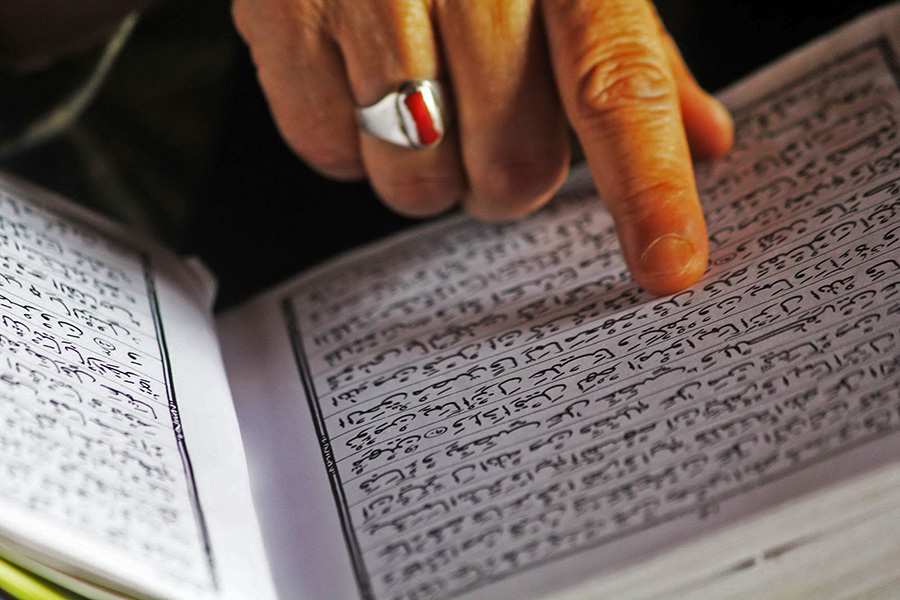
This means she can remarry only after the Iddat period is over, and meanwhile, it gives the man a chance to ponder what he has lost. If he has pronounced only one Talaq, then he can take his wife back during the Iddat period without a second Nikah.
Further, the Iddat period is made obligatory. It has been proven by medical science that a woman’s body is cleansed of the DNA of her former husband during the Iddat period of 84 to 90 days. So, if she remarries after Iddat, no question of any physical linkage with her former husband could be admissible.
Types of Talaq
In India, Islamic Fiqh (jurisprudence) details Talaq in two books: firstly, Majmua-e-Qawanin-e-Islami, published by the All India Muslim Personal Law Board (in Urdu and English). On pages 225 and 226, the correct manner of pronouncing Talaq is given, which spells out that Talaq should be pronounced only when the wife is not pregnant, not menstruating, and the husband has not cohabited with her since the last period. In the case of older women (in menopause), this condition will not apply.
The explanation further says that pronouncing more than one Talaq in a month is not permissible, nor if the man is in an inebriated condition.
Secondly, Qamus al-Fiqha (Vol. 4), published by Mahad-ul-Aali Al Islami, Hyderabad, on page 349, describes the Talaq allowed by Islam.
Talaq-e-Ahsan is the most preferred type of Talaq under Islam. Under Talaq-e-Ahsan, pronouncing the word Talaq once is enough, following the conditions given above. If after the first pronouncement, the Iddat period, usually 84 days, passes, then the Talaq is formalised. It is preferred because even after the first pronouncement, a husband can take his wife back. But if he wants to take her back after the Iddat period, a re-Nikah is required. This Talaq is also known as Talaq-e-Ba’in.
To further elucidate, it would be pertinent to go through Message of the Qur’an to Muslims by SSU Tabrez, wherein he summarises the procedure for pronouncing divorce most acceptably according to the Holy Qur’an and Sunnah, as explained in Islamic Jurisprudence.
He writes: If divorce seems to be the only option, it should be pronounced in a period in which the husband has not approached his wife after her menstruation. A single pronouncement should be made in the presence of two mature witnesses. Unless there are serious reasons requiring her to leave, the woman shall continue to stay in the husband’s house for three menstruations — her waiting period — after the pronouncement of divorce. This waiting period, during which they stay together but do not have a husband-wife relationship, provides a golden opportunity to reassess the situation and reconsider their decision.
If they decide to mend the relationship, the husband can revoke his pronouncement (with good intention) before the completion of the three months. He may do this by physically approaching the wife or verbally revoking it. This decision should also be conveyed to two adult witnesses. If the husband stands by his decision, separation is established after the Iddat period. However, if they wish to reunite in future, it is permitted only after a fresh Nikah.
Further, even the second pronouncement of Talaq is revocable. The same process for reunion will be followed. However, if after the second reunion the discord resurfaces and divorce is pronounced for the third time, it becomes irrevocable.
Reforming Talaq Practices
It is the duty of Islamic scholars to condemn and forbid unethical practices introduced gradually by male chauvinists and groups, in this case, lawyers, to serve their vested interests. On the other hand, Muslim scholars, by sweeping the ills prevailing in the Ummah under the carpet, are shying away from their prime responsibility of Nahi-‘anil-Munkar (stopping forbidden or unethical practices).
This further raises questions about how Talaq should be pronounced. Most Islamic jurists are of the view that Talaq should preferably be given in the presence of witnesses, but in almost all cases, this act happens during private hours of the couple, so this may not be feasible.

Keeping in mind Allah’s displeasure and the requirements of the time, it would be preferable if Muslim bodies like the AIMPLB advise making the presence of witnesses compulsory, as it gives the irate husband another chance to reconsider his decision before pronouncing Talaq in the presence of witnesses. Further, the Board should publish a booklet in all Indian languages explaining the whole process in simple, clear language.
On its part, it would be better if the Indian judiciary empanels some Muftis, and depending on their guidance, the courts could base their decisions instead of being exasperated by different Arabic terms and sources.
(The writer is a New Delhi-based senior commentator on national, international, defence and strategic affairs, environmental issues, an interfaith practitioner, and a media consultant. Ideas are personal.)