SRINAGAR: An invasive weed capable of surviving Kashmir’s sub-zero winters and completing its life cycle in the Valley has established a self-sustaining population in a rice-growing area of Pulwama, raising concerns about its potential spread into agricultural and non-crop ecosystems under changing climatic conditions, according to a 2026 study published in Applied Biological Research.
The researchers found that mature parthenium seeds recorded 65 per cent germination under laboratory conditions, while field observations confirmed that the plant could survive winter as seeds, emerge in spring and produce new seeds before the onset of severe autumn frost. The findings provide the first evidence of the successful completion of the life cycle of Parthenium hysterophorus under the temperate conditions of Kashmir Valley. This was the first report of the weed’s existence in Kashmir, unlike the one previously reported.
The paper, Life Cycle Dynamics and Invasive Risk of Parthenium hysterophorus L. in Rice Ecosystem of Temperate Kashmir, documents the weed’s capacity to establish itself in Kashmir’s agricultural landscape, despite the climatic constraints traditionally associated with its survival in colder environments.
The research was conducted by Ashaq Hussain, Intikhab Aalum Jehangir, Tasneem Mubarak, Nazir Ahmad Teeli, and Najeeb R Sofi, all affiliated with the Mountain Research Centre for Field Crops, Sher-e-Kashmir University of Agricultural Sciences and Technology of Kashmir (SKUAST-K), Khudwani and M Anwar Bhat, who is affiliated with the Directorate of Education, SKUAST-K, Shalimar.
The study was conducted after researchers spotted a population of 28 parthenium plants along a pathway between rice fields at the Seed Multiplication Farm, Padgampora, in Pulwama district, on September 23, 2025. The site was part of a 20-hectare rice-field survey.
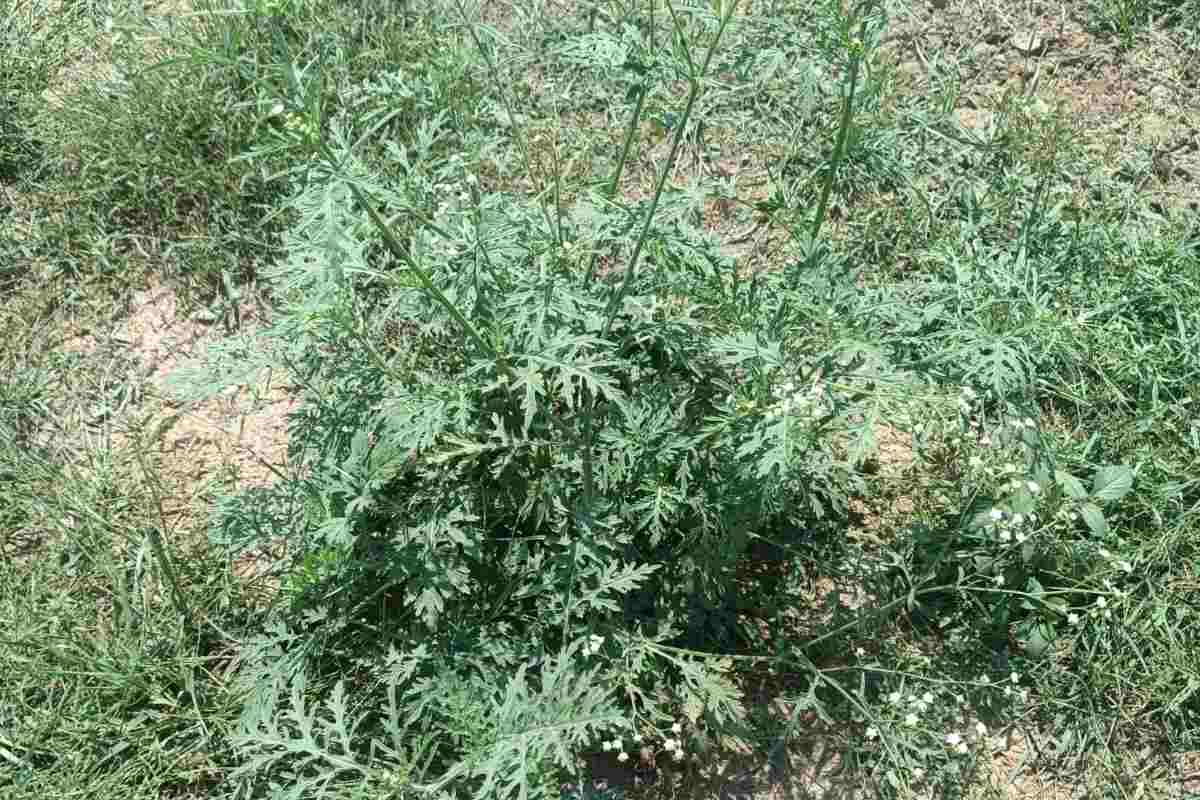
The researchers observed plants at different stages of growth, from seedlings and rosettes to branching, flowering, seed maturation and senescence. The presence of these different stages, together with the production of viable seeds, indicated that the weed was not merely appearing sporadically but had established a population capable of sustaining itself at the site.
The paper notes that the findings “highlight the invasive potential of parthenium to establish and proliferate within rice ecosystems of Kashmir”, and calls for comprehensive surveillance, early detection, targeted eradication and long-term monitoring to prevent its spread.
Weed Survives Winter and Regenerates after Cutting
The study found that parthenium followed a complete annual growth cycle in Kashmir, despite severe winter conditions. Its aerial parts dried and died after the onset of severe autumn frosts below minus 2°C in November, but mature seeds survived under sub-zero temperatures and moist soil conditions.
Seedling emergence was observed from late March to early May, when mean daily temperatures rose to between 10°C and 20°C. The plants took approximately 180 days from germination to flowering and 190 to 200 days to initiate seed production. Mature seeds developed by the second week of October, before the onset of severe winter frost.
Laboratory tests showed that 65 per cent of the mature seeds germinated, confirming their viability and the successful completion of the reproductive cycle.
The researchers also documented the weed’s ability to regenerate after mechanical cutting. Seven of the 28 plants had been cut by a brush cutter at heights of 10 to 45 centimetres above ground level but subsequently regenerated. One regenerated plant flowered and produced seeds.
“Plants that were mechanically cut at heights of 18-45 cm above ground level regenerated vigorously through the production of lateral shoots following the loss of apical dominance,” the paper states.
The observation has implications for weed-control efforts, as cutting the plant above ground may not be sufficient to prevent its growth or reproductive development.
The biometric analysis revealed considerable variation among the plants. Their height ranged from 7 to 76 centimetres, leaf numbers from three to 26 per plant, and flower and bud production from zero to 230 per plant. Fresh shoot weight ranged from six to 58 grams.
The researchers attributed much of this variation to differences in the plants’ growth stages, with individuals at different stages of development present at the same location.
Early Stage of Establishment
The parthenium population was found along a pathway between large rice seed multiplication fields, rather than in the waterlogged rice-growing area itself. The site consisted of a well-drained pathway, with irrigation and drainage channels on either side.
The researchers found that the weed was associated with several common temperate weed species, including white clover, Bermuda grass, wild carrot, plantain and other vegetation typically found along field margins, bunds and pathways.
Although parthenium plants were noticeably taller than the surrounding vegetation, the researchers did not find dense, parthenium-dominated stands or evidence that the weed had displaced the existing vegetation.
This suggests that the population was still in the early stages of establishment. However, the presence of plants at different growth stages and the production of viable seeds indicated that it had already achieved self-sustenance at the site.
The paper suggests that the founding population may have originated from seeds dispersed by wind from nearby roadsides or introduced through contaminated farm machinery or crop seed. The precise source of the infestation, however, was not established.
The researchers caution that the presence of parthenium in the rice agro-ecosystem should not be interpreted as evidence that it can thrive in continuously waterlogged rice fields. Irrigated rice fields and wetlands are generally unsuitable for its establishment, but well-drained habitats adjoining them, including pathways, field bunds and foothill ecosystems, can provide favourable conditions for its growth and spread.
Changing Climate
The study places the findings in the context of parthenium’s ability to adapt to a wide range of climatic conditions. Originally native to tropical America, the weed has spread across tropical, subtropical and warm temperate regions of Asia, Africa, Australia and the Pacific.
The researchers note that its establishment in Kashmir’s temperate environment demonstrates its ecological plasticity and capacity to adapt to local conditions.
During the study period, November 2024 to October 2025, the minimum temperature during winter fell to minus 7.09°C. The site received 137 millimetres of precipitation during the winter period, nearly 65 per cent below the long-term normal, resulting in drought-like conditions across Kashmir during winter and early spring.
Despite these conditions, the weed completed its life cycle. The researchers found that the prevailing temperatures, sunshine, soil moisture and near-neutral soil pH supported its vegetative growth and reproductive development.
The study estimated that parthenium required 1,700 to 1,750 growing degree days to reach flowering and 1,890 to 1,920 growing degree days to initiate seed production.
The researchers warn that rising temperatures could improve the suitability of Kashmir’s agricultural landscapes for parthenium, potentially enhancing its establishment, spread and competitive ability. They refer to documented upward expansion of the weed in other Himalayan regions, including Bhutan, Nepal, Himachal Pradesh and Uttarakhand.
However, the paper also acknowledges that severe autumn frosts remain a constraint on the weed’s growth and reproductive success in Kashmir. While the aerial portions die, the ability of mature seeds to overwinter and germinate the following spring provides a mechanism for population persistence.
The researchers therefore recommend immediate surveillance, systematic mapping, early detection, eradication of newly established populations and strict quarantine measures to prevent the weed from spreading before it becomes a major invasive species in crop and non-crop ecosystems.