by Mehrunnisa Maryam
As younger generations shift to Urdu and English, Kashmiri faces social stigma, institutional neglect, and digital marginalisation, raising urgent questions about identity, heritage, and survival.
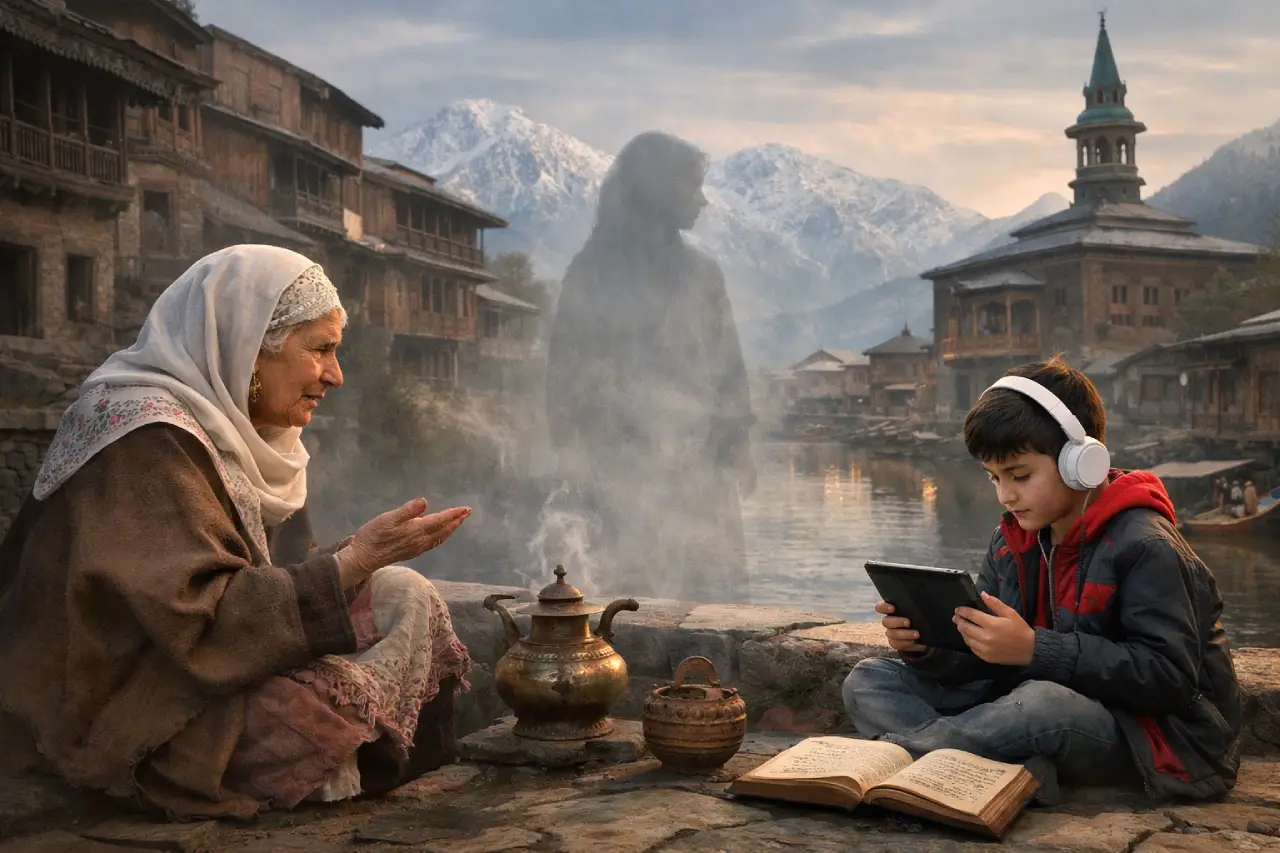
In the sun-drenched courtyards of Downtown Srinagar, Jana Begum, an old grandmother, calls out to her grandson, “Ruhaan saeba, kyah chukh karaan?” (Ruhaan, what are you doing?) The boy, barely eight, looks up from his tablet, eyes blinking in confusion, and responds in crisp, polished Urdu: “Dadi, main game khel raha hoon” (Grandma, I am playing a game).
This brief, everyday exchange is a microcosm of a quiet cultural catastrophe. The Kashmiri language (Koshur), a 5,000-year-old linguistic marvel with roots in the ancient Dardic and Indo-Aryan families, is being reduced to the status of a “museum piece.” Classified by UNESCO as vulnerable, its decline is not the result of a single “guilty” generation, but rather a systemic shift driven by social prestige, economic necessity, and collective psychological insecurity.
This is the reality for much of Kashmir’s Gen Z, a generation that has inherited a “linguistic orphanhood.” They are fluently navigating the global world in English and the social and religious world in Urdu, but the language of their ancestors has become a ghost in their own mouths.
If you ask the Millennials, the parents of today’s children, why they stopped speaking Kashmiri to their toddlers, the answer is often rooted in modernisation.
During the late 90s and 2000s, there was a widespread belief that the Kashmiri accent “corrupted” a child’s ability to speak English or Urdu properly. It was deduced that the Kashmiri language brought about a tinge of mother tongue influence to the other essential and influential languages used in the ever-evolving world. In a hyper-competitive world where success meant clearing the IAS or moving to Dubai, parents viewed Kashmiri language as a liability. “We wanted them to have the best start,” says Farooq Ahmed, a high school teacher. “We thought Koshur was something they’d pick up anyway. We were wrong.”
By prioritising “refined” Urdu and “professional” English, Millennials inadvertently broke the intergenerational chain. They created a generation of “passive speakers”, youth who can understand the pain in a Kashmiri song but cannot articulate their own joy in the same tongue. “Listening to hakeemo waare wechtam, doad nai dagg kemich cham? I suddenly feel something shifting inside me; it isn’t just a song, it’s a mirror to our very own story, a pain without a visible wound,” says 22-year-old Huzaifa Wani. “However, I will always find it haunting, a halfway existence, to have a heart that beats in Kashmiri but a tongue that navigates the world in English, which we were told would make us ‘civilised.’ I hear the stories of Gulrez or the sharp wit of an old Kashmiri proverb, and suddenly I feel the ‘inherited ideas’ stir inside me, yet when I try to speak, the words feel like borrowed clothes that don’t fit. I am an exile in my own home, understanding every word of my mother’s grief but unable to comfort her in the only language that knows the depth of our pain.”
For Gen Z, the language gap is further widened by the digital world. Until very recently, the internet didn’t “speak” Kashmiri. YouTube tutorials, Instagram reels, and Netflix dramas are in English, Hindi, or Korean.
“If I speak Kashmiri at a high-end cafe in Srinagar, people look at me like I’m uneducated,” says Insha, a 21-year-old college student. This social stigma has forced Gen Z to adopt a “linguistic camouflage.” They speak Kashmiri with their grandparents, Urdu with their parents, and English with their peers. In the process, the “emotional depth” of their mother tongue is being lost.
In the late 20th century, Urdu was the symbol of prestige and social mobility. Parents believed that speaking Kashmiri would give their children a “rustic” accent that would hamper their success in interviews or elite social circles. This led to a unique linguistic fusion, where the structure of the sentence remains Kashmiri, but every meaningful word is borrowed from Urdu or English.
Linguists argue that the state is also to blame. For over a century, Kashmiri was ignored by the government. Urdu was the official language for administration, even though it wasn’t the mother tongue of the majority.
While Kashmiri was recently made an official language in September 2020, the damage of decades of exclusion in schools remains. Many private schools famously “fined” students for speaking their native language on campus, branding it as “uncivilised.” This institutional shaming taught children that their identity was something to be hidden, not celebrated. Because the language was never taught formally in many schools until recently, an entire generation grew up unable to read or write the Koshur script, severing their link to centuries of Sufi poetry and philosophy.
Speaking to Ghulam Hassan Talib, a retired KAS officer and a renowned Kashmiri writer from South Kashmir, he argues that the gravity of this linguistic erasure is beyond repair. “We have lost an entire generation to the allure of elite foreign languages, the very generation that was meant to be the custodian of our Kashmiri legacy. Losing the language is equivalent to losing our history.” He points out that while other communities like Bengalis or Punjabis wear their mother tongue as a badge of honour, Kashmiris have developed a strange “shame.” He warns that once the language is gone, the stories of our ancestors, from the struggles to the nuances of our Sufi past, will become a locked room to the next generation.
However, the story isn’t over. A “cultural renaissance” is brewing on the very platforms that once threatened the language. Young creators like Touqeer Ashraf (Kaeshur Praw) and platforms like Yikvot are making Kashmiri “cool” again. They use Instagram to teach vocabulary and host virtual reading groups for classical literature. Innovations like AI-powered assistants are bridging the gap between ancient phonetics and modern tech, ensuring Kashmiri has a seat at the digital table.
The “withering” of the language is a warning. When a language dies, the unique way a community perceives the world dies with it. As the saying by poet Amin Kamil goes, “Kaéshir-i-seet kaeshir saerie, nateh veeran-ik-haeraan kaav” (Only our language makes us Kashmiri, or else we are crows of a wasteland). Without it, the valley may still be beautiful, but it will be silent.
(The author is a Journalism and Mass Communication student at Government College for Women, MA Road. Ideas are personal.)