by Hurmat Altaf
Reading The Alchemist through Stoicism, Santiago’s journey shows purpose, resilience and self-discovery, urging courage, presence and faith over fear and failure.
The Alchemist has been written by a top-notch Brazilian novelist, Paulo Coelho, in Portuguese (O Alquimista), and was published in 1988. Later, in 1993, it was translated into English.
The novel has been divided into two parts, preceded by a prologue, and concluded with an epilogue. It falls into the category of bildungsroman, specifically in its type of Entwicklungsroman, a coming-of-age novel that deals with the metaphorical growth of the protagonist. The narrative encapsulates the extraordinary journey of Santiago, who experiences a sequence of events and, through enduring considerable hardship and consistency, ultimately realises his cherished dream.
Paulo Coelho says in the preface of the book, “But if you believe yourself worthy of the thing you fought so hard to get, then you become an instrument of God, you help the Soul of the World, and you understand why you are here.”
Philosophy of Stoicism
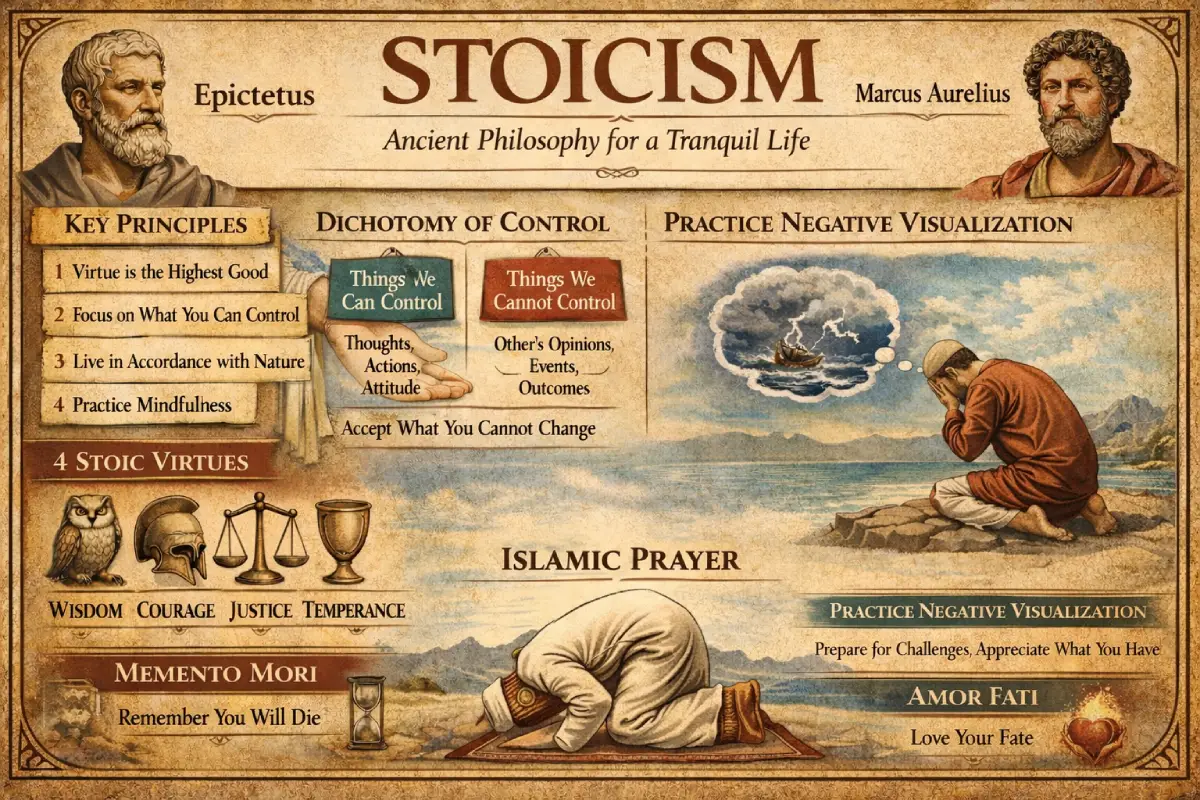
The novel can be totally analysed through the lens, or for that matter, the philosophy of stoicism. Stoicism is a philosophy that originated in ancient Greece and has had influential proponents of virtue in it throughout history. It was founded by Zeno of Citium. According to the Oxford English Dictionary (OED), Stoicism is “the endurance of pain or hardship without the display of feelings and without complaint.” As Epictetus, a notable Stoic philosopher, has said, “We cannot choose our external circumstances, but we can always choose how we respond to them.”
Similarly, Santiago embraces Stoic principles throughout his journey. He applies the philosophy to realise his long-held dreams. One such example of stoicism is the statement, “If you pay attention to the present, you can improve upon it. And, if you improve on the present, what comes later will also be better. Forget about the future, and live each day according to the teachings, confident that God loves his children. Each day, in itself, brings with it an eternity.”
The novel begins with a prologue in which the alchemist reads a story on Narcissus, but with a twist where the Lake, despite seeing Narcissus every day, does not notice its beauty.
“Why do you weep?” the goddesses asked.
“I weep for Narcissus,” the lake replied.
“But…was Narcissus beautiful?” the lake asked.
“Who better than you to know that?” the goddesses said in wonder.
“After all, it was by your banks that he knelt each day to contemplate himself!”
The lake was silent for some time.
Finally, it said:
“I weep for Narcissus, but I never noticed that Narcissus was beautiful. I weep because, each time he knelt beside my banks, I could see, in the depths of his eyes, my own beauty reflected.”
It can be interpreted in multiple ways, but my interpretation of it is that we get so engrossed in our outer beauty that we lose the beauty of our soul and indeed fail to realise the sole purpose of our existence, which is discovering ourselves.
The Transformation
Santiago’s transformative journey in The Alchemist begins in Andalusia, Spain, as he chooses the life of a shepherd over his father’s priestly aspirations. Along the vibrant landscapes, encounters shape Santiago’s destiny, from the insights of a wise gypsy woman to the mystical gifts from the king of Salem, Melchizedek, in Tangier, Morocco.
Working for a crystal merchant in Tangier provides Santiago with valuable experiences, and the caravan journey across the Sahara introduces him to the Englishman, deepening his spiritual growth. As Santiago’s quest unfolds, platonic love with Fatima emerges at the oasis, and visions about war and two hawks reveal profound insights. When captured by tribesmen, Santiago’s journey takes an unexpected turn when he is asked to become the wind, which the alchemist had earlier claimed. The wisdom of the alchemist in Al Fayoum imparts transformative lessons about God as the driving force behind human existence.
Santiago faces adversity, being beaten by two thieves, leading to the ultimate revelation against the backdrop of the Pyramids of Giza. Here, Santiago discovers the literal and metaphorical treasure within himself—the essence of his Personal Legend.
Life Has A Purpose
Therefore, from this novel, I deduced that life is neither meaningless nor a cake walk, but full of hardships and misery. But it is all we have, and we need to make it meaningful by consistently working towards our goals and finding our purpose. “The problem is that they don’t even realise that they’re walking a new road every day.” Santiago initially sees it as a lesson about his sheep, but metaphorically, it underscores missed life opportunities, leaving individuals with nothing but regrets!
Each one of us harbours the passion in our lives to bring our dreams and aspirations to fruition, but how many of us are actually able to accomplish it? A handful! It is because some falter at the daunting outset, others lose their way midway, and a few succumb to distractions, and then one in a million overcomes all these obstacles and reaches the zenith, and our protagonist, Santiago, is one in a million. Santiago becomes a prototype for individuals who, despite facing hardships and misery, achieve success.

Personally, what struck a chord with me was how the novel imparts the wisdom of facing challenges with a brave heart. Santiago’s journey, laden with obstacles, beautifully mirrors the Stoic belief that we can choose how we respond to external circumstances.
This profound lesson became my key takeaway, inspiring me to embrace life’s tribulations with courage and fortitude. I would like to conclude with the line from the text itself, “There is only one thing that makes a dream impossible to achieve: the fear of failure.” In this modernistic world, where people have become disillusioned, the fear of failure has to be overcome to reach heights.
(The author is currently pursuing a Master of Arts degree in English Literature at the University of Kashmir. Ideas are personal.)