by Manejeh Jehan
The Pheran, which declined amid colonial influence and shifting aspirations, was preserved by some Kashmiris and later re-emerged among diaspora communities as both a reclaimed cultural identity and a fashionable garment

We all love the Pheran now, but in its journey, arguably with roots in the Central Asian Chopaan (cloak), while beloved to most Kashmiris, it remained lesser known in the wider world and went through a period of wilful avoidance by a couple of generations who saw it as less fashionable in exchange for Western wear like jeans, skirts, suits, or tight-fitted shalwar-kameez, sari, sharara, gharara-type South Asian garments.
This period also highlights the wilful avoidance of learning and speaking the Kashmiri language. This post-colonial impact, although subtle and sublime, came with the adoption of a Western system of education and a growing interest in Bollywood (Hindustani) cinema.
Interestingly enough, the Pheran was being dubbed as repressive, impractical, more for the peasant class, unnecessary, non-fashionable, and an “old-style” garment. Soon enough, those adopting Western attitudes proudly highlighted that they didn’t own a single Pheran, nor chose to wear one, as some sort of certification of finally becoming “progressive,” often twinning it with dropping the Kashmiri language from their spoken choices. This phenomenon was borne out of ignorance of their own culture, values, and history, and perhaps a gross misunderstanding of what progression truly meant in a deceptive world.
During this period, there remained some who stayed true to their identity, comfortable in their skin, modest, and practical. They continued to choose the Pheran as their go-to, or simply as fashionable attire in their lives, and did their part in representing this identity beyond their cocoon (Kashmir Valley).
Not apologetically, but proudly, with love, flair, and grace.
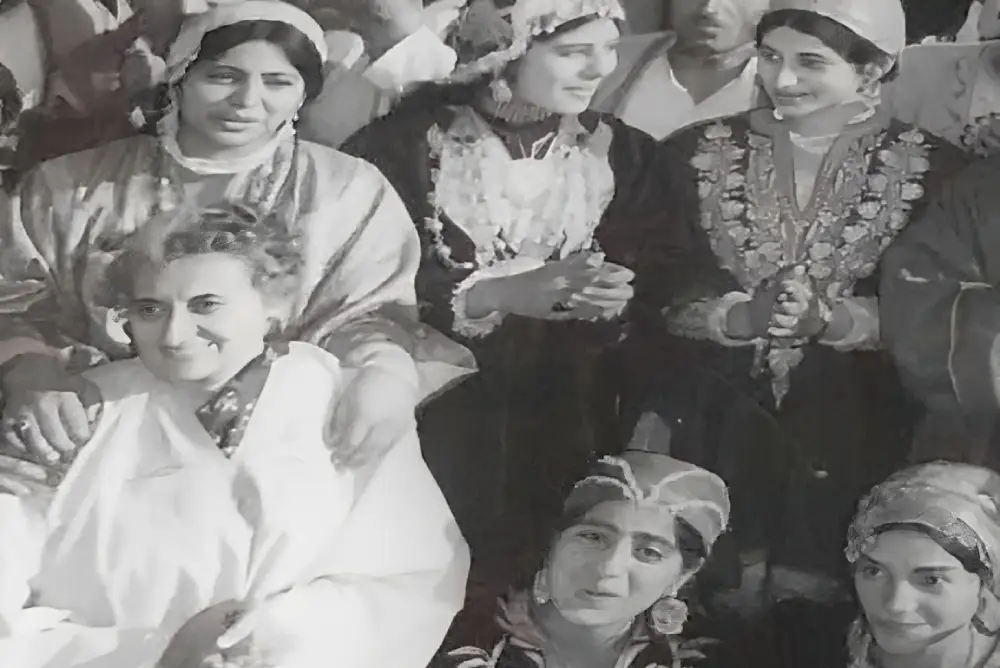
Sharing a photo that was recently posted from such times: a delegation of young college girls meeting the then (stylish) Prime Minister of India, Indira Gandhi (circa Jan 1972), and dressing her in a Pheran. Interestingly, Mrs Gandhi, a few generations down from a Kashmiri Pandit lineage, had, due to her forefathers’ migration to Allahabad, UP, lost the Kashmiri identity in language, dress, and food, but perhaps not the longing for it. The girl dressing Mrs Gandhi, standing right above her, is my dearest mother, Rifat Jabeen: a beacon of Kashmiri culture, traditions, belonging, and identity in her own right. May Allah bless her for her sincerity and for staying genuine as a Kashmiri, ensuring she passed it along in so many ways.
This photo also reminded me of a more recent phenomenon I witnessed about 10 years ago, when we were preparing for a large Kashmiri gathering in the United States. Several Kashmiri-origin, well-to-do, well-meaning ladies rather proudly stated:
“Oh, we don’t own a Pheran,” “Oh, we never got one made at our wedding,” “Oh, we just wore a tille ka suit at our ‘aab shearun’ (a wedding ceremony traditionally requiring a Pheran as essential attire), so it does not get wasted,” “Oh, we find no use for it here in the US,” “How come you have one or so many?” “Did you get this from your mother or grandmother?” “What do you do with it here?”, while some complimented my Pherans too: “It’s beautiful,” “We love it,” “Could we borrow it?” “Let’s trick you into sharing it.” The reactions were both stunning and clever, but always laced with a profound misunderstanding of their own identity.
A few from the same group of ladies, however, not only own some but wore them with love, pride, and elan. I saw all of this while sharing my emotion of utmost puzzlement, “Why on earth would a Kashmiri woman not have a Pheran in her closet, and if not, does she not relinquish her right to be called Kashmiri?” That’s the level of emotion we Kashmiris carry for this garment.
I wore my set of Pherans in the US right from the get-go of my arrival there, at home, on trips, at work, at gatherings that were Kashmiri, Western, South Asian, or American. At Christmas, Eid, Thanksgiving, office events, even corporate dos, at the mosque, school, art and community neighbourhood festivals. Always a great conversation starter, always a way to bring awareness while maintaining comfort and personal style. It never felt odd nor limiting. If anything, it generated compliments, curiosity, and interest.
A nice twist: a few years later, the same lovely ladies (who had relinquished the Pheran and completely ignored it in their American closets) started to wear Pherans with gusto, happiness, and pride, flaunting them, even trying their hands at building businesses around them, investing in couture designs, planning for months on which one to choose, and making attempts at staking a claim as some sort of cultural icon. That was a delight to witness, both in terms of how beautiful and adaptable the Pheran really is, and the human behaviour of how people build barriers against themselves due to strong egos and a desperate desire to please others.
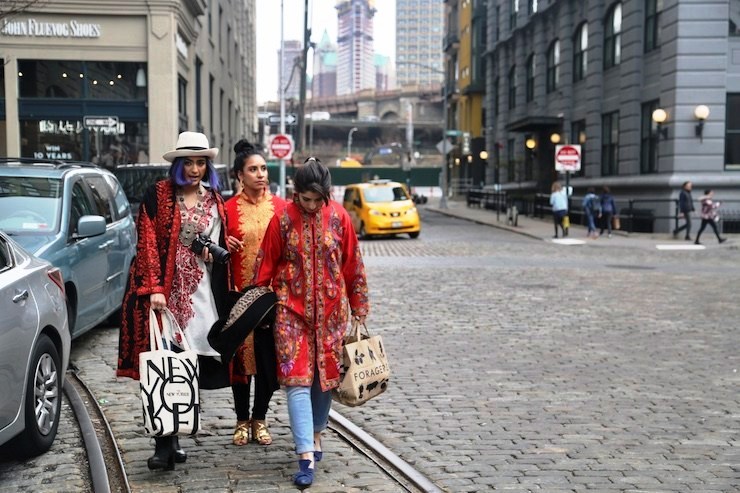
Finally, the Pheran was having its moment on the runway. Finally, it was “fashionable.”
But did we miss the part of why so?
The Pheran was never made for (Western) “fashion.” It defined style, a forever fashion, with its versatility and distinction serving its main purpose with efficiency and modesty.
It was always a representation of us as a people. Our cloak-style, modest, and practical garment, with our distinct flavour among its cousins and sisters in the Turkish Kaftan, Palestinian Thobe, Moroccan Sailik, African Jubba, Arabic Abaya, Persian Chador, Uzbek Chopaan, and the like.
It was never in the race for “fashion.” It was always its own entity, much like any other modest garment.
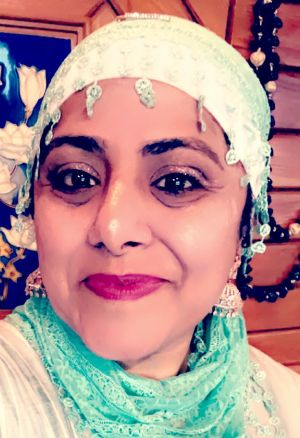
Today, I keep getting requests from many friends from various cultures and identities asking where to buy one, all with longing eyes; they’d love one too. And it is always delightful to witness.
To my mum, mother-in-law, grandmothers, and aunts, thank you for teaching me the value and purpose of Pherans and nurturing that love in my heart from a very young age. I cannot be more grateful to you all.
To all these lovely ladies in the photo, you are the original style icons. You held up your true selves, untouchable in the modern world of Pheran as a fashion tag. Be blessed wherever you are!
(The author is a Kashmir-born and trained physician-scientist, working for the biotech/ medical device industry in the United States. Ideas are personal.