Babra Wani recounts how she and her team defied hunger and thirst while researching from the most sensitive religious text a script for a show that is now part of Kashmir’s audio-visual history
Every time, the Kashmir Life staff is invited over a cup of tea, something new is cooking up. That happened in February when the staff rushed to the tiny newsroom that lacked enough chairs to make everybody comfortable.
“We are renewing the programme (Jashn-e-Ramzan) after the initial success of season one, but I have a slightly different idea for this one,” the editor told us as we started sipping Tanha Ashu’s tea. The tone was unmistakably suspenseful, leaving us intrigued and eager for more.
Having been part of season one, hosted by amazing Sabreen Ashraf, I was intrigued by the new twist: Syed Shadab Ali Gillani, my colleague, would be the face of this series. “A male host? Would it work? What would be the response? What if it faltered?” Our minds raced with questions. Yet, knowing Shadab’s exceptional hosting skills brought us some comfort.
By the meeting’s end, we decided on two parallel series centred on Ramzan, the Muslim month of fasting. I was thrilled to be part of Jashn-e-Ramzan season two and Aaj Ki Mulaqaat season three. I was tasked to lead the research team while coordinating for the Aaj Ki Mulaqaat at the same time.
The Team Takes Shape
Initially, I sought permission to let me handle the research solo, but thanks to Faiqa Masoodi, our online editor and Shadab’s intervention, I was persuaded otherwise. “It will be too taxing for you,” they cautioned. Trusting their advice, I agreed, and our team was swiftly formed: Shakeela Shawl, Faiqa Masoodi, Aiman Fayaz, Humaira Nabi, and Khalid Bashir Gura as the editor agreed to oversee things.
Almost a week later, we had the first meeting of the research team on Sunday. Though we had already created a WhatsApp group to stay in touch, ironically, it marked the beginning of doing away with weekly off.
A Twist in the Plan
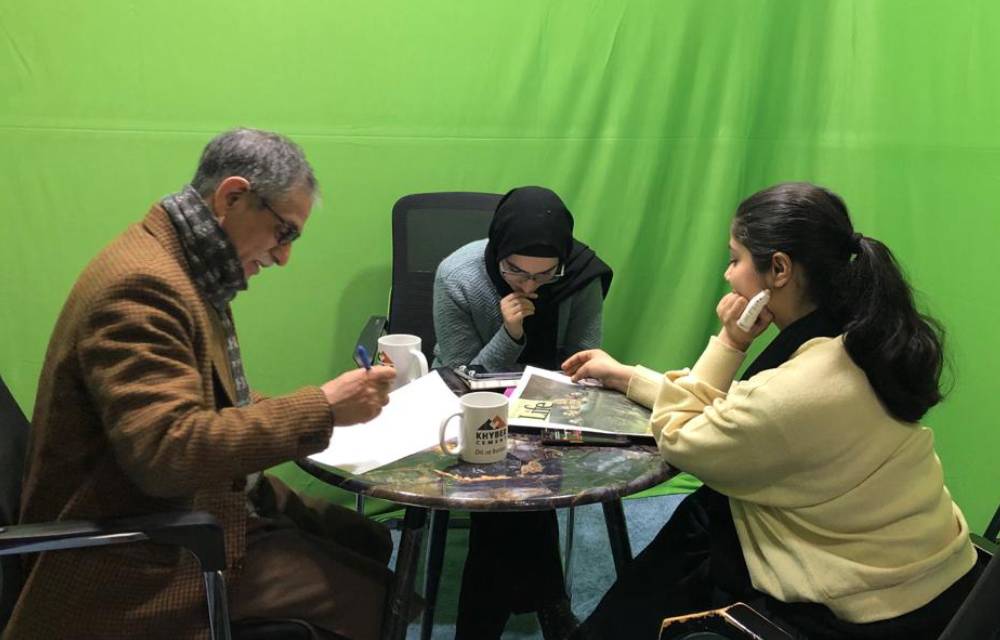
As I struggled with some physical issues, Aiman Fayaz assisted me zealously, her enthusiasm unmatched. After lunch, we resumed research, joined by our editor at 3 pm to frame questions. However, another twist emerged: “This season’s theme will focus solely on the Qur’an, and all questions will revolve around the holy book.” Unlike the season 1, it was focused. Every episode would require five questions. The task had grown more daunting, requiring questions, options, answers, and explanations – a time-consuming endeavour indeed.
That Sunday, Fayaz Najar and I worked tirelessly until in the evening to craft questions that would form the foundation of our month-long series on the Qur’an. By the end of the day, we had meticulously framed 10 questions, accompanied by detailed answers and explanations. As I returned home at 8:30 that night, I felt a sense of accomplishment, knowing that our diligence would pay off eventually.
Given the sensitive nature of our subject matter, we had to be extremely cautious and accurate. I drew lessons from our previous season, where mistakes had been made, and ensured that our questions were framed with utmost precision. While my role was less demanding than Shadab’s, who bore the weight of the series on his shoulders, I still found myself grappling with the daunting task of handling two series and framing questions daily.
Ebb and Flow
The exercise was a rollercoaster with its highs and lows. Yet, Shadab never once pressured us with questions, understanding that delays were inevitable. This month-long series was a celebration of knowledge, and as we studied, researched and framed questions, we engaged in intense discussions that broadened our understanding. For me, it was a rediscovery of the Quran.
Almost every episode had its theme. We got used to working late at night locating themes and crafting questions. This seamless collaboration was a testament to our team’s dedication and commitment to producing a series that would enlighten and educate our audience. We would frame questions in Urdu, and I would transliterate them for Shadab’s ease.
A Glimpse into the Chaos
To dedicate maximum time to Jashn-e-Ramzan, we would record numerous interviews for Aaj Ki Mulakaat in a single day. This gruelling schedule left us exhausted, with most of my iftaars consumed on the go. Rare moments of respite included a few iftaars with family and a singular occasion with colleagues at a restaurant. The latter was notable for the employees’ fascination with Shadab, who they dared not approach, fearing an impromptu interrogation.
It is crucial to acknowledge that each 15–20-minute episode was the culmination of long hours of toil, determination, research, and patience. Navigating vast amounts of knowledge and information was a daunting task, requiring rigorous fact-checking due to the sensitive nature of the content. Scholars aptly described it as “information overload.”
Lessons Learnt
My experiences in Jashn-e-Ramzan seasons one and two were distinct. While the first season involved travelling with the team and researching locations, the second season pushed me to the back end. Eventually, every sentence was well received.
Jashn-e-Ramzan brought recognition to Shadab, as an impressive and capable host, a lifetime experience to Umar Dar and Shuaib Wani, challenges to Iqra Akhoon, and an enhanced skill set. For me, it taught me patience and no second option to study. We strove for accuracy, selecting precise Urdu words and syntax to create an aural experience. Our questions followed themes, exploring topics like metals, minerals, flora, and fauna mentioned in the Qur’an.
As I immersed myself in the research team, my attachment grew so strong that even in slumber, a thought would strike me: “I have to frame the Questions.” My daily routine transformed, as I began crafting questions immediately after sunrise, a habit that continued until I arrived at the office. There, we would engage in lively discussions with our editor, pouring over handwritten notes and explanations. We had adopted a traditional approach, relying on bundles of white sheets to frame our questions. Occasionally, Shakeela Shawl would share photographs of her meticulously crafted questions.
As the series ended, I experienced a sense of withdrawal. The absence of questions to be framed and explanations to be written left me feeling empty. My connection to those bundles of white sheets began to wane.
A Labour of Love
Despite the challenges we faced, our team remained resolute. We received overwhelmingly positive feedback, validating our tireless efforts, patience, and dedication. There were moments of confusion and self-doubt, but together, we persevered, motivating each other to push forward.
While most of us focused on framing and researching questions, Faiqa Masoodi calmly delved into the history and significance of the places Shadab would visit for the shoot. Her quest for accurate information was not always easy, with some days yielding readily available answers and others requiring intense struggle.
It was not questions alone. We also meticulously crafted the scripts for the inaugural and final episodes. We strove to create a narrative that rivalled poetry in its beauty and elegance. Shadab’s distinctive voice and hosting style paid fitting tribute to our tireless efforts.
A Season of Reflection
In contrast to the previous season, I found myself in a more relaxed state, despite not traveling with the team. My ailing back forced me to adopt a more subdued pace. However, during the month our collective focus and motivation intensified. We were driven to excel.
So far, the series has been watched by more than 67 lakh people and it is still being watched like the inaugural season. In the acknowledgement, I feel an overwhelming sense of pride and personal accomplishment. Our team’s unwavering dedication had yielded a triumph.
A Legacy
Jashn-e-Ramzan remains one of the most talked-about and celebrated projects to date. I hope that our future endeavours continue to make a meaningful impact, allowing us to contribute positively to society in every way possible.