The 2025 Amarnath Yatra, planned for 38 days but cut short to 28 due to heavy rains, saw over four lakh pilgrims undertake the journey in a month defined by devotion, tragedy, foreign participation, and unprecedented security measures, reports Maleeha Sofi
On July 3, the first day of darshan, Sourabh Singh and two friends stopped at a rivulet near the Amarnath cave, just 200 metres from the shrine. A veteran of four yatras, Singh said he hesitated at the icy water, prayed to Lord Shiva for strength, and stepped in, only to find it warm. His friends, however, felt the chill. Calling it a miracle, Singh said he had never experienced such power at the holy cave. For him, 2025 was a year of divine wonder; for the administration, it was a year of high stakes.
The 2025 Amarnath Yatra, originally planned as a 38-day pilgrimage, was cut short to 28 days after heavy rains compromised access. Coming in the aftermath of the Pahalgam massacre on April 22, it was seen as an attempt to restore visitor confidence. The journey saw the participation of 4.14 lakh pilgrims. Five fortnights after the massacre, many doubted whether Kashmir could attract large numbers of pilgrims. The question was whether this year could surpass last year’s record of around 5.1 lakh pilgrims, the highest in 12 years. Preparations had been underway well before the attack.
Preparations in Motion
Planning for the pilgrimage began in January 2025. LG Manoj Sinha, who heads the Shri Amarnath Ji Shrine Board (SASB), had his first meeting at Raj Bhawan on March 5. Registration opened on April 15, with offline registration available at more than 540 bank branches across India. The daily limit was set at 15,000 pilgrims, and the registration fee was fixed at Rs 220. Foreign nationals followed a slightly different process.
Though ensuring safety is the top priority, the April 22 massacre made it more challenging. During a visit to Poonch, Home Minister Amit Shah reviewed the security arrangements. On May 29, the MHA announced that 581 companies of paramilitary forces would be deployed across Jammu and Kashmir for the Yatra. Besides, the Jammu and Kashmir administration and police were authorised to utilise 156 Central Armed Police Force companies already stationed in the region, including 91 CRPF, 30 SSB, 15 CISF, 13 BSF, and 7 ITBP units, each comprising about 75 to 80 personnel.

Facilities and Infrastructure
E-KYC centres and on-the-spot registration for pilgrims were set up at several locations, including Nowgam and Katra railway stations. A new Yatri Niwas at Pantha Chowk, Srinagar, was inaugurated by LG Sinha on June 30. Built entirely from public donations, it could accommodate 1,300 pilgrims at a time. The five floors dedicated to yatris comprised 75 rooms with a total bed capacity of 225, as well as 43 dormitory rooms.
The Baltal and Chandanwari–Pahalgam routes were widened from four to five feet to 12 feet to ensure smoother travel. The LG praised the move, noting that narrow paths created difficulties during rainfall. He inaugurated a foot over-bridge at the Nunwan camp. Akashvani Srinagar launched an audio studio dedicated exclusively to the special transmission of the Amarnath Yatra.
Health Minister Sakina Itoo conducted multiple review meetings to ensure that all identified health facilities, including the base hospitals at Pahalgam and Chandanwari, were fully functional before the start of the Yatra. She emphasised the need for round-the-clock services, essential medicines, oxygen support, mobile medical units, and rapid response teams to meet emergencies. She directed departments to conduct mock drills and capacity-building sessions for medical and paramedical staff to handle altitude sickness, trauma care, and emergency evacuations. She also called for close coordination between the Health Department, Disaster Management Authority, SDRF, and other allied agencies for real-time response during the pilgrimage.
At the Nunwan and Baltal base camps, 100-bedded hospitals were operational. Yet, despite the arrangements, some locals complained about gaps in services at the Sub-District Hospital, Pahalgam, which serves both pilgrims and residents. One local said, “The hospital has an ultrasound machine, but no radiologist was deployed for the Amarnath Yatra.” He believed this caused hardship to both groups.
In the first week of the Yatra, the Food Safety Department of Jammu and Kashmir issued 215 registrations to langars, community kitchens, operators and vendors, conducted 171 inspections, tested 910 food samples through mobile vans, held 77 training and awareness sessions, and seized and destroyed 30 kilograms of substandard food items.
SRTC buses and minibuses operated throughout the Yatra period. Helicopter services, which had been available in previous years, were absent in 2025. An order from the Home Department banned all aviation devices, including helicopters, drones, UAVs, and balloons, between July 1 and August 10. All pilgrimage routes were declared no-fly zones. LG Sinha said the decision was taken to ensure the safety of pilgrims. “Only 8 per cent of pilgrims used helicopter services in previous years, so this decision will not affect the Yatra in a major way,” he explained, adding that it was prompted by earlier accidents. The decision was termed “absurd” by the Chief Minister.
Deaths
The high altitude pilgrimage is a challenging task, especially for the aged and ailing. Official figures recorded 24 deaths, a nine per cent decrease from the previous year. Over 50 people were injured in around eight accidents.
For Surinder Pal Arora, son of Gain Chand Arora, the pilgrimage turned into tragedy on July 12 near the Z-Morh Tunnel. Part of a group of seven yatris trekking from Burimarg to Railpathri, he began behaving erratically, apparently due to high altitude sickness. Witnesses said he ran aimlessly, took repeated cold-water showers, and then leapt over a railing near the tunnel, disappearing into a glacier. Rescue teams and drones were deployed immediately to recover his body.
Two days later, on July 14, the Z-Morh Tunnel saw another incident when a CRPF convoy vehicle overturned, injuring three personnel on Amarnath duty. Earlier, on July 5, four buses collided near Chanderkote Langer, leaving 36 people with minor injuries. Beyond road mishaps, a police officer on duty sustained injuries from an accidental firing.
Devotees
Pilgrims take either the traditional 48-kilometre Pahalgam route in Anantnag or the shorter but steeper 14-kilometre Baltal route in Ganderbal to reach the cave. This year, 414,311 yatris performed darshan at the holy cave. The number was set to surpass last year’s total, but the Yatra, originally planned for 38 days, was cut to 28.
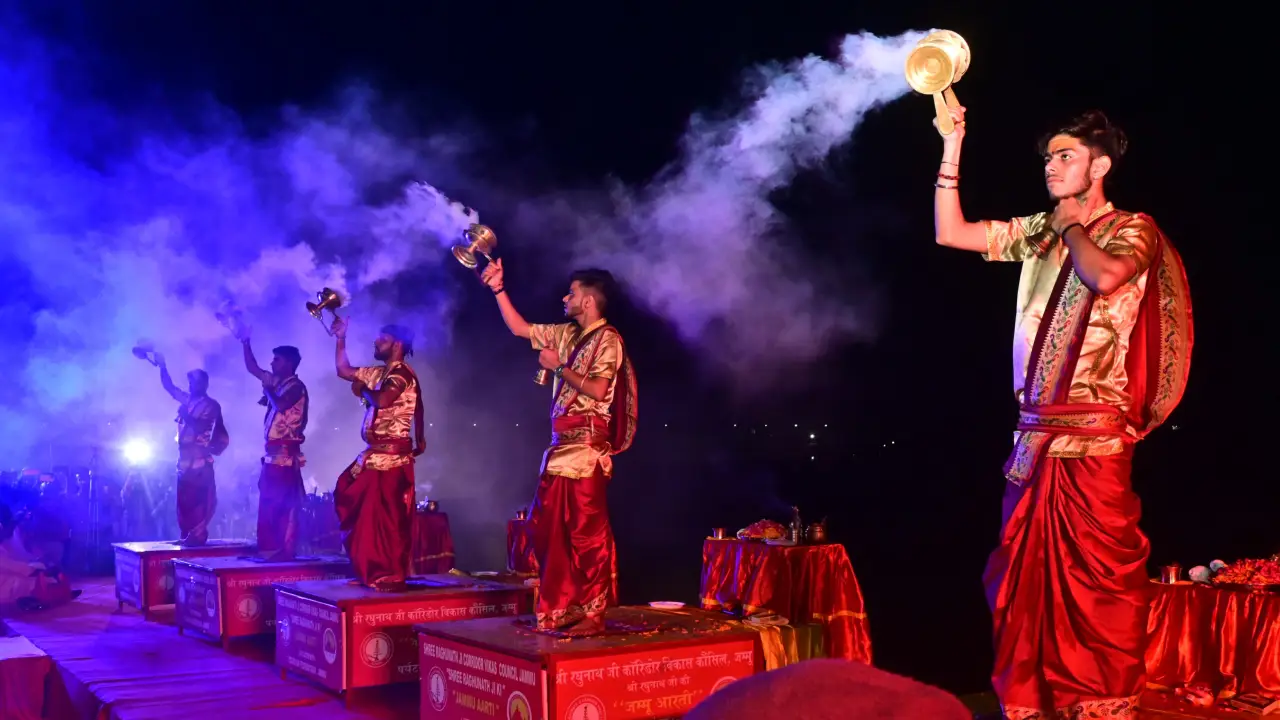
LG Manoj Sinha became the first Chairman of the Amarnath Shrine Board in recent years to reach the holy cave through the Baltal track, undertaking the trip on June 11, days before the official start. At the cave, he announced that an alternate route from Chandanwari to Pissutop would be made available in 2025, with safety hand railings and surfacing for pilgrims travelling on foot.
On July 1, police reported a case at Baltal involving a forged Yatra registration card. Shivam Mittal of Dwarka Puri, Haryana, had obtained the fake card through fraudulent means, attempting to bypass security checks.
The first batch of over 4,500 pilgrims left Bhagwati Nagar camp on July 2, flagged off by LG Sinha, and were welcomed at Udhampur, Anantnag and Srinagar before reaching the Baltal and Nunwan base camps.
Darpan, a pilgrim from Punjab, praised the security and healthcare arrangements. Another in the same batch urged people to visit Kashmir for the Yatra, saying the Pahalgam attack had caused fear but that there was no cause for concern.
The Yatra’s reach extended beyond India. Nine devotees from six countries attended. Canadian Ross Norman Leech described the geology and nature of Kashmir with admiration, saying that at the cave, he experienced tears and deep silence. He noted that the track was challenging but praised the availability of food, palkiwalas and ponywalas.
Another devotee, Dheeraj Joshi, drew attention for travelling to Amarnath by cycle. He had been cycling for six months to visit different temples, carrying his tent and food, and expressed satisfaction with the security arrangements.
While arrangements were praised, visitor Mohit Bhan, who went to the shrine on July 12, said there was a need for improvement in waste disposal and lavatory facilities. He attributed the shortcomings to both the administration and the public.
For others, the experience was reassuring. “Our families were initially worried, but seeing the strong security presence, all doubts have vanished. The atmosphere is peaceful and encouraging,” said Meena Sharma, a devotee from Rajasthan.
Weather
Climate change has touched every corner of the world, and the Amarnath Yatra was no exception. The Shivling, the ice idol worshipped by pilgrims, was covered by snow, but this year’s winter brought a snowfall deficit, and summer’s high temperatures caused it to melt earlier than usual.

The weather initially favoured the pilgrimage, allowing it to proceed without disruption despite circulating rumours. This changed on June 30, when heavy rain halted the movement of pilgrims from the Bhagwati Nagar Camp in Jammu. No darshan took place that day.
Pilgrims were permitted to resume darshan the next day, but no fresh movement was allowed because of persistent rain. The Yatra was eventually cut short, with August 2 recorded as the final day of darshan instead of August 9.
Business
The Yatra’s success depends on a vast network of people, from government-arranged langars to palkiwalas, each playing a part. In 2025, 122 langars along the routes served free food to pilgrims. A team of 1,222 medical professionals provided round-the-clock healthcare. More than 90 medical facilities along the route offered a combined 560 clinical beds, supported by 26 dedicated oxygen booths. A fleet of 45 ambulances, including nine equipped for critical care, was stationed for emergencies.
Official records on July 3 listed 13,431 ponywalas across Jammu and Kashmir, alongside 3,899 pithuwalas and 10,231 palkiwalas. Around 870 hawkers operated along the routes. Rayees Bhat, president of a pony stand, said this year was less remunerative than previous ones. While he appreciated the administration’s arrangements, he criticised the rule allowing only one pony per person. He explained that when a ponywala manages two or more animals, it increases earnings, but this limit has reduced their income.
About 1.84 lakh pilgrims used services like palanquins and ponies through the prepaid system, and 6,500 workers were engaged in maintaining cleanliness.
For transport, Gulzar Wani, president of a Sumo stand, managed over 600 vehicles. He described the Yatra as a success, with arrangements among the best in recent years.
Bhan observed with satisfaction the role of Muslims in facilitating a pilgrimage sacred to Hindus. He said the Yatra was an example of different communities coexisting peacefully.