When rainstorms snapped the optical fibre link between Srinagar and Jammu, phones fell silent and the internet vanished. What followed was a day of panic and improvisation, yet also of unexpected intimacy, as people queued for cash, cooked long-forgotten meals, and rediscovered their families. Babra Wani traces how a sudden digital blackout unsettled, yet quietly reconnected, Kashmiris
As the rains poured down heavily, Ghulam Ahmad, 50, sat in his petrol auto-rickshaw on the banks of the Doodhganga, near Bagh-e-Mehtab’s railway bridge. For over an hour, no passengers arrived. Resigned, he turned the key to head back home.
Ahmad pulled out his modest Lava phone and dialled his daughter’s number. It did not connect. Confused, he kept staring at the tiny screen until a man nearby shouted in Kashmiri, “Phones have stopped working.”
A chill ran through him. Panic rose in his chest as he started the rickshaw and drove off. He reached home, unsettled, unsure, and still searching for answers. Only when he saw his daughter did relief wash over him.
Although his phone had already gone silent, his daughter managed to access the internet for a while, enough to make a few slow calls. She told him that Jio’s network was still working, but others were down. In a hush-hush tone, he asked her if all was well, if anything terrible had happened, if anyone was facing a death sentence. She reassured him that it was only a flood threat. “Jammu and Kashmir is going to get flooded again,” she said. Minutes later, her phone went offline too.
Livelihood at Risk
On August 27, with the flood threat looming and connectivity still down, Ahmad returned to his usual spot. Driving passengers is his livelihood. Yet without networks, his regular customers could not call him for rides. He has a QR scanner for online payments, which makes things easier when passengers don’t have cash. However, without internet access, people could not make payments. He remembered letting go of one passenger because of it. Another man, unaccustomed to carrying cash, had to stop at a friend’s house to borrow money before paying him.
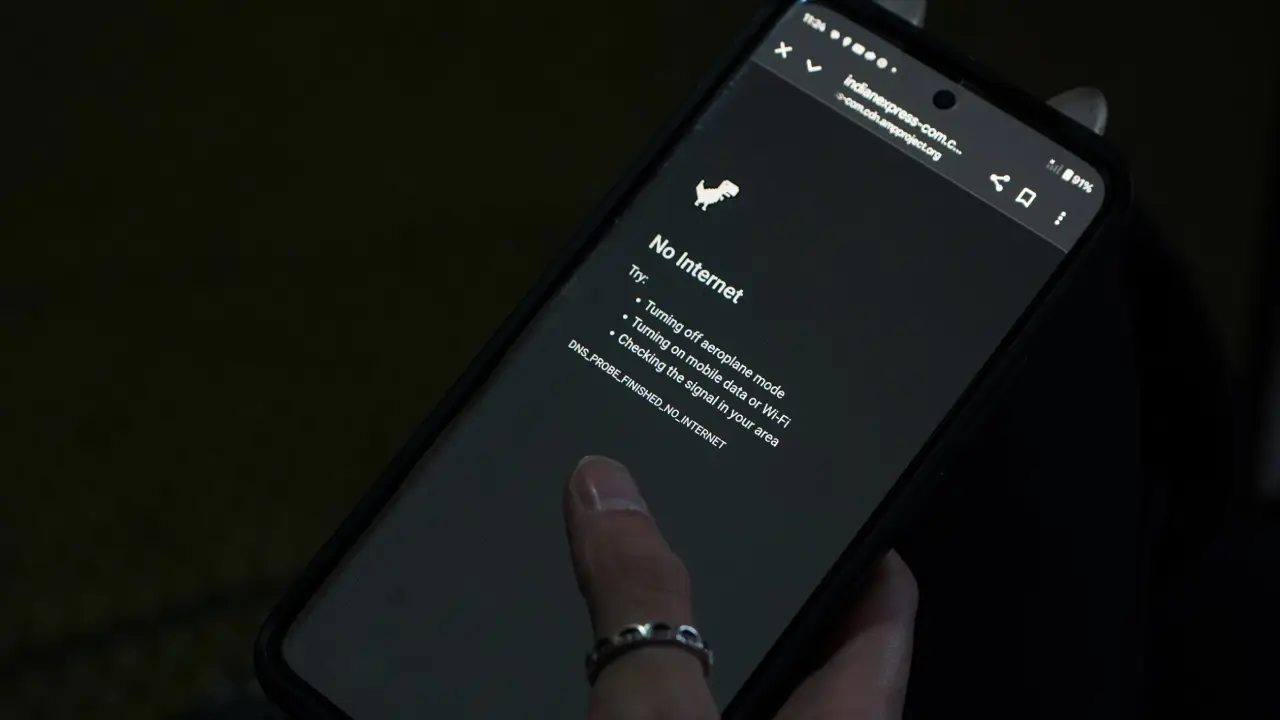
This experience was repeated across Jammu and Kashmir. On August 26, at around 4 pm, mobile connectivity was snapped. Some networks showed weak signals, others went completely dark. The immediate reason was unclear at first. Hours later, telecom operators sent messages citing damage to the underground OFC caused by heavy rains.
Jammu and Kashmir is among the regions in India with exceptionally high cell phone penetration, and the massive RBI-supervised financial inclusion drive has connected almost the entire population to digital payment systems through banks. By late 2018, mobile subscriptions had surged to about 13.84 million, surpassing the total population and translating to nearly 109 phones per 100 persons, while by March 31, 2024, district-level digital coverage of savings and business accounts had reached around 99.51 per cent.

Journalists Left Stranded
The sudden silence not only paralyses transport. It also froze newsrooms. One online editor for a local organisation recalled the moment vividly. He said he often joked during stressful news days that the internet should stop for a while so he could rest. But when it actually stopped for the first time in his career, he felt an almost frantic urge to connect, desperate to break the story he was working on. He found himself torn between longing for a pause and the compulsion to break the news.
Another journalist, who relied almost entirely on her phone for work, explained that every part of her professional life, from scripting and writing to contacting sources, depended on connectivity. Even her commute was filled with scrolling Instagram, watching videos, or listening to music. When the shutdown struck, she said she was left stuck.
She described going through her phone repeatedly, searching for signals, hoping to make a call or refresh the internet. Nothing worked. Calls were off, the internet was off, and everything was off. Those 22 to 24 hours felt suffocating, she admitted. Yet she also confessed that, unexpectedly, the enforced pause gave her a fleeting sense of solace.
A Forced Pause
Recalling the evening when the phones went silent, one journalist said that as she left her office and returned home, everything felt shut down. With neither calls nor internetworking, she found herself cut off. She described how she changed clothes, washed her face, and, for the first time in years, enjoyed tea and supper without distraction. Usually, she admitted, she remained absorbed in her phone, in the constant pull of the internet and scripting.
That night, between 8 and 10 pm, she cooked four dishes simply because there was nothing else to do. She said she ate heartily, as though she had tasted a real meal after a very long time, and felt as if she had all the time in the world. Normally, after dinner, she would have turned to her phone and social media, but instead, she read a book for an hour before going to bed.
The next morning began with tea alongside her family. For her, it was a rare sense of living a ‘normal’ life, not one dictated by a digital world. For those 24 hours, she felt transported back to a time when it was normal not to be connected, when it was fine not to know everything. She described it as peaceful in moments, though frustrating too, because all her work depended on the internet.

Books, Family and Lost Time
As connectivity broke down, books quietly resurfaced as a source of engagement. Many who rarely read reached for old volumes. One young woman said she finished an Urdu novel in a few hours because there was nothing better to do. Her mother, who occasionally wrote short stories, completed one within a single day because her phone was out of reach.
With mobile phones silenced, people also began reconnecting physically with their families. Nasir, from South Kashmir, admitted that for the first time in years, he sat with his parents for more than two hours, talking endlessly. He realised how much quality family time had been eroded by his dependence on the phone. He confessed that it struck him then that daily life itself now breathed online, from paying and shopping to ordering food.
A Return to Cash
The shutdown also forced many to return to cash. For the first time in years, people stood outside ATMs in long queues, waiting for their turn to withdraw cash. Some machines went out of order, and banks saw heavy withdrawals. Even a Rs 10 coin suddenly held importance.
Maleeha, a Srinagar resident, recalled how she had gone shopping for her cousin’s wedding on August 26, when connectivity snapped. Left anxious, she realised she had no cash to pay. With the wedding due the very next day, the crisis struck her hard. She admitted she had never carried cash because she usually relied on online payments, but this moment showed her how deeply digital dependence had crippled people.
Stranded Without Change
A Srinagar woman travelling from Jahangir Chowk to Shalimar in an electric rickshaw carried only an Rs 500 note. She admitted she had never kept cash and did not know how she would manage without her phone. The driver refused to accept it, explaining that the fare was Rs 20 and he had no change. On a normal day, he would have asked her to pay online, but with the internet down, even he was uncertain when services would return.
She stopped several people on the roadside, pleading for change, until a fellow passenger paid her fare. She took his contact details to repay him once connectivity was restored. Perhaps she has already paid him back, though Airtel users still complained of erratic signals.
Empty Hours
The disruption was not only about payments or work. People were left with long, empty hours, realising they had nothing else to do. Sameer, a 23-year-old from Anantnag, wandered restlessly around his house. He said he had no music, no series, no films saved on his phone because he always streamed everything online. He admitted he berated himself for not keeping anything offline until services resumed.
For students and families separated by distance, the worry was much deeper. Unable to contact their loved ones directly, many described the silence as close to death.
A Kashmiri student in Iran said he had felt broken when the network snapped. With no news or information, he feared the recurrence of unrest like in 2016 or 2019. He recalled rumours of political leaders’ deaths circulating, which added to his distress, until a friend messaged around 6 pm to say it was only a weather disruption. That, he said, finally brought him relief.
Similar stories echoed among almost every Kashmiri living outside. One student remembered calling relative after relative in desperation, trying to learn what was happening back home.
Matters of the Heart
Shabnam, from Jawahar Nagar, remembered her confusion when mobiles went offline. She was on WhatsApp with her fiancé when the screen suddenly showed no network. Restarting the phone did not help, and others around her reported the same. She admitted her first thought was not about politics or the news but how she would speak to her fiancé.
At her office, when the blackout began, she left at 6 pm to find him waiting outside. He told her that since calls were not working, he had grown worried and had come to check on her. She called it thoughtful and said it showed her how much she meant to him.
When connectivity finally returned, the very first thing people did was call their loved ones to check on their well-being.
A Stark Realisation
Whether it was love stories, family conversations, working from home, streaming entertainment, or breaking news, the weather-induced outage forced people to confront their dependence. Ahmad’s passengers learnt to carry cash, Shabnam discovered the tenderness in her relationship, and Nasir realised the value of unbroken time with his parents. For many others, the abrupt silence made them face the reality of how digital reliance had shaped their lives.