Kashmir is grappling with a severe water crisis as climate change and a prolonged dry spell deplete springs, rivers, and snowfall, endangering agriculture, tourism, power generation, and daily life., reports Syed Shadab Ali Gillani
The image is haunting. A worried Kashmir woman is in despair. Standing shocked and bewildered beside the cracked earth where the iconic Achabal Spring flowed. It looked as if tears would stream down her weathered cheeks but it did not happen almost akin to the emptiness of the dry basin before her.
“Oh spring, have you stopped giving us drinking water? Will you let us perish?” the woman, identified as Saja Banoo from Ara Khushipora village, cried aloud at the spring that has been a key tourist destination since Mughals rediscovered it during their occupation, almost 450 years ago. “Oh Allah, let this spring flow again. What has happened to us? Oh Allah, let the water gush forth once more!”
Her sorrowful pleas to the heavens, captured in a viral video, resonated deeply with Kashmiris witnessing their land transform before their eyes. It offered an idea about the harsh reality gripping Kashmir: a severe water crisis fuelled by a prolonged dry spell and the ominous spectre of climate change.
Just as the woman’s cries reflect the despair in Achabal, another event served as a stark warning: the postponement of the Khelo India 2025 winter games, scheduled to be held in Gulmarg. The lack of snowfall, the very foundation of winter sports, rendered the slopes bare and the event impossible.
“These games have been a huge hit. 1123 athletes participated in the debut edition in 2020, 1208 in 2021, 1395 in 2023 and 800 in 2024,” a senior officer associated with the arrangements for the event said. “We were expecting better participation this year as Ladakh and Gulmarg were supposed to partner in the game. But no snow meant it was not going to happen.” The tragedy is that Gulmarg is one of the few places outside the Alps that are famed for powdered snow, fundamental to great skiing. Now, there is no snow at all.
These two events, seemingly disparate, are interconnected threads in a tapestry of environmental distress that threatens the very fabric of life in Kashmir.
Kashmir, historically more prone to floods than droughts, is now facing unprecedented water scarcity, a challenge that strikes at the heart of its identity and economy.
Dry Spell
Kashmir traditionally had five seasons – Sounth (Spring), Grishm (Summer), Wahrat (Monsoon), Harud (Autumn) and Wandh (Winter). Over the years, one has disappeared leaving the global four seasons. “Now, the seasonal shift is when we are required to change the clothes,” Fayaz Ahmad, a Kupwara villager said. “However, the tragedy is that we are in winter and we are wearing early summer clothing.”
Kashmir’s elaborate winters are a culture and an economy in itself. It has Chilai Kalan, a 40-day harshest phase of winter, followed by another 20 days of Chilai Khurd with a slightly better temperature. The 20-days of Chila Bacha would mark the beginning of summer and the wet earth would permit Virkin and Teak Batnay flowers to grow. What has been fascinating about the 3-phase winter was that most of the snowfall would take place in the first phase and freeze like iron and then start gradually dripping in early February.
“The temperature would improve gradually,” Waseem Ahmad, an erstwhile rice grower in Shopian said. “By the time, we would require irrigating the rice fields; we would have enough water.”
Not anymore
The winter of 2024-25 has been unusually dry, with January and February recording a staggering precipitation deficit touching 80 per cent. Except for a brief spell of moderate snowfall in late December and again on February 20, Kashmir and its higher reaches have remained largely dry. This prolonged lack of rain and snow has had a devastating impact on water sources across the region.
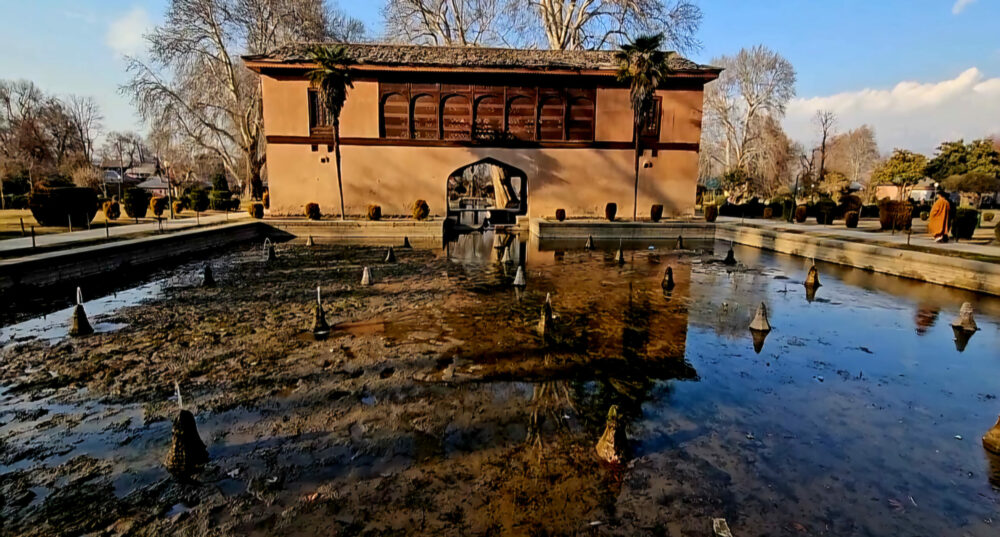
Many perennial springs, the lifeblood of countless villages, have either dried up completely or are discharging water at alarmingly low levels. The Achabal Spring, whose development as a fascinating picnic spot is attributed to Empress Noor Jahan stands as a stark symbol of this crisis. Once a vibrant source of water for nearly 20 villages, it is now barren. Every day, after the viral video, people come with pre-cooked food and distribute it among people to seek divine forgiveness.

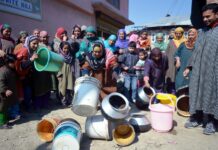
The Verinag Spring, the source of the mighty Jhelum River, is also experiencing its lowest water discharge in living memory. Kokernag is also suffering from a lack of discharge. In the Ganderbal district, numerous village springs have been declared unfit for drinking due to contamination, forcing authorities to issue warnings against their use.
The impact extends beyond the domestic water supply. The Jhelum River, the lifeline of Kashmir, is witnessing a continuous decline in water levels. At Sangam in South Kashmir, the water level has dropped to -1.01 feet, below the Reduced Level (RL) of zero. In Srinagar, at Ram Munshi Bagh, it has fallen to 3.52 feet. Major tributaries of the Jhelum are also facing severe water shortages. Years after the activists were crying over Kashmir emerging as the easy crucible for climate change, the situation on the ground is visible to all: the climate in Kashmir is changing, and its effects are becoming impossible to ignore.
Right now, Jammu and Kashmir is staring at a severe water crisis, with Chief Minister Omar Abdullah issuing a stark warning. “J&K is staring at a water crisis this year. It’s not a recent phenomenon; it’s been building up for a few years now,” he stated, emphasizing the need for a collective effort to tackle the issue.
The crisis stems from a prolonged dry spell that has left Kashmir parched. As on February 21, 2025, meteorological department records indicate an alarming 72 per cent deficit in precipitation for January and February, with only 53.2 mm of rain recorded against the expected 188.2 mm.
The Economic Fallout
The dry spell’s impact extends beyond drinking water. Kashmir’s agrarian economy is under grave threat. With irrigation sources drying up, the peasantry is being requested to reconsider traditional paddy cultivation. Over the decades, Kashmir has been dependent on staple rice on the plains and the Food Corporation of India (FCI) has converted rice fields into apple orchards. Now rice cultivation is limited to only a handful of areas but these belts are seriously suffering from adequate irrigation.
“We are advising farmers to shift to drought-resistant crops like millets, corn, and pulses,” said Sartaj Ahmad Shah, Joint Director of the Agriculture Department. “But the transition is not easy. Paddy farming is deeply rooted in our culture and economy.”
Apple orchards, another pillar of Kashmir’s economy, are also at risk. The lack of winter snowfall has deprived trees of the necessary chilling hours, essential for fruit-bearing cycles. Apple growers fear a significant decline in apple yield, spelling financial disaster for thousands of families dependent on the sector. Apple is the key mover and shaker of Kashmir’s peripheral economy and is offering a yearly income of around Rs 15000 crore.
The impact on the tourism industry is equally devastating. Hoteliers in Gulmarg, Pahalgam, and Sonamarg report a sharp decline in winter tourism, with thousands of bookings cancelled due to the absence of snow. Right now the drop is more than fifty per cent. “Too many people were keen to see snowfall and enjoy,” Asif, a major hotelier, whose operations are almost at the major tourist destination in Kashmir. “There was no snowfall and visitors skipped their visits.” Gulmarg would remain filled to the brim for most of the winter. Not in 2025, so far.
The power generation situation is dim. The NHPC runs a chain of power houses across Jammu and Kashmir and their output is lowest in recent history. Officials said the fall is almost eight per cent.
A Climate Crisis
Kashmir has historically been more prone to floods than droughts, making the current crisis all the more alarming. Experts attribute the shifting weather patterns to climate change, with rising temperatures reducing snowfall and causing glaciers to retreat.
“Western disturbances, which usually bring rain and snow to the Himalayas, have weakened,” explains meteorologist Faizan Arif. “This is not an isolated phenomenon; it is a long-term trend.”
The consequences are already visible in rising forest fires. Over 50 fire incidents have been reported across Jammu and Kashmir in January alone. Fires have engulfed forested areas in Tral, Bandipora, Pulwama, and Srinagar, destroying large tracts of vegetation and displacing wildlife.
That Kashmir climate was changing was visible already. The patterns had shifted. Normally Kashmir would see snowing in late November and early December. It now happens either before that or in late January and March. “Earlier, the dry snow would accumulate over the hills, replenishing the glaciers and gradually part of it would melt and feed the valley,” an academic said. “Now it snows late and is wet and then the mercury would soar in March and the entire glacial melt would come down and pass Kashmir.”
Kashmir’s glaciers have lost nearly 20 per cent of their mass over the past five decades due to rising temperatures and declining snowfall. Experts warn that a prolonged drought and reduced precipitation, particularly during ChillaiKalan, are accelerating glacial retreats, leaving Kashmir struggling with water shortages. Black carbon from biomass burning further exacerbates melting by reducing snow reflectivity. They are calling for sustainable water management and emission reductions to prevent a worsening crisis.
Ironically, in 2024 alone, Kashmir recorded 90 disease outbreaks across 10 districts. These included hepatitis, acute diarrheal disease both of which are mostly waterborne diseases and chickenpox. Hepatitis A was mostly reported in the last months of 2024 in different parts of Kashmir including in the northern and southern parts.
Biotic Interventions
Before sustainable management is conceived, the Kashmir society and the government will have to look at the crisis it has landed the water bodies into. Most of the water bodies in Kashmir are sewage dumps and all kinds of non-biodegradable waste is getting into the rivers and streams. Jammu and Kashmir generated 34,384 tonnes of plastic waste during 2021-22, which decreased slightly to 30,342 tonnes in 2022-23. In 2022-23, 32 operational Material Recovery Facilities (MRFs) recycled 52.82 per cent of it. What happened to the rest of it?
Over the last few years, the entire focus of the Jammu and Kashmir government is on tourism. The rules and regulations are seemingly absent.

Kashmir’s pristine trekking routes, including Tarsar Marsar and the Great Lakes Trail, are facing an environmental crisis as rising footfall leaves behind plastic waste, carbon emissions, and soil degradation. Black carbon from bonfires and vehicular emissions is accelerating glacier melting by reducing snow reflectivity, leading to early thawing and disrupted snowfall patterns.
While adventure tourism supports local livelihoods, unchecked pollution threatens the region’s fragile ecosystem. Environmentalists urge stricter regulations, eco-tourism policies, and responsible trekking practices to curb damage and protect Kashmir’s delicate landscapes from irreversible harm.
“Scores of hotels are coming up,” one major industrialist said. “A hotel is just not a place to sit only. It needs a lot of facilities and that has added to the ecological stress. You move across Kashmir, major new projects are coming up. It will have an impact. The government must know the carrying capacity of the space and not the hotels.”
Now, the Chief Minister has said his government will intervene and change the tourism policy to attract more investment. New chains are coming in. Radisson group runs eight hotels in Jammu and Kashmir and it is planning to add more.
Experts assert that before things start getting out of control; Kashmir will have to go to one major landmark: have water bodies so clean that one can drink the water. This will help take the situation to the next level, they assert
Road Ahead
Amid the worsening crisis, the Jammu and Kashmir government is scrambling to devise contingency plans. Right now, the administration is urging residents to conserve water and announced a review of water management policies. This, however, is a quick-fix thing.
“There is an urgent need for a comprehensive water management policy,” hydraulic engineer Aijaz Rasool believes. “We must focus on groundwater conservation, rainwater harvesting, and restoring traditional water bodies. Additionally, unchecked urbanisation and deforestation need to be controlled.”
There are calls for reviving traditional water conservation practices, such as recharging water bodies through small check dams and restoring neglected streams. Some villages have already started community-driven initiatives to de-silt local springs and regulate groundwater usage.
“While the government will have to adopt a more proactive approach, it can’t just be a government-centric effort,” the Chief Minister recently said promising to engage with the public to develop collective solutions. “All of us, as residents of J&K, must change the way we take water for granted.”