Across Kashmir and Jammu, rivers have tested a truth older than any proverb: that when one brother drowns, the other does not stand on the bank, writes Mir Rameez Raja
Saida Begum came to the riverbank still holding the thought of lunch.
She had been waiting at home in Jablipora, a small village in Bijbehara’s periphery, for her two sons to return. Majid, the elder at 29, had finished his postgraduate studies but preferred the company of sheep to the elusive offices in an unemployment-abundant Kashmir. Shahid, 25, was a graduate and was still hunting for possible opportunities.
Neither had ever considered their father’s work beneath them. On April 13, 2026, morning, they had taken the flock out to graze near the Jhelum, as they did most mornings. They also planned to wash them before the early spring shearing. She expected them before noon. They did not.
When word reached her, she ran.
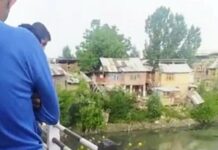
At the Padshahibagh riverbank, amid the police and the SDRF teams and the gathering crowds, she called them. There was noise only. It was a commotion ruling the river and the riverbanks as the people were attempting to fish out the two brothers.
There was no answer to her frantic calling. The Jhelum, swollen from days of rain, fast and indifferent, had already taken them both.
What happened that morning is, in its outline, simple. Majid slipped while washing the sheep near the bank. The current caught him immediately, the kind of current that gives no warning and no second chance. Shahid, standing nearby, watched his brother go under.
He did not run for help. He did not shout for a rope. He jumped.
“The current was too strong,” a resident, Ishfaq Ahmad, one of the first to reach the spot, told a reporter. “Both of them were swept away.”
Many hours later, their bodies were fished out.
Brother Is The Refuge
The bond between brothers is unbreakable, as there is no buddy like a brother. Every society cherishes the brotherhood, the real and the metaphoric.
In Kashmir, there is a saying that holds two truths about brotherhood in careful tension: Bou Bayes Dushmana, Bou Bayes Push Panah (a brother can be a brother’s worst enemy, but a brother can always be a brother’s last shelter).
In the long, bitter life of inheritance disputes and family land and the thousand small competitions of shared blood, the first half of that proverb earns its keep. But at the edge of a river, with a brother going under, something older and fiercer than rivalry takes over.
Across Kashmir and Jammu, in river after river, season after season, year after year, brothers have proved the second half of that saying, not with words, but with their lives.
It is almost always the same shape of moment. Ordinary morning. Ordinary errand. Then water, and a decision was made in no time at all.
In May 2017, Tanveer Ahmad, 21, and his brother Zahoor Ahmad, 24, shepherd boys from Manzgam in Uri, had taken their flock to the Jhelum. While washing the animals, the river’s flow took one. The other went after him. Even before the search operation was launched, the roaring flow had taken them away.
What is striking is not the tragedy alone, but the echo. Nine years later, in Bijbehara, Majid and Shahid went to the Jhelum with their sheep on an ordinary morning, and the river took them the same way. It was the same decision made in the same heartbeat, as though Kashmir’s brothers are caught in a loop they cannot, or will not, break.
Bathing to Death
Water bodies in Kashmir and Jammu have always created tragedies involving the brothers.
In October 2015, two school students, Jaffar Hussain, 19, and his brother Arshad Hussain, 20, were walking home from school in Reasi when they stopped at a stream to bathe. One started going under. The other jumped in. The police and locals reached them too late. They were pulled out dead from a stream neither of them had feared.
In May 2019, on the outskirts of Jammu, two boys, Mohammad Mudassir, just seven, and his brother Mohammad Tariq, eleven, had taken the family cattle to graze near the Nikki Tawi. The afternoon was hot. Mudassir waded in to cool off. He couldn’t swim. He started drowning. Tariq saw it and dived in without hesitation.
SDRF and police searched for over an hour. Both bodies were recovered. Seven years old and eleven years old, one trying to stay cool on a summer day, the other not pausing for a single thought before jumping in after him.
In July 2024, in the mountain streams of Kishtwar, Nasir Hussain, 16, and his younger brother Yasir, 13, drowned together in the Bonjwah belt of Kishtwar. Situation and circumstances were the same: hot and humid weather and a jump to cool off.
Sand Mining Brothers
In January 2022, in the Jhelum at Khawajabagh in Baramulla, a sand-laden boat capsized. Hilal Ahmad Malla and Naseer Ahmad Malla, brothers from Larwaghat in Bandipora, were working on the boat together. One body was recovered by evening. Searches for the second continued into the night.
Each incident of these drownings has its own details, its own geography, its own family’s particular grief. But they share a grammar. There is always a moment of ordinary life, washing sheep, returning from school, beating the summer heat. There is always water. And there is always a second person on the bank who does not remain on the bank.
The story does not belong only to brothers.
On a Sunday afternoon in June 2023, in Shadipora, Sumbal, Bandipora, a 21-year-old named Nazakat Ali drowned while bathing in a river. Locals tried to reach him. In the commotion, his sister, unnamed in official records, unrecorded in the bureaucracy of disaster, ran to the bank and jumped in after him. Nazakat was barely pulled out. He was taken to JVC Hospital in critical condition. His sister did not survive the rescue attempt.
The following morning, Monday, June 26, Nazakat Ali died in SKIMS. Within hours of each other, a sister and brother were gone, she taken by the water trying to save him, he taken by the hospital despite being saved. The proverb does not mention sisters. She did not need a proverb.
In January 2026, the canal at Theon Kangan in Ganderbal district added its own chapter. Mumtaz Ahmed Tedwa suffered a cardiac episode, lost consciousness, and fell into a power canal. His brother Tanveer saw it happen and entered the canal to pull him out. Mumtaz was recovered, stabilised at Kangan hospital, and later referred to SKIMS Soura. Tanveer was swept away by the current.
SDRA teams, police, and SDPO Kangan all conducted coordinated searches along the canal stretch. The last report said Tanveer had not been found. One brother was saved. The one who saved him was still missing. That is perhaps the cruellest variation of this story, the rescue that half-worked, the brother who gave himself for a sibling who lived, and whose own fate remained unresolved, suspended somewhere in the cold water of central Kashmir.
And then on June 14, 2025, in Doda, the youngest version of this story: Abrar Ahmad, 12, and Asrar Ahmad, 10, were playing cricket near the swollen Chenab. The ball fell into the river. Abrar went to retrieve it and was swept away. Asrar, ten years old, jumped in after his brother. A Deputy Commissioner and a Senior Superintendent of Police arrived personally to supervise the search. Neither boy was found. Ten years old. No pause. No calculation. Just a brother in the water, and then two.
Back in Jablipora, the neighbours of Majid and Shahid Malik remember them in the way that people always remember the recently dead, with the sharp, specific detail that grief preserves. They were soft-spoken. They were never too educated to tend the sheep. They helped people. Majid was about to be married. The invitations may already have been sent.
The large crowd that gathered for the funeral walked behind two brothers who had always walked beside each other. The graves in the local graveyard received them together, as the river had taken them together, as they had lived.
Jane Austen once wrote: The younger brother must help to pay for the pleasures of the elder. In Kashmir, it is invariably the elder who lives, and, if required, dies for the younger.