The Jhelum surged past its danger marks again in September 2025, reviving memories of 2014. Frequent floods, unchecked mining, weak infrastructure, and climate extremes expose Kashmir’s fragile defences and unanswered questions on preparedness, reports Masood Hussain
Engineers who have been working with the Jhelum, Kashmir’s main river, have consistently asserted that the Valley has survived for centuries in a 55-year flood cycle. The last of this flood started in the evening of September 5, 2014, at a time when the then Chief Minister Omar Abdullah was busy making preparations for the next assembly election.
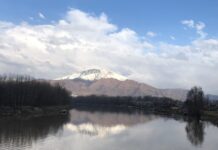
On September 3, 2025, when the Jhelum once again surged past the danger mark at crucial monitoring stations, including Sangam in Anantnag and Ram Munshi Bagh in Srinagar, memories of 2014 revived. In just a matter of hours, the river rose from 22 feet to 27 feet at Sangam, and at Ram Munshi Bagh, it touched 22.25 feet, well above the danger threshold. A day later, during wee hours, Jhelum reported a breach in Pampore outskirts, inundating a vast belt, a situation authorities are busy managing.
For residents, it marked the seventh “close call” since that devastating 2014 deluge, when the river had peaked beyond all known limits, sweeping away homes, bridges, hospitals, and schools. A conservative estimate put the costs that Kashmir paid for the 2014 deluge was more than Rs 100 thousand crore.
“It feels the same all over again,” cried an exasperated shopkeeper to his colleagues, as they stood watching the Jhelum roar and coil like a restless serpent through the city that Emperor Asoka once laid down. “It isn’t just the date that feels like a cruel reminder.”
Beyond the residents of low-lying neighbourhoods, the hardest hit were Srinagar’s traders. Many of them, whose shops line the vulnerable banks of the Jhelum, spent the night virtually camped out beside the river. For most of the line, the people were lined up on the banks as if trying to form a wall and stop the levels from a visible surge. “I had no insurance, a sick parent at home, and then my hosiery shop was swept away,” recalled Nazir Ahmad, a middle-aged businessman, watching the waters churn from Budshah Bridge, his 2014 experience. “Only God knows how I found the strength to start over. I lost my parent soon after the floods.”
As dusk fell and the Maghrib prayers ended, the city’s markets, Gonikhan, Lal Chowk, Abu Guzar, Hari Singh High Street, Polo View and others sprang into frantic activity. Mini-trucks lined the streets as shopkeepers hurriedly loaded their goods, driving them to safer places. The panic was so stark that an endless convoy of the newly introduced Red Buses, the most visible emblem of the Smart City project, rumbled out of Patha Chowk depot and towards distant lakeshore belts.
Warnings about the risk to low-lying areas sent families into a desperate race against time. Belongings were hauled from basements and ground floors to upper storeys before the water could arrive. “By nine in the evening, we had cleared everything from our ground floor,” said a Sikh resident of Mehjoor Nagar. “By half past nine, I had already taken shelter at a relative’s house in HMT.” Thousands of families had finished similar operations hours earlier, driven by the rising river and the memory of what unchecked waters can do.
An official with a national insurance company said inquiries had surged in recent weeks. “By September 3, the number of calls had shot up,” the employee noted. “Many dormant policies were suddenly revived after years, and several fresh ones were taken out as well.” According to the Union Finance Ministry, insurance companies disbursed nearly Rs 1,805.87 crore in claims after the 2014 Kashmir floods, with public sector insurers accounting for Rs 729.75 crore and private firms covering Rs 1,076.12 crore. The insurance claims helped a section of the trade to rebuild their businesses as many residents reconstructed their flood-devastated homes.
A Miscalculation
The panic was real as the waters spilt over, but many failed to see the larger reality: this was no match for 2014. That year, the Jhelum carried nearly one lakh cusecs of water; this week, its discharge was less than half of that. Even so, on September 3 the river swelled beyond last week’s levels, putting Kashmir through the second flood scare in just seven days.
Historically, Kashmir has lived under the shadow of fires, floods, and recurring waves of cholera. Few outside expert circles, however, realise that Kashmir faces two kinds of floods, routine inundations and rare, devastating deluges. The 2014 disaster fell into the latter category. Since then, the Jhelum has repeatedly risen to danger levels, but never with the same fury. Engineers familiar with the measurements suggested that the water was flowing at nearly twice the velocity of the 2014 floods.
Official records confirm that since September 2014, the Jhelum has crossed the danger mark at least 11 times, averaging nearly one major flood scare every year. The river threatened to breach in March 2015, July 2017, July 2018, April 2019, June 2022, July 2023, and again in late August 2025, when torrential rains and cloudbursts in south Kashmir pushed levels to 23.99 feet at Sangam and 21.10 feet at Ram Munshi Bagh. Less than a week later, another surge unfolded, leaving vast stretches on the outskirts of Srinagar underwater.
“We faced a flood-like situation just last week,” said an engineer involved in managing Srinagar’s water systems. “But this time, every tributary of the Jhelum, big and small, was running at full capacity. The saving grace was that the heaviest rains were concentrated in south Kashmir rather than the north, which allowed the waters to drain more quickly and prevented prolonged stagnation.”
Consequences
Unlike in the past, the August–September weather this year was more severe in Jammu, which witnessed devastating human losses. Two yatra spots were struck, one by a cloudburst and another by a landslide, while several other isolated incidents together claimed over 120 lives. More than 30 people remain missing. Kashmir too reported casualties, the worst of them in a Kullu suburb of Himachal Pradesh, where six Kashmiris were buried alive in a landslide while they slept.
It will take a long time to fully assess the losses caused by the inclement weather that triggered floods across the region. Beyond the vast stretches now submerged, Kashmir has borne heavy costs due to the closure of the Jammu–Srinagar national highway. Unlike in the past, when blockades were usually confined to the Banihal–Ramban stretch, this time, massive soil erosion near Udhampur has virtually cut the Valley off. For the past 10 days, no vehicular movement has been possible between Srinagar and Jammu, barring a few hours in between. Railways, once projected as the panacea for Kashmir’s communication crisis, have also proved unreliable, with the monsoon shutting down the Katra–Jammu link and leaving train travel as little more than an option.
The disruption coincided with the peak season of apple picking, especially of the high-density varieties. Truckloads of fruit were dispatched, only to be stranded as the highway closed. While it is still too early for a precise estimate, traders say losses already run into hundreds of crores. The damage continues to mount, with some growers shifting their produce to cold stores, waiting anxiously for the road to reopen and stabilise.
With the highway shut, Kashmir is already witnessing a steady rise in prices, particularly of vegetables that largely come from Jammu and Punjab. As both these regions struggle with the impact of floods, the situation is expected to grow even more grim in the days ahead.
Too Many Questions
While the authorities are busy managing the crisis unleashed by the floods, questions far outnumber answers. Leading the charge was none other than Chief Minister Omar Abdullah, who set the tone by asking the first round of questions.
Sharing his photographs from the same spot in 2014 and 2025, Omar took to Twitter on August 27. “Almost the same spot & very similar damage,” he wrote. “What if anything did we learn from the 2014 floods? What corrective steps were taken in the last 11 years? What flood mitigation measures were implemented since Oct 2014? These are all questions that the elected government will seek answers to because the last 48 hours have been a shocking eye-opener.” He later told reporters that he would review the department and try to locate the answers for the failures spanning 11 years.
The 2014 deluge had exposed a set of critical gaps in the way urban Kashmir, especially Srinagar city, lives. The water had shown up its traditional and historic routes to move within and around Srinagar. It has flown through the narrow passages, which were the waterways at one point in time, but were choked in the city’s urbanisation race. Tragically, the interruptions were seen to have come from the government as well as civil society.
Initially, there was an exercise to locate the obstructions in the routine water courses, and long lists were drafted. There are huge habitations in the flood basin areas along with the community infrastructure including mosques, seminaries and cemeteries. Besides, a set of critical social infrastructure was also built by the successive governments in the flood basins, especially Bemina, where, apart from many things, the major children’s hospital is located. At one point, even notices were served to some localities to vacate and restore the traditional passage of the water. Soon, as the government realised that it involved many small towns within the city of Srinagar, especially in its fringes, the file was folded and consigned to records.
Even now, courts are hearing various cases of encroachment to the water courses like Shah Kul, the clean stream that feeds the Mughal garden of Nishat.
The World Bank Project
After narrowly escaping flood devastation twice in just ten days, the governance apparatus has come under public scrutiny. In quiet conversations, people question the ‘projects’ launched in the aftermath of 2014.
A controversial rehabilitation package apart, the real major outcome of the 2014 deluge was the World Bank-funded nearly Rs 2000 crore Jhelum Tawi Flood Recovery Project (JTFRP). Of this, the government has been able to spend only Rs 1560 crore. It involved a total of 213 projects.
It includes construction of an additional gynaecological block of the women exclusive Lala Ded Hospital for Rs 118.22 crore; 160-bedded new complex for Bone and Joints Hospital for Rs 140 crore; upgradation of 49 dewatering stations within and around Srinagar for Rs 124 crore with Rs crore Supervisory Control and Data Acquisition Centre for 80 dewatering stations; and a Rs 40.16 crore State Emergency Centre at Ompora. Some of these works have been completed, and a few are still at the bidding stage.
De-silting Jhelum
The major concern for Kashmir, however, has remained the choking course of the main river from Khanbal to Khadanyar and the Wullar Lake in between. From ancient days, this has remained the main challenge of the rulers to dig out the shoals and de-silt the river so that the discharge has enough space to pick the speed and flow down. Maharajas actually brought in electricity to Kashmir early twentieth century with the sole purpose of powering the dredgers. The Irrigation and Flood Control (IFC) has a mechanical irrigation wing that has historically dredged out the silt and sold it in the open market.
In the aftermath of the devastating 2014 floods, the government announced ambitious plans to protect Kashmir from future disasters, earmarking Rs 2,083 crore for the management of the Jhelum and its tributaries under the Prime Minister’s Development Package (PMDP) of 2015. De-silting the Jhelum was one of the major components of the plan. Ten years later, however, both official statements and Right to Information (RTI) disclosures reveal a picture of half-finished works, stalled dredging, and continued vulnerability.
Replying to questions in the Assembly in March 2025, Jal Shakti Minister, Javid Ahmad Rana revealed that the carrying capacity of the Jhelum in the Srinagar stretch has been enhanced from 31800 cusecs to 41,000 cusecs.
Explaining the flood management plan, Rana said it was divided into two phases. Phase I, approved in 2015–16 for Rs 399.29 crore, focused on short-term measures and is reportedly nearing completion. Out of 31 works sanctioned, 16 are complete and 15 remain under execution. The entire Rs 114.29 crore received as central assistance for Phase I has already been spent, he added.
Phase II (Part A), approved in March 2022 with an estimated cost of Rs 1,623.43 crore, is designed to mitigate flood threats of up to 60,000 cusecs. Work is underway on 30 bank protection schemes, of which 29 have been tendered and 16 completed. Progress stands at around 80 per cent.
The Detailed Project Report (DPR) for the broader Phase II package, estimated at Rs 5,411.54 crore, has been submitted to the Central Ministry of Jal Shakti but is awaiting approval. While Part A has administrative clearance, the remaining components are still seeking financing options. Meanwhile, one notable intervention under the plan has been the construction of entry and exit gates at Hokersar wetland, completed at a cost of Rs 28.45 crore.
At the same time, questions raised through an RTI have exposed worrying gaps. The Irrigation and Flood Control Department admitted that no dredging of the Jhelum or its flood spill channels has been carried out between March 2020 and March 2025. This is despite repeated expert recommendations, including a 2018 report by the Central Water and Power Research Station, which underlined the urgency of dredging the Sangam (Anantnag) Asham(Bandipora) stretch. The last major dredging work was done by M/s Reach Dredgers of Kolkata, but no fresh contracts have been issued in the past five years.
While the RTI response did note that the carrying capacity of the river has improved, 41,000 cusecs at Sangam–Padshahibagh, 32,000 cusecs at Ram Munshi Bagh, and 35,000 cusecs at Sopore compared to pre-2014 figures, the absence of dredging has raised doubts about long-term resilience. Instead, the department highlighted desilting of 670 kilometres of irrigation canals in 2023–24, which removed 2.9 lakh cubic metres of silt.
“If the Flood Spill Channel is de-silted, our discharge capacity will cross 60,000 cusecs,” one senior IFC engineer said. “But if you think we can manage a flood on the scale of 2014, it is impossible.”
Equally concerning are the widespread encroachments choking the river and its channels. The department reported the removal of 1,233 structures, 215 boundary walls, and over 5.8 lakh trees. But nearly 6.3 lakh trees and close to 1,900 structures remain in place across Srinagar, Baramulla, Anantnag, Bandipora, and Pulwama, severely weakening flood defences.
A decade on, official figures highlight incremental progress but also an unmistakable gap between promise and performance. With floods striking Kashmir repeatedly since 2014, and the Jhelum swelling beyond danger levels almost every year, the absence of dredging, incomplete projects, and unaddressed encroachments underline just how fragile the Valley’s flood management remains.
“The fact of the matter is that the small works on the embankments of the river helped a lot,” PDP lawmaker, Waheed Parra, whose constituency’s 15 villages are flooded, said. “People do allege that the breach was deliberate, but I doubt.” He said had the project of creating a passage for 60,000 cusecs had been completed, no breaches would have taken place anywhere. “The tragedy is that the government had not posted people at decision-making levels in the department for a long time,” he said. “The Chief Engineer was posted only a week or so ahead of the flood situation.”
Devastating the Tributaries
Post-2019, the governance structure operated like a bulldozer. People were managing curfew restrictions during the enforced internet outage and phone closure, and the administration invited tenders for the riverbed mining. The bidders moved with heavy machinery into the Kashmir water bodies and devastated them. Many years later, Dr Raja Muzaffar started moving to the National Green Tribunal and successfully managed to get orders on merit.
Illegal extractions became the new norm almost everywhere. It reached a stage where the extractions went so deep that it disconnected the main rivulet from the minor irrigation canals that rose from it. At a few places, it devastated the banks of these tributaries that when the floods came, massive soil erosion took place. Experts are sure that the aquatic life was compromised.
In Dawlatpora village, a Rs 30-crore modern water treatment plant built painstakingly over more than a decade now lies nearly defunct because its source, the ancient Arbal Nag spring, has withered away in just the past two to three years because of relentless mining along the Doodh Ganga river. Several springs dried up. “Illegal mining has become endemic across south and central Kashmir, eating away at tributaries of the Jhelum like the Veshaw, Rambiara, Romushi, Doodh Ganga, Ferozpor Nallah, Sindhand Sukh Nag,” Muzaffar said. “These mountain-fed streams are not just ecological lifelines but also cultural anchors, supporting irrigation, fisheries and drinking water sources.”
There are studies suggesting that unchecked mining has altered Jhelum’s morphology, increasing water turbidity and even creating sinkholes due to groundwater depletion.
Official records reveal the extent of extraction. In 2021–22, 0.47 million tonnes of sand and minor minerals were mined from 37 designated sites. By 2022–23, that figure more than doubled to 1.14 million tonnes from 72 sites.
“The fact of the matter is that the relentless riverbed mining offered the flood waters enough of space to move,” Parra said. “But the larger reality is that the floods destroyed apple orchards, paddy land and whatever came in its way. At a few places, the water course changed.”
The reckless riverbed mining is complemented by another serious issue: the erasure of minor irrigation canal system. With the sprawling rice fields converted into orchards, people’s dependence on irrigation has fallen sharply. Instead of keeping those canals intact, the people have annexed them to their orchards or simply reduced their size. This has done away with a huge network of small water bodies, which had some retention capacity and groundwater charging ability.
“In various places I visited, the people started asking for desilting of the canals or creating temporary sand-bag flood protection bunds,” one lawmaker said. “This is too much dependence on the government, as the people used to desilt their own canals every year. That tradition has been given up.”
Haphazard Development
In Jammu and Kashmir, development has always been a haphazard affair both in public and private sector. The uneven spread of Srinagar and other suburban localities indicates an urbanisation that many think does not suit Kashmir, a land scarred, flood-prone prone and high-earthquake belt.
Over the years, the major communication projects like railways and a vast network of roads have created new artificial divisions in a small valley. “The railway track came up and divided Kashmir into Upper Valley and Lower Valley,” a professor, living adjacent to the track, said. “Then the Highway was upgraded, and it added yet another slice on the lower side of the valley. Now the ring road has created a new geography of it.”
Though the planners have been trying to keep some gaps for the drying up of water channels, these are too narrow to manage the floods when they hit Kashmir. The investment of hundreds of crores in the housing projects by the society on the flood basin areas shall remain a huge concern for the new generation.
Climate Change
Floods are a normal phenomenon, and Kashmir has survivedthe worst floods in history. What is, however, very serious is the frequent flood situation taking place. Experts attribute it to extreme weather conditions including more frequent cloudbursts. Of late,
Kashmir is showing clear signs of warming, with studies of data from 1980 to 2017 revealing a statistically significant rise in both maximum and minimum temperatures. Annual averages suggest an increase of 0.035°C in maximum and 0.022°C in minimum temperatures, with the warming trend more pronounced in maximum temperatures, according to a 2021 study carried out by Javaid A Dad and many other scholars While precipitation patterns remain variable, driven 72 percent by western disturbances and 28 per cent by the Indian summer monsoon, there is a noticeable shift, with monsoon influence increasing in south Kashmir.
These shifts, coupled with steady warming, point to a fragile climate balance whose disruption could have grave implications for Kashmir’s food security, water resources, and ecological sustainability.
The gradual warming is impacting the glacier deposits. More than 170 glacial lakes across the erstwhile Jammu and Kashmir state are now showing alarming signs of expansion, placing it among the most vulnerable regions in the Himalayas to sudden flood disasters. The Central Water Commission, in its June 2025 monitoring report, has warned that of the 432 glacial lakes in India requiring “vigorous monitoring for disaster purposes,” 120 are in Ladakh and 57 are in Jammu and Kashmir.
The report underlined a striking rise in the glacial lake outburst floods (GLOFs). The Commission has pressed for urgent preparedness measures, including satellite-based early warnings and real-time monitoring, to protect downstream communities in Jammu and Kashmir and Ladakh from the potentially catastrophic consequences of glacial retreat and expanding lakes.

Frequent Cloudbursts
Kashmir needs to accept that it is the new crucible of climate change. Cloudbursts, the new destruction tools, are showing up more frequently. On August 14, 2025, a massive cloudburst struck Kishtwar in the Chenab valley, leaving more than 67 people dead. Many people are still missing. Four days later, another cloudburst in the twin Kathua villages killed seven persons.
Kashmir, experts believe, has a unique geography, making it especially prone to cloudbursts. It receives moisture from both western disturbances and the southwest monsoon, which together generate dense, water-heavy clouds that collapse violently over the mountains. Given the fact that the region has fragile, unstable terrain with loose soil, they believe deforestation, concrete construction, mining, over-tourism and land use change make a small cloudburst unleash a flash flood.
New Challenges
While the government and society may have to think seriously about the critical issues the Valley is facing on the flood management front, the floods need not be taken on a standalone basis. Jhelum is the main drainage artery that helps Kashmir survive. It is expected to pay back for the biotic intervention that impacts it. From its banks to its waters, from its depth to its course, the policy makers will have to re-examine seriously and start getting into the decision-making.
“After the breach was reported, I started getting ready for the office, and my family resisted,” one professor living in the Nowgam belt said. “I said I cannot do anything by sitting at home. I told them to keep the doors and windows open and welcome the waters as and when they please to come. But ensure, leave the home and save your lives. It is not that Jhelum is coming to us. The fact is that we have come to Jhelum on our own.”