Jammu and Kashmir faces an impending water crisis as glaciers vanish, water bodies shrink, and irrigation systems falter, endangering agriculture, ecosystems, and daily life. The crisis deepens with groundwater depleting and natural springs drying up due to climate change and unchecked human activity. Despite government conservation efforts, time is running out to safeguard the future of millions reliant on these fragile water sources, writes Humaira Nabi
For Javed Dar, a senior photojournalist from South Kashmir’s Anantnag district, covering an environmental crisis was not enough—he felt compelled to act. The sight of the once-pristine Sandran rivulet, which flows through his village of Muniwar, choked with plastic waste, household refuse, and farm debris, was unbearable.
In early February, social media was flooded with striking images and videos of young men, clad in aprons and gloves, wading through the polluted waters, hauling out heaps of garbage. Leading them was Javed, who had channelled his frustration into action.
“The banks were drowning in waste—plastic bags, discarded trash, and rotting farm residue. It was not just an eyesore; it was killing the river,” Javed recalled. What began as a personal mission soon evolved into a community movement. Inspired by his dedication, young men from the village rallied around him, determined to restore the river that had once been their village’s lifeline. Their relentless efforts transformed the sluggish, polluted stream into a glistening waterway.

The Worsening Water Crisis
The Sandran Rivulet reflects the worsening plight of water bodies across Kashmir, many of which are in distress. Rivers and streams across the region are on the brink of depletion, signalling an alarming environmental crisis.
In mid-February, despair swept across Kashmir when Achabal, a vital water source sustaining 15 villages and a tributary of the Jhelum, dried up for the first time in history. The sight of women wailing along its barren banks underscored the profound anguish of a community witnessing its lifeline vanish before their eyes.
Simultaneously, the Jhelum and its tributaries were flowing at near-zero levels, signalling a severe water crisis. At Sangam, the Jhelum’s water level had dropped to -1.01 feet below the Reduced Level (RL) of zero on the gauge. At Ram Munshi Bagh, it stood at just 3.52 feet, while at Asham, it had fallen to a mere 0.75 feet. Reports indicated that 65 per cent of water sources across the region were facing severe depletion, exacerbating drought-like conditions.
A Vanishing Heritage
A 2023 survey conducted by the Ministry of Jal Shakti revealed a grim picture of Jammu and Kashmir’s water bodies, indicating that over 23 per cent had either dried up or were beyond repair. A report by the Department of Environment, Ecology, and Remote Sensing (Jammu and Kashmir Government) found that more than 50 per cent of water bodies in Srinagar had been lost over the past century. A comparative study of historical maps from 1911 and 2000 revealed the complete disappearance of several water bodies.
Environmental experts attribute this crisis to a combination of climate change and human-induced factors, including unchecked urbanisation, encroachments, and inefficient water management.
The Shrinking Lifelines
The Jhelum River, originating from Verinag in south Kashmir and flowing through Srinagar before emptying into Wular Lake in the north, has long been the lifeblood of the region. Yet, in recent years, it has suffered a dramatic decline in both water quality and volume, a crisis that has been largely ignored despite its profound implications for the local population.

This deterioration is primarily due to the unchecked disposal of waste by commercial and residential establishments. Over the past two decades, the Jhelum has borne the brunt of heavy pollution, with untreated liquid and solid waste from homes, hotels, and businesses in Anantnag, Pulwama, Srinagar, and Baramulla districts flowing directly into its waters. Raja Muzaffar Bhat, a Kashmiri environmental activist, underscores the gravity of the situation. “In settlements along the Jhelum River, from its origin in south Kashmir to its confluence with Wular Lake, untreated wastewater from drainage systems flows directly into the river,” he said. “The rampant and unchecked dumping of solid waste in and around these areas has severely degraded its water quality.”
The escalating pollution crisis not only endangers the Jhelum but also poses a serious threat to the health and livelihoods of the communities that rely on it. Houseboats, once a symbol of the Jhelum’s grandeur, now often rest on mud rather than water, a stark reminder of the river’s dwindling levels. Despite its vital role in sustaining the region, the river has been left to languish, with little effective waste management or pollution control in place.
The Jhelum’s plight is a microcosm of a broader environmental crisis, one that demands urgent attention and action. Without significant intervention, the river’s degradation will continue to jeopardise both the ecosystem and the people who depend on it, underscoring the need for a concerted effort to restore and preserve this lifeline of Kashmir.
Doodh Ganga Story
One of the Jhelum’s major tributaries, the Doodh Ganga River, faces an equally grim fate. Over 500,000 people in Srinagar’s uptown area and parts of Budgam depend on the Doodh Ganga water supply plant in Kralpora for drinking water. Yet, municipal liquid waste, including untreated sewage from homes and government pumping stations, is routinely dumped into the river.
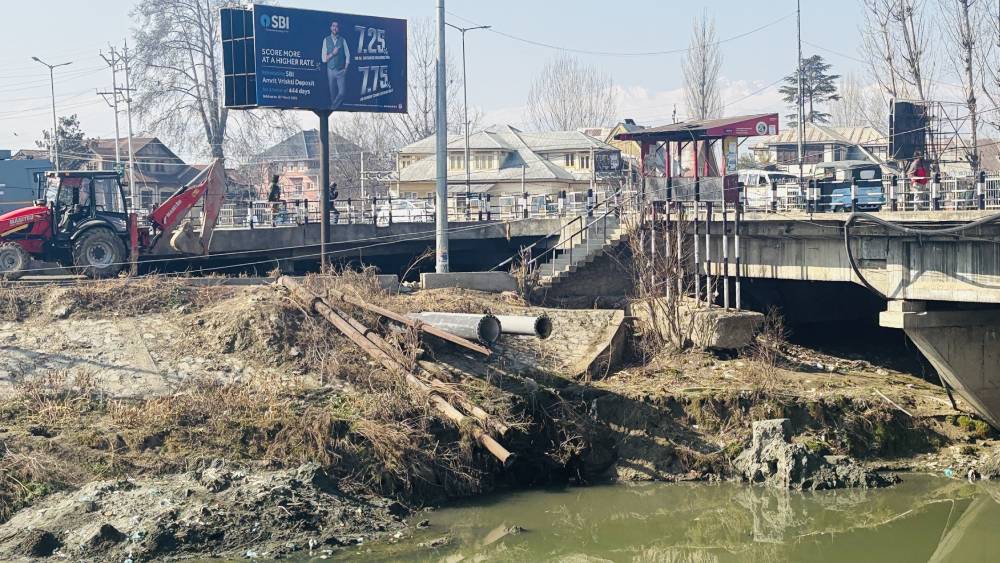
In 2022, the National Green Tribunal (NGT) held local authorities accountable for failing to curb pollution in the Doodh Ganga and imposed a penalty of Rs 35 crore on the Jammu and Kashmir government. The river is further contaminated by solid and liquid waste from over a dozen villages and Chadoora town, with several latrines even having direct outlets into the water.
The Jhelum’s other tributaries—Vishav, Pohru, and Sindh—are also in severe decline. The Vishav River is plagued by excessive agricultural runoff and untreated sewage, leading to high levels of chemical contamination. Similarly, the Pohru and Sindh rivers are suffering from pollution, encroachment, and reduced water flow, threatening their very survival.
The Disappearing Lakes
Wular Lake, the second-largest freshwater lake in Asia and the largest natural floodwater reservoir in the Jhelum basin, has not been spared. Over the past century, the lake has shrunk dramatically, with its open water surface diminishing from 90 square kilometres in 1911 to less than 15 square kilometres in 2013. Encroachments, siltation, and deforestation in the catchment area have driven this alarming reduction.
Dal Lake, one of Kashmir’s most iconic tourist destinations, has also been steadily shrinking. Urban expansion and pollution have taken a heavy toll, with the lake’s area reducing from 22 square kilometres to 10 square kilometres over the past five decades, according to a 2018 report by the Dredging Corporation of India. Historical records paint an even starker picture: in 1200 AD, Dal Lake spanned 75 square kilometres, highlighting the extent of its decline.
The Disappearing Wetlands
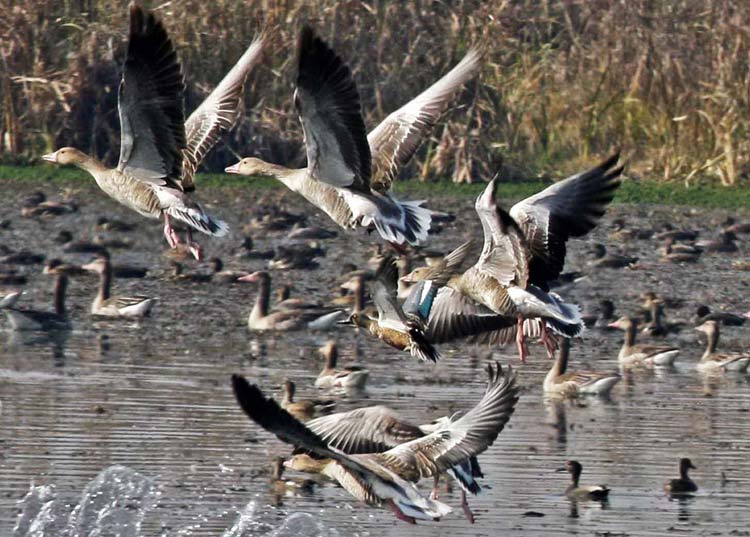
Wetlands are among the most crucial ecosystems on the planet, often described as “nature’s kidneys” for their ability to filter pollutants, regulate water levels, and sustain biodiversity. In Kashmir, these fragile ecosystems play an essential role in maintaining the hydrological balance. Acting as natural reservoirs, they help mitigate floods, recharge groundwater, and ensure water availability during dry spells. They also provide critical habitats for migratory birds and aquatic life.
The Kashmir Valley once boasted a vast network of wetlands, with 755 documented water bodies. However, rapid urban expansion, unregulated development, and widespread encroachments have caused an alarming reduction in their size and ecological health. The consequences are already evident in the form of increased flooding, declining water quality, and the loss of diverse flora and fauna.
A Landscape in Decline
A 2017 study conducted by the University of Kashmir’s Department of Earth Sciences revealed that nearly 20 wetlands in and around Srinagar have vanished over the past five decades. The total wetland area in the Jhelum basin—considering wetlands larger than 25 hectares—has decreased from 288.96 square kilometres in 1972 to just 266.45 square kilometres today.
One of the most severely affected wetlands is Narkara, situated on the outskirts of Srinagar. Once an expansive marshland, it has been encroached upon by unchecked urbanisation. Research from the University of Kashmir indicates that agricultural land in the area has declined by 78 per cent, from 22.63 square kilometres in 1965 to just five square kilometres in 2016. The primary reason for this transformation is the rise in built-up areas, which have expanded twenty-eightfold in the last fifty years. By 2016, urban settlements covered 37.12 per cent of Narkara’s total catchment area.
Other wetlands have faced similar fates. The Haigam Wetland Conservation Reserve, once a thriving habitat for migratory birds, has been significantly degraded due to paddy cultivation. A recent assessment by the Green Citizens Council, also known as the Environmental Policy Group (EPG), described Haigam as practically “dead and buried” because of relentless encroachments and a lack of conservation efforts.
Hokersar Wetland, designated a Ramsar site in 2005, has also suffered from human encroachment and pollution. Located just 12 kilometres west of Srinagar, Hokersar has lost 5.75 square kilometres of its area in the past four decades. Despite its international ecological significance, unchecked siltation and pollution have severely diminished its capacity to support birdlife and aquatic species.
Perhaps the most striking example of wetland destruction is Achan, a once-thriving marshland that has now been reduced to a municipal landfill site. Until 1983, Achan was a flourishing wetland, home to a wide variety of bird species and located near Anchar Lake, the second-largest lake in Kashmir. However, a government directive at the time led to its transformation into a landfill. Today, Achan receives between 400 and 500 tonnes of waste daily from Srinagar, turning what was once a vital ecological site into an environmental catastrophe.
The Lost Legacy
The reign of Sultan Zain-ul-Abideen in the 15th century marked a golden era for Kashmir, characterised by remarkable advancements in water management, infrastructure, and agriculture. His visionary projects transformed the region, creating a network of canals, ponds, and irrigation systems that sustained communities for centuries. Today, however, much of this legacy lies in ruins, eroded by neglect, urban expansion, and environmental degradation. The once-thriving waterways and irrigation networks he meticulously developed have either dried up, been encroached upon or vanished entirely.
One of the most significant casualties of this neglect is Nallah Mar, a canal built during Zain-ul-Abideen’s reign. Once a vital navigational waterway, it connected the Brari Nambal lagoon to Khushal Sar, facilitating water transport between Dal and Aanchar lakes. Well into the 20th century, Nallah Mar served as a lifeline for Srinagar’s old city, enabling trade and movement. However, with the rise of motorised transport, its importance waned, and in the 1970s, it was filled in and converted into a road. This decision proved ecologically disastrous. Brari Nambal became choked, disrupting the entire water system of Srinagar. What was once a flourishing artery of the city now lies buried beneath asphalt, a stark symbol of lost heritage.
Zainageer’s Vision in Ruins
In north Kashmir, the region of Zainageer, named after the Sultan himself, was another testament to his ingenuity. The Nallah Zainageer, originating from Nallah Madhumatti in Bandipora, was a revolutionary irrigation project that sustained agriculture across a vast expanse, from Sagipora in Kupwara to Wular Lake in Baramulla. Recognising the need for additional water, Zain-ul-Abideen diverted the Pohru Canal, ensuring uninterrupted irrigation. This intricate water system not only supported farming but also shaped the socio-economic fabric of the region. Today, however, the canal is in dire need of designation and repairs, with many villages struggling to access sufficient water.
In Tujar Sharief, Budshah Pond, named after Zain-ul-Abideen, once provided clean drinking water to the entire village and its surroundings for over six centuries. Now, this historical pond lies in decay, buried under heaps of garbage, a poignant reminder of the erosion of a once-great legacy.
The Fragility of Irrigation
Irrigation is the lifeblood of agriculture in Kashmir, where irregular and insufficient rainfall makes water management essential. Most rainfall occurs in winter when temperatures are too low for plant growth. As temperatures rise from May onward, rainfall decreases, leaving much of the growing season dry. With farming dependent on a single crop, cultivators rely on snow-fed streams to construct small canals or pools, which irrigate 60 percent of the valley’s cultivated land.
Locally known as Khoul, these canals were more than mere water channels; they were the veins of the land, sustaining both life and culture. Kashmir’s agrarian communities practised an annual tradition known as Khoulwan, a collective effort to desilt and maintain irrigation canals that fed the rice paddies. This practice, deeply rooted in rural life, ensured that water from streams and springs reached the fields efficiently, sustaining the region’s staple crop, rice.
However, with the shift to apple cultivation and the advent of concrete canals, this tradition has faded, leading to unintended environmental consequences. Khoulwan was more than an agricultural necessity; it was a practice that ensured environmental sustainability long before conservation became a global concern. Villagers, regardless of caste or class, came together for a day to clear silt and debris from the canals. This not only ensured an uninterrupted flow of water but also prevented blockages that could devastate crops. The de-silted material, rich in nutrients, was often repurposed as a natural fertiliser, enhancing soil fertility.
Vanishing Snow
This winter, travellers flying into Kashmir have been confronted with an unsettling sight. From their aeroplane windows, the once-majestic Pir Panjal range appears stripped of its snowy grandeur. Instead of a pristine winter spectacle, they look down upon barren peaks, where only isolated patches of snow cling to the rugged slopes. The transformation is more than striking—it is alarming. What should have been an unbroken expanse of white is now a fragmented and fading landscape, a stark reminder of a climate in crisis. These mountains, long regarded as the sentinels of Kashmir’s winters, now stand as eerie symbols of change. Their exposed slopes, visible even from the sky, signal an undeniable warning: snowfall is dwindling, and with it, the lifeblood of rivers, ecosystems, and communities that rely on it is melting.
Chillai Kalan, the 40-day period that marks the harshest phase of winter in Kashmir, was once synonymous with heavy snowfall and prolonged subzero temperatures. In recent decades, however, this defining season has witnessed a sharp decline in snowfall, with heavier precipitation shifting towards late winter.
The winter of 2024–25 ended with a 75 per cent precipitation deficit, continuing a troubling trend. The previous winter, 2023–24, was recorded as the driest in Kashmir’s history, surpassing all previous records, according to data from the Meteorological Department. In Srinagar, only 1.5 mm of precipitation was recorded between December 21, 2023 and January 30, 2024, making it the driest-ever Chillai Kalan. The last time the valley experienced such extreme dryness was in 1966 when just 0.6 mm of precipitation was recorded. The second driest winter occurred in 2015, with 5.6 mm of precipitation.
The trend of diminishing snowfall has been evident over the past several years. During the winter of 2021–22, Kashmir received 262.5 mm of precipitation between December and January, marking a 9 per cent deficit from the normal 288.4 mm. The previous year, between December 2020 and January 2021, the region recorded 180.9 mm, a deficit of 37 per cent.
Vanishing Glaciers
Kashmir’s glaciers are retreating at an alarming rate, driven by rising carbon emissions. Experts warn that nearly 30 per cent of the region’s glaciers have disappeared over the past six decades. A 2024 study by researchers from NIT Srinagar, led by Mohammad Ashraf Ganai and Syed Qaiser Bukhari, highlights the dramatic loss of glaciers in the Pir Panjal range. Published in the International Journal of Hydrology Science and Technology, the study reveals that 122 glaciers have shrunk from 25.7 square kilometres in 1980 to just 15.9 square kilometres in 2020. South-facing glaciers are melting faster than their north-facing counterparts, with those situated between 3,800 and 4,000 metres experiencing the most significant retreat.
A 2018 study led by Professor Shakil Romshoo, based on satellite mapping of 147 glaciers, found that between 1980 and 2018, Kashmir’s glaciers shrunk by 28.82 per cent—a far greater loss than in many other parts of the Himalayas. Glaciers below 4,200 metres have nearly vanished, leaving only a few remaining water bodies. Kolahoi Glacier, Kashmir’s largest and a key water source for the Lidder and Sindh rivers, has lost nearly 23 per cent of its mass since 1962.
Romshoo, an earth scientist and Vice Chancellor of IUST, emphasised the gravity of the situation. “There are 18,000 glaciers in Jammu, Kashmir, and Ladakh, all steadily melting,” he said. “Glacier retreat is a widespread issue across the Himalayas, and in recent years, the rate has increased dramatically. While this year’s melting is slightly lower than last year’s record levels, it remains a serious concern.”
A Looming Water Crisis
The shrinking snowpacks in river basins across the northern hemisphere, vital for water supply, have also been severely impacted by climate change. A recent study published in Nature by researchers from Dartmouth College highlights that snowpack size has been declining over the past 40 years and will continue to shrink as global temperatures rise.
According to the International Centre for Integrated Mountain Development (ICIMOD), the Hindu Kush Himalaya (HKH) region has warmed at an average rate of 0.2°C per decade over the past 50 years. These glaciers are the primary sources of mountain springs, streams, and major rivers such as the Indus and Ganges, which are lifelines for millions downstream. If the decline in snowfall continues at its current pace, exacerbated by rising temperatures as seen in 2023, the consequences could be catastrophic. Massive water shortages and food insecurity may soon threaten millions, making the preservation of these fragile ecosystems more urgent than ever.
Depleting Groundwater
The decline in precipitation over the years has led to a significant depletion of groundwater levels in Kashmir. Once abundant with natural springs, Kashmir is now witnessing an alarming trend of water sources drying up. Of over 258 springs spread across Kashmir, many are facing depletion. Local communities frequently report the drying up of springs in their areas, with major water sources such as Bulbul Nag, Panzath Spring, Aripal Spring, Verinag Spring, and Sheerbag Spring all experiencing noticeable declines in water levels over the past few years.
In early January 2025, the Department of Public Health Engineering, Ground Water Division Srinagar, issued a public notice mandating the registration of bore wells and production wells across Kashmir Province. The directive, based on the Jammu and Kashmir Water Resources Regulatory Authority regulations of 2010 and 2011, aims to regulate groundwater usage and prevent overexploitation. This decision underscores the worsening groundwater crisis in Kashmir and highlights the urgent need for conservation measures.
Aijaz Ahmad Dar, a resident of Sopore, invested heavily in digging a bore well in his lawn after his area began experiencing erratic water supply. However, within just a few months, the bore well dried up, leaving his family struggling for water. “The borewell was fifty feet deep, but the water started diminishing within a month,” Aijaz said. “I deeply regret the money I spent on it.”
Experts also point to unregulated and excessive riverbed mining as a significant factor exacerbating groundwater depletion. The uncontrolled extraction of sand, gravel, and stones from riverbeds disrupts the natural process of groundwater recharge, preventing water from seeping into underground reservoirs. This, coupled with declining precipitation, has intensified the water crisis, posing a serious threat to both surface and groundwater resources in Kashmir.
“Extensive riverbed mining over the past five to six years has significantly worsened the crisis,” Raja Muzaffar said. “Streams and rivers play a crucial role in replenishing groundwater, but excessive and deep mining has disrupted this natural process. As a result, the seepage of water toward springs, wells, and underground reservoirs has been severely affected, further accelerating groundwater depletion.”
Lawmakers Call for Action
As Jammu and Kashmir faces an escalating water crisis, lawmakers across the region have raised urgent concerns, calling for immediate government intervention. Members of the Legislative Assembly have urged authorities to prioritise the restoration and conservation of water bodies in their constituencies, emphasising the need for sustainable water management.
Chief Minister Omar Abdullah convened a meeting of the Jal Shakti Department to assess the crisis and formulate a response. Writing on X, he acknowledged the severity of the situation: “J&K is staring at a water crisis this year. It is not a recent phenomenon—it has been building up for years. While the government must adopt a more proactive approach to water management and conservation, this cannot be a government-centric effort. All of us in J&K must reconsider the way we take water for granted. I will be reviewing the measures the Jal Shakti Department intends to take and will also be engaging with the people of J&K over the next few months on what we can do collectively.”
Now the government is planning to reinvest resources in Kashmir’s canal systems so that people get the water to irrigate their fields. The government is lifting a Rs 35 crore loan from the National Bank for Agriculture and Rural Development (NABARD) to revive the canal network in Bejbehara, the local lawmaker, Dr Bashir A Veeri, was told. This will help him restore the 25.5-km Dadi Canal, which was irrigating 3,045 hectares of land. Reviving the forgotten canal network in Kashmir is expensive and time-consuming. Till these are revived, Kashmir may not be able to produce rice for the time being.