As Kashmiri literature crosses linguistic boundaries, translators confront questions of fidelity, cultural loss, readership and preservation, reports Babra Wani
For centuries, Kashmir’s literary inheritance has travelled beyond the language in which it was written through translators who have tried to carry its history, poetry, stories and worldview into other linguistic worlds.
Perhaps the most consequential example is the Rajatarangini, Kalhana’s 12th-century chronicle of Kashmir’s kings. Haidar Malik is regarded as the first to translate the work into a foreign language, rendering it into Persian during the reign of Mughal Emperor Jahangir.
Its journey into English was more consequential still. Sir Aurel Stein, the Hungarian-born British archaeologist, produced the first complete scholarly English translation, published in 1900 as Kalhaņa’s Rājatarangiņi: A Chronicle of the Kings of Kaśmīr. His work was followed by Ranjit Sitaram Pandit’s translation in 1935.
Through such translations, a history largely locked inside Sanskrit and Persian became available to readers who could not access the original. The argument for translation remains much the same today, although its stakes have changed.
“Translating literary works into other languages is a blessing in disguise,” said Hafsa, an avid reader. “We were able to read all the amazing Persian poets through the translation of their works and that is amazing.”
For Kashmiri literature, however, translation is no longer simply about introducing an old literary tradition to outsiders. It is increasingly becoming a way of reconnecting Kashmiris themselves with a language many of them inherited but never properly learnt.
A Major Anthology
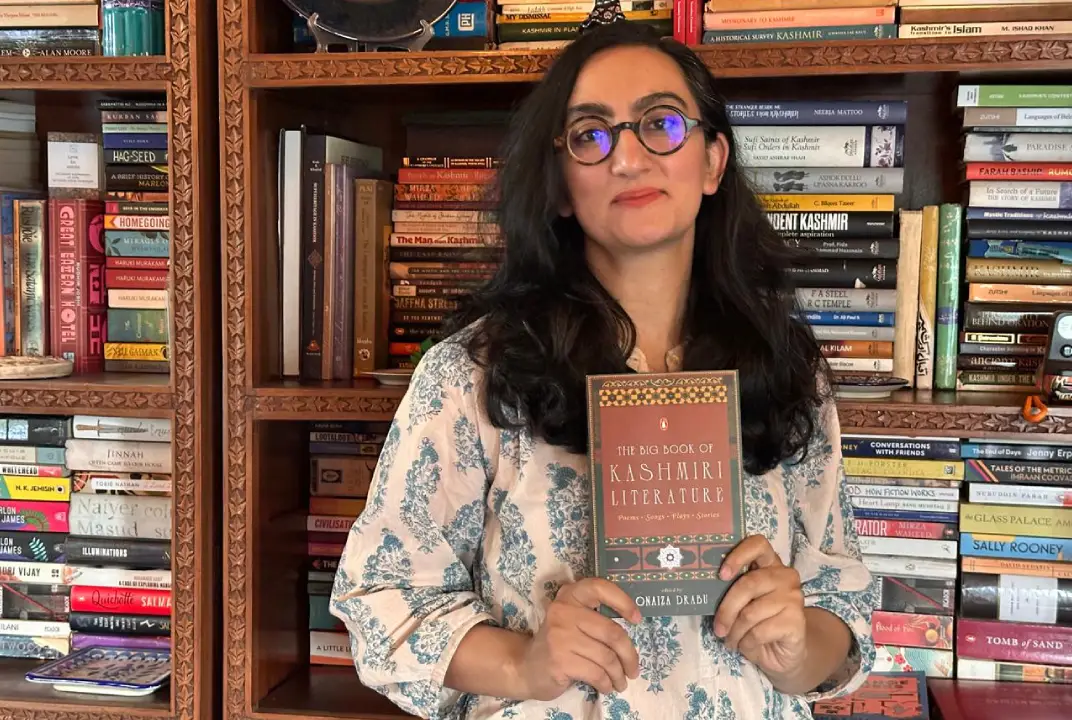
The debate over the possibilities of translation received a fresh push with the publication of Onaiza Drabu’s The Big Book of Kashmiri Literature. The 664-page anthology brings together six centuries of Kashmiri writing, from 14th-century mystical verse and folk chants to ghazals, modern fiction, radio plays and excerpts from novels, translated into English by around 20 translators.
The scale itself is significant. Rather than presenting Kashmiri literature through a single author or genre, the book attempts to offer an overview of an entire literary tradition.
Translators who worked on it describe it as an important intervention. Veteran translators have also praised Drabu’s effort to bring together material spanning centuries and genres that rarely reaches readers outside the Kashmiri-speaking world.
But the anthology also exposes the central difficulty of literary translation: how do you move not merely words, but a culture, its associations and its emotional registers, from one language to another?
The Difficult Craft

Dr Roop Krishen Bhat’s answer begins with the translator. A linguist, author and translator, Bhat’s academic engagement with Kashmiri began with his PhD on Kashmiri grammar. He subsequently spent years studying the language and has published around 45 books, including translations and short-story collections. He has translated between Kashmiri, English and Hindi and has contributed to Sahitya Akademi publications.
For him, the first requirement is mastery of both languages. “Both languages, the source language and the target language, equally, whoever has the mastery and understanding is a good translator.”
But even mastery does not make translation mechanical.
“You do everything exactly, literally,” Bhat said of word-for-word translation, “but” that does not necessarily convey what the original means.
A translator has to find an equivalent expression in the target language while preserving the intention of the original. The problem becomes particularly complicated when language carries culture. “Language reflects the culture,” Bhat said.
He pointed to Kashmiri honorifics. A plural form can be used when addressing a single person as a mark of respect. English has no equivalent distinction in the pronoun “you”.
“This is basically a cultural expression,” he said. “If you are aware of it, you can become a good translator.”
Without that cultural understanding, he said, a word-for-word translation “doesn’t do justice” to the original.
Poetry makes the task harder still. Simile, rhythm, tone, idiom and cultural references can all operate differently in another language. “Understanding them and making them equal is a tough task,” he said.
Prose is comparatively easier, Bhat believes, although culturally rooted and idiomatic passages can remain difficult. Different genres bring different problems: fantasy requires specialised terminology, while science fiction and children’s literature have their own linguistic demands.
Yet one problem is common to almost every translator of Kashmiri: there simply are not enough of them.
“There are a lot of eminent translators and writers,” Bhat said, but the number of people capable of translating Kashmiri directly into English remains limited.
“We really need translators,” he said. “The more translators there are, the more we can say that we are getting richer.”
A Literary Bridge
Neerja Mattoo, translator and former English educator, sees translation as a bridge between linguistic communities.
Her own journey began as a student under Professor J L Kaul, whom she describes as being “like another father” to her. Kaul gave her two Kashmiri short stories, Akhtar Mohi-ud-Din’s Swarga Hoor and Ameen Kamil’s Kaukar Jung, and asked her to translate them for a Sahitya Akademi collection of contemporary Indian stories.
She did. The translations were accepted and published. She later became a teacher and did not immediately pursue translation. It was the deterioration of Kashmir’s situation during the 1990s that brought her back to it.
“When the situation here deteriorated a lot in the 90s, and there was very little education in the college, I thought that people should know that not only is there bloodshed in Kashmir, but there is a lot of literature in Kashmir,” she said. “So, I started translating more.”
Her work subsequently took her towards Kashmiri women’s poetry, including the contrasting traditions of mystical and romantic lyric.
“One is mystic and the other is romantic lyric,” she said. “So, two Kashmiri women started both. They should know how great literature was in Kashmir.”
The translations introduced readers to a literary tradition that many did not know existed. “People liked that book. For the first time, many people got to know that this kind of work is also done in Kashmir,” she said.
Poetry’s Problem
For Mattoo, poetry presents the greatest challenge. She does not attempt to reproduce a Kashmiri poem’s rhyme scheme mechanically in English. Instead, she tries to recreate its metre.
“I did not even try to keep that kind of rhyme scheme,” she said. “But I tried to get the same metre in English.”
Yet rhythm cannot come at the expense of meaning. “You cannot play with meaning. You have to keep the meaning honest.”
The translator can rearrange words to retain something of the original’s rhythm, but the meaning has to remain intact. “It was difficult, but I tried. And people liked it,” she said.
The economics of translation, however, have been less rewarding. “I don’t think I get a proper due,” Mattoo said. “Let me tell you clearly. I did not earn much from my translations.”
She recalls receiving a small payment for her early Sahitya Akademi translations. For several later books, she said, she has taken copies and distributed them among people because her primary motivation has been to make the literature known.
“I am so interested that people get to know,” she said.
Translation, she insists, should not be undertaken primarily for money or recognition. “If you feel like doing it, then do it. Then only will you do an honest job.”
A Language Question
For Mattoo, translation has also become a defence of Kashmiri itself. She believes fewer people are writing in Kashmiri today, with young writers increasingly choosing Urdu or English. Yet she also senses a renewed interest among younger people, partly because Kashmiri is taught in schools.
“There is also a feeling, a sentiment, that we have our own language. Why are we leaving it?” she said. “I think the readership has increased.”
She remembers an incident at a Delhi conference on D H Lawrence. She and another Kashmiri colleague were speaking to each other in Kashmiri when a senior Delhi University professor approached them.
He asked what language they were speaking.
“In Kashmiri,” she replied.
“Is Kashmiri a language? I never thought it was one,” he told her.
The remark shocked her.
“You have a feeling, you have an attachment to your mother tongue,” Mattoo said. “You do not want it to be looked down upon.”
She rejects any suggestion that Kashmiri is inferior because it belongs to a comparatively small linguistic community.
“How can they think it is inferior if they read Lal Ded?” she asked. “How can they think it is an inferior language?”
The vaakhs of Lal Ded, she argues, contain philosophical ideas of extraordinary subtlety.
“If this language is capable of expressing those feelings and those subtle ideas, then this language cannot be looked down upon.”
For Mattoo, Kashmiri’s history of absorbing vocabulary from Sanskrit, Persian, Arabic and other languages is itself evidence of its adaptability.
Its linguistic openness, she believes, is not a weakness but part of its richness.
Across Boundaries
Dr Mufti Mudasir Farooqi, professor in the Department of English at the University of Kashmir and a translator of Kashmiri, Persian, Urdu and Arabic literature, takes the argument beyond language.
His translations include The Captured Gazelle: The Poems of Ghani Kashmiri and Yusuf’s Fragrance: Poems of Mahmud Gami, both published by Penguin.
Translation, he argues, moves literature across linguistic and geographical boundaries. “Translation is important, especially retranslation.”
Readers know Greek, Roman, Arabic and Persian literary traditions today partly because generations of translators carried them into languages accessible to wider audiences.
For Kashmiri, he believes the need is even greater.
“In the case of Kashmiri, it is all the more important because there are not many people who know Kashmiri language. It is not an international language, it is a regional language. But our literature is very rich, and the world should know our literature.”
Translation can allow Kashmiri literature to cross what he calls a “linguistic boundary”.
“I think translation is the only way that we can make the richness of Kashmiri literature available to the world.”
But what travels with literature is not simply text.
“People would know not just what Kashmiri language and Kashmiri literature is, but also something about our culture, about our civilisation, about our values, about our worldview.”
That makes translation a form of cultural exchange. But exchange comes with loss. “In translation something is lost and something is gained,” Farooqi said.
The translator’s task is to make the balance work in favour of the translated text: “maximum gain and minimum loss.”
The Translator’s Burden
Farooqi considers poetry substantially more difficult than prose because the translator has to negotiate meaning, rhythm, rhyme, form and mood simultaneously.
Reproducing an original rhyme scheme can be “very difficult, almost impossible”. A translator may instead attempt to reproduce its mood through forms available in the target language.
But the challenge begins before writing. “No one needs to read the original text more closely than the translator.”
The translator must first enter the depths and layers of the original, understand what it is doing and then produce a work that can survive independently in another language.
Fidelity alone is insufficient. The translated work must also possess literary and aesthetic value of its own. “That is the challenge of the translator.”
Farooqi also rejects the notion that a translation must always be a literal reproduction.
Some translations, he points out, function as transcreations. Edward Fitzgerald’s famous rendering of Omar Khayyam is celebrated as literature despite its distance from the original.
“It is easy to find fault with translations but more difficult to produce one that is very faithful and appealing at the same time.”
For him, the translator is navigating a difficult terrain between fidelity and literary beauty.
A Younger Return
That difficult terrain is now attracting younger translators.
Muhammad Nadeem, who has translated Kashmiri short stories and poetry, believes Kashmiri literature urgently needs a larger place in world literature.
He points to Aga Shahid Ali as the only Kashmiri writer represented in the Norton Anthology of Poetry.
“It is high time our literature is represented in World Literature,” he said.
Nadeem is concerned that Kashmiri literary production remains small compared with other languages. He argues that translation can provide an immediate route to wider recognition. But he sees another function as well.
For him, translating Kashmiri literature has become a form of dissent and preservation at a time when books can be removed from libraries and literary works can become vulnerable to political pressures.
If works by writers such as Mahjoor, Rahi, Akhtar Mohi-ud-Din, Lal Ded and Nund Reshi were ever declared “problematic”, he argues, translations stored across languages could help ensure that the works survive.
Translation, in this sense, becomes an archive outside the boundaries of the original language.
Learning the Script
For Raunak Bhat, translation began almost accidentally. A journalist who has worked with Kashmiri literature for about two and a half years, he began experimenting with translation in 2024.
His first attempt was poetry by Pandit Jindal Kaul, popularly known as Masterji. He showed the translation to someone he considered an authority on Kashmiri translation and was told it was poor. He did not stop.
Instead, he continued privately, jokingly calling himself a “bathroom translator”, translating because he enjoyed it, without showing the work to others.
His relationship with translation changed after he was introduced to Onaiza Drabu and subsequently worked on the anthology. Today he concentrates primarily on prose.
“Kashmiri prose is very niche,” he said.
Kashmiri literature has historically been dominated by poetry. Fiction emerged comparatively late: Dina Nath Nadim wrote what is considered the first Kashmiri short story in the 1950s, while Akhtar Mohiuddin wrote the first novel around the same period.
Bhat estimates that the number of Kashmiri novels may now be around 40 to 50, although estimates vary. That relative scarcity is precisely what interests him.
His own connection to the language is also unusual. Raised in Jammu, he did not receive formal education in Kashmiri. His parents spoke the language at home and his grandmother spoke only Kashmiri.
“I grew up hearing Kashmiri a lot because my parents would only speak Kashmiri at home.”
His greatest obstacle when he began translating was therefore not necessarily understanding the language but reading its script. Educated in Hindi and later Urdu, Bhat had to reconnect with the written form of Kashmiri.
“So when I say reading is a challenge, it is primarily a script-related challenge and not so much about language.”
He believes the difficulty would be reduced if Kashmiri texts were more widely available in Devanagari.
Family Dictionary
Bhat has another resource: his family.
Certain Kashmiri words have no precise English equivalents. The translator must find the closest literary expression rather than substitute a dictionary definition. He cited khaslat, for which “nature” or “propensity” might approximate the meaning.
“The main challenge really is, one, to understand words and, two, to make sure that you are able to land them well into English.”
His parents and grandparents have often acted as an informal linguistic archive, particularly for words no longer commonly used. He tests difficult expressions with them, using their knowledge to establish whether he has understood an unfamiliar word or phrase correctly.
But he does not work entirely alone. Onaiza and other friends have provided feedback, while experienced Kashmiri translators have reviewed his work.
The corrections, he says, are usually about fine-tuning rather than fundamental changes.
His preference is clear. “I will any day choose prose over poetry.”
For him, Kashmiri poetry is almost too precious to experiment with.
“Kashmiri poetry is sacred,” he said. “I would not dare get into something… I let the experts do the experts’ thing. I focus on prose more.”
Poetry’s dense idiom, rhythm and economy make it particularly difficult.
“Kashmiri poetry, it is laced in such beautiful registers. It is ripe in idiom. It is so frugal, so beautifully metered, so beautifully laid out.”
A Gateway Back
Bhat does not believe translation threatens the original language. He sees the opposite possibility. A translation can create curiosity about the source text.
“It compels people to go back to the originals and find out what was it in the original.”
This is particularly important when even Kashmiri speakers struggle to read older literary works because of their vocabulary.
A reader may understand conversational Kashmiri but find the language of an older novel difficult.
Translation can therefore become an entry point rather than an endpoint. But Bhat believes translation cannot solve the problem by itself. The relationship with Kashmiri has to begin in childhood.
“I feel like we should give more emphasis to Kashmiri,” he said. “The very first lesson that is taught in our schools should be in our own mother tongues.”
For him, the future of Kashmiri literature depends as much on readers as on translators.
Women’s Voices
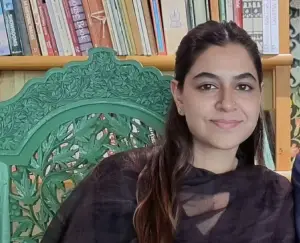
Nasheem Ashraf came to translation through another route. A postgraduate from Ashoka University and a fresher in translation, she began working on Kashmiri literature while researching women’s narratives.
Her research exposed a gap in Kashmir’s historical record: the scarcity of women’s voices in formal archives.
“The narratives of women in our official history, in our official, what we call archives, there are very few of them.”
She does not interpret that absence as evidence that women had little to say. Rather, much of their knowledge survived orally because women historically had limited access to publishing and other public spaces.
“Women have said very important things throughout history. They have spoken about these things long ago, when we did not have a name for it.”
Lal Ded, she argues, is often reduced to a passive image of a mystic woman, obscuring the political and intellectual force of her work. “If people actually knew what Lal Ded wrote about and believed in, they would not associate that docile character with her.”
Habba Khatoon has similarly been reduced, in Ashraf’s view, to romance and longing.
“We have relegated women and their work to certain genres. It is either romance, or it is mysticism. But I think what they did is very political,” she said. “They speak about the history of Kashmir.”
She believes this is part of a wider problem: Kashmir’s history has often been interpreted through a male lens.
“The history we have officially seen of Kashmir, we only know it from a male gaze, from a male lens.”
Recovering Zeba
Ashraf’s translation work brought her to Zeba Zeenat, a Kashmiri woman poet she believes deserves much greater attention.
“Nobody knows about her,” Ashraf said. “And look at the kind of work she’s done.”
Zeba Zeenat had no formal education but produced poetry of considerable depth. Finding her work was itself an exercise in recovery. Ashraf had to locate a locally published copy through contacts because very little secondary scholarship existed around the poet.
“I think we should hold on to” that book, she said, despite typographical errors and other limitations.
The experience reinforced an important lesson: translation can itself become an act of preservation.
For writers whose work has limited circulation, translation creates another textual record and another route into scholarship. Ashraf’s own relationship with Kashmiri makes that mission personal.
Finding Kashmiri
Born in 1997 and raised in Srinagar, Ashraf did not grow up speaking Kashmiri fluently, even though the language was spoken at home.
“I did not grow up speaking in Kashmiri. I still don’t. It is something that I had to teach myself.”
Like Bhat, she remembers Kashmiri particularly through her grandmother.
At university, Professor Abir Bazaz told her: “The best thing that Kashmiris can do right now is that we go back to our language.”
At the time, she did not fully grasp the significance of the advice. Years later, while researching Kashmiri literature and women’s narratives, she did.
“As you grow older, as you read, as you absorb, I understood later what he was telling me that day.”
For Ashraf, returning to Kashmiri is not merely a cultural exercise. It is an act of reclaiming something that has been inherited but weakened through generations of linguistic displacement.
When she thinks of accessibility, her first thought is not the international reader. “I think when you say accessible, mere dimaag mein sabse pehle aata hai, making it accessible to ourselves, first and foremost, before anybody else.”
She believes many younger Kashmiris have inherited Kashmiri culturally without fully inhabiting it linguistically.
“We have to train ourselves to speak in Kashmiri, because we do not think in Kashmiri.”
For her, consciously choosing to speak the language becomes almost political.
“It is a conscious political choice which I have to make.”
Yet language survives in unexpected places. When she speaks to her niece and nephew in Kashmiri, expressions emerge that she does not consciously remember learning.
“Something that is really, really deep, that you cannot explain often in words, you always find that expression in your mother tongue.”
Loss And Gain
Ashraf accepts the central paradox of translation.
“Of course, a lot is lost in translation. But a lot is also gained in translation.”
Some Kashmiri expressions cannot be reproduced exactly in English. Poetry narrows the translator’s freedom further because meaning, rhythm, tone and musicality all have to be negotiated.
“In prose, I think you have a little more freedom. But in poetry, you get a little limited.”
Her work on Zeba Zeenat also required an understanding of the poet’s Sufi context. She consulted her mother, aunt and others familiar with the tradition.
“Even if you translate one line from someone… you should do whatever you can to do justice.”
But the impossibility of perfect equivalence does not make translation futile. Ashraf herself began reading Habba Khatoon in English for precisely that reason.
“When I started reading Habba Khatoon, I thought, let me just first read the English one, so that I understand Kashmiri. And then I will read Kashmiri, so I will understand it better.”
That is what she believes an anthology can provide: a gateway. “I think this is a gateway. This can encourage a lot of people.”
The translated anthology becomes an outline of Kashmiri literary history, a map showing chronology, genres and writers. “It is like a map. It can be a gateway. It allows a conversation.”
Its most important audience, however, may be Kashmiris who cannot comfortably read Kashmiri.
“The target audience is, of course, all Kashmiris. But I think it will be very important for people who are Kashmiri but are not accustomed to the language.”
For Ashraf, language is partly learned and partly inherited.
“I know that people can learn Kashmiri, but there is something that you inherit through your legacy, through generations.”
“You have something to call your own. Nothing can beat that.”
She sees signs of a wider return. Kashmiri students are pursuing research into the language and its literature at universities across India and abroad.
“We are going back to our culture. We are going back to our language.”
The Necessary Doubt
But not everyone is convinced that translation itself is the achievement.
An insider from Kashmir’s cultural industry, speaking on condition of anonymity, questions whether the enthusiasm surrounding translation sometimes mistakes publication for literary success.
“Even ChatGPT and other AI tools can translate now,” the person said. “Even these tools will tell you why translation is important. But the question is, do these translated works actually reach the English readers?”
The concern is not simply about readership.
“The question is whether all those translations were actually good,” the insider said. “Simply translating something into English does not mean that the translation has necessarily succeeded.”
Serious comparative criticism, the person argues, remains limited. A translation needs to be assessed against the original, rather than merely judged by how fluent its English sounds.
“The question is, the translation that has been done, is it faithful to the original? Who is going to discuss that?”
Institutional commissioning does not automatically resolve the question of quality.
“If someone gives you a thousand rupees and asks you to translate something into English, does your translating it automatically turn it into a masterpiece?” the insider asked. “It does not.”
Window or Door
Rumuz, one of the translators who worked on Drabu’s anthology, offers a more nuanced defence.
The question of who exactly constitutes the “target readership”, she argues, is itself complicated because English in Kashmir belongs to a particular educational and social ecosystem.
Translated works, she says, have already found readers among English-speaking Kashmiris as well as outside the region. “If not a door, translations do become a window into the spirit of Kashmiri literature.”
For her, translation is not simply about words. It is about “translating worlds”, not sentences but sensibilities. The translator must constantly negotiate between beauty and fidelity. “One is very lucky if it is both.”
Perfect equivalence may be impossible, she acknowledges, but refusing to translate would create a greater injustice.
“There is no complete justice in delivery but if the attempt is not done at all, that would truly be injustice.”
She points to scholars who have engaged with Kashmiri literature because translations made the texts accessible, including historians who have written about Lal Ded.
Translation, therefore, may not be the final destination. It can be the route by which readers, researchers and eventually other translators discover the original.
Institutional Route
There is also more formal machinery for translation. The Sahitya Akademi commissions translations across Indian languages, particularly works that have won its literary awards.
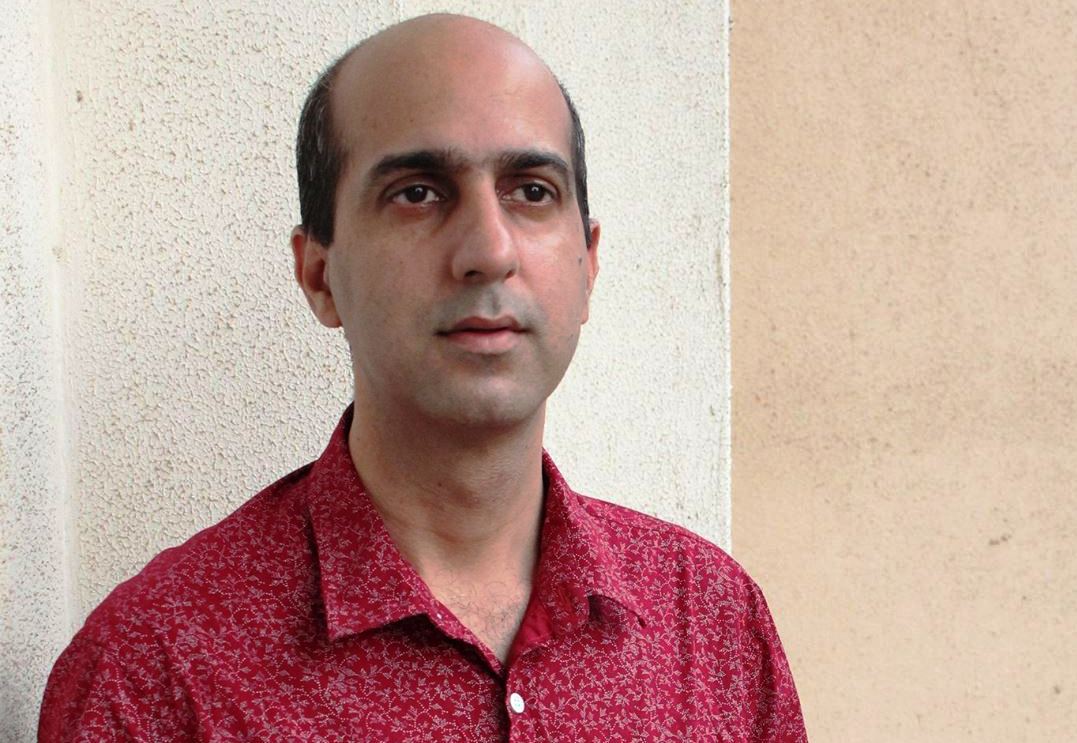
Shad Ramzan, its convener, said the process operates through language boards, each comprising ten members, including a convenor. The boards identify suitable works and translators.
“We give it to a genuine translator who knows both languages properly,” he said.
The process does not end with submission. A translator is generally given a year to complete a book, although extensions can be granted depending on its length. The completed translation is then sent to a reviewer proficient in both languages.
The reviewer identifies shortcomings and suggests corrections. “If there is any deficiency, we first inform the translator.”
The translator makes the changes and resubmits the work before another review. Only after the reviewers are satisfied is the manuscript sent to the Akademi press.
Ramzan said the institution has translated hundreds of books over five or six decades. During his four years with the Akademi, around 15 books have been taken up, including works translated from Nepali, Rajasthani, Kannada and Punjabi into Kashmiri.
“A language benefits when literature from another language comes into it,” he said.
The traffic also runs in the opposite direction.
The Akademi selects Kashmiri works for translation into other languages, generally beginning with books that have received the Sahitya Akademi Award. Ramzan said five such books were initially selected, with another five now being taken up, including novels and poetry.
Translators can also receive awards and recognition through the institution.
What Travels
The argument surrounding Kashmiri translation ultimately goes beyond whether a particular poem is rendered perfectly or whether an anthology reaches a particular readership.
It is about what happens to a literary culture when fewer people can read its oldest texts, when younger writers increasingly choose other languages, when women’s voices survive largely outside formal archives, and when even native speakers struggle with the written language.
And for the sceptics, translation must still answer a harder question: once the words cross the linguistic border, who is reading them, and are they good enough to make the journey matter?
Perhaps that is the real test.
A translation succeeds not simply when Kashmiri becomes English, but when the journey makes someone want to return to Kashmiri.