Seemingly, Kashmir is rewriting its coldwater fisheries story, from subsistence catch to a technology-driven, export-ready industry, reports Mir Rameez Raja
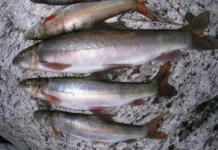
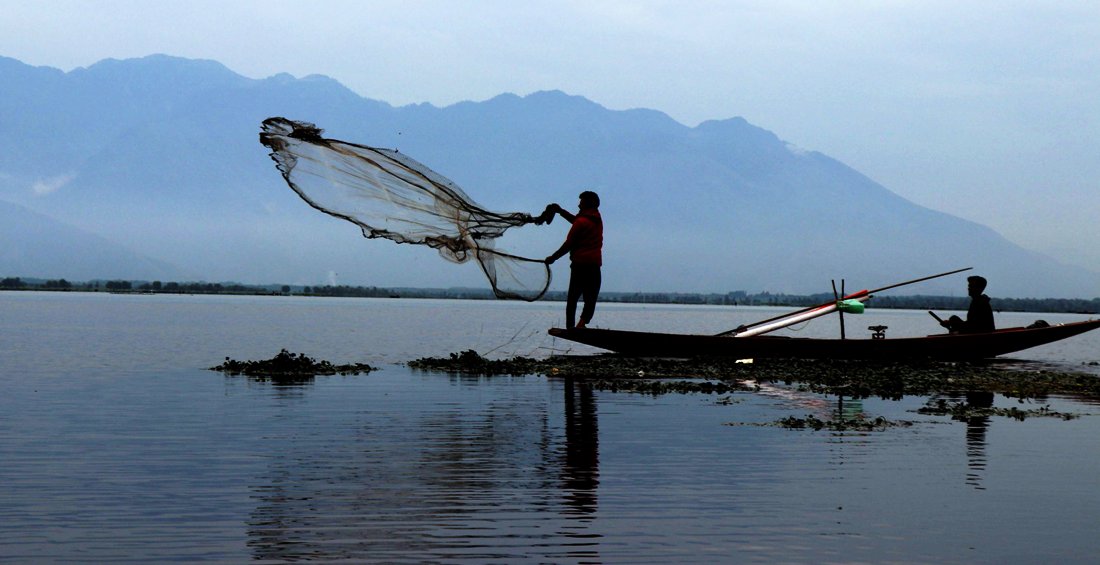
Kashmir has always been trout country. The British brought Rainbow Trout here more than a century ago, and the fish took to the cold, clear streams of the Himalayas as if it had always belonged. For generations, fishing in these waters was a way of life, nets cast at dawn on Wular Lake, lines dropped into the Lidder and the Sindh, a quiet economy woven into the rhythm of the mountains.
That quiet economy is now being dramatically amplified. The fisheries sector is in the middle of its most significant transformation in decades, driven by central funding, new technology, private enterprise, and a policy push from the highest levels of government.
Whether or not the fish production has fallen is open to debate. Official data suggests that the total fish production has climbed from 20,039 metric tonnes in 2016-17 to 29,400 metric tonnes in 2024-25. Economic Survey 2026 suggests the highest fish production of 29900 tons was recorded in 2022-23, which fell to 28000 tons in 2023-24 and then improved to 29400 tons in 2024-25. By November 2025, the Survey put the number at 20680 tons for 2025-26.
The compound annual growth rate of the sector has jumped from 1.38 per cent before the Pradhan Mantri Matsya Sampada Yojana (PMMSY) was launched, to 6.60 per cent by 2024-25. Jammu and Kashmir has been declared the best-performing union territory in fisheries for 2023-24.
Now, the question is whether the infrastructure, the institutions, and the ecology can keep pace, and if at all, the benefits are reaching the fishers who have worked these waters all their lives.
The Trout Story
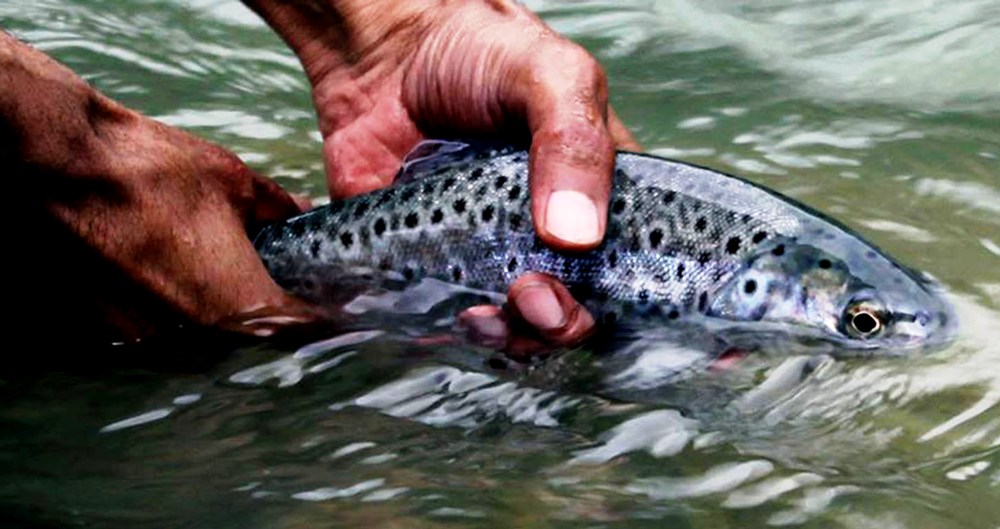
Of all the metrics coming out of Jammu and Kashmir’s fisheries sector, the trout numbers are the most arresting. From 302 metric tonnes in 2016-17, trout production has reached 2,650 metric tonnes in 2024-25, almost a nine-fold increase in eight years. This growth story, however, is too small. The Economic Survey 2026 explains that in 2024-25, of the entire fish production (29399.8 metric tonnes), carp constituted 45.04 per cent, and trout by 9.01 per cent, leaving the rest of 45.93 per cent to other fish.
Despite this, the trout seed production has reached 154 lakh ova annually. The department now exports ova to Tamil Nadu, Ladakh, Uttarakhand, Sikkim, Arunachal Pradesh, and Nagaland.
This, officials assert, was not an accident. It was driven by a sustained push to build hatchery infrastructure, expand private sector participation, and introduce modern farming systems. By the end of 2024-25, over 2,100 trout production units were operating in the private sector; five government trout hatcheries had been established, along with ten private ones. Forty-six Recirculatory Aquaculture Systems (RAS), which reuse up to 98 per cent of water, enabling year-round production, have been commissioned. Two large government feed mills and eight private mini feed mills were in operation.
The Private Sector
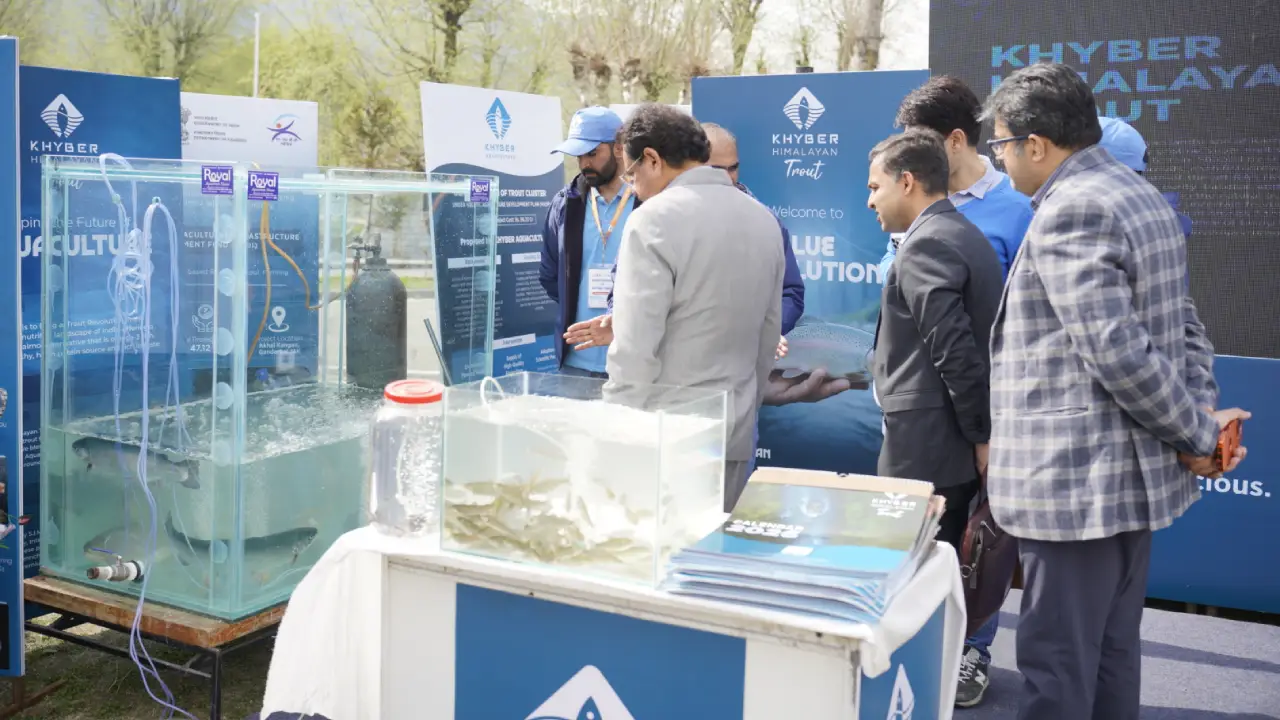
Among the private players, K2 Khyber Aquaculture has emerged as the most ambitious. At the March 2026 National Conference on Cold Water Fisheries, the company presented a Rs 56.33 cr trout cluster initiative under the Holistic Agriculture Development Programme (HADP), designed to integrate production, hatcheries, processing, and supply chains while supporting more than 150 local farmers.
Its flagship project, a Rs 47.12 cr Recirculatory Aquaculture System facility being built at Akhal in Kangan, is designed to produce about 1,500 metric tonnes of trout annually in phase one. The facility is projected to generate roughly 300 direct jobs and over 3,000 indirect employment opportunities. The company also highlighted hatchery infrastructure capable of producing about 20 million fingerlings annually, an Individual Quick Freezing unit, oxygenated transport trucks, and a microbial testing laboratory.
This kind of integrated private investment, bringing capital, technology, and market linkages together, is precisely what the sector needs if it is to move beyond government-supported subsistence farming toward commercially scaled, export-oriented aquaculture.
There are small initiatives around. Officials said of 3050 fish producing units across Jammu and Kashmir, 2950 are in the private sector, and only 67 are government-owned. Anantnag tops the list with Ganderbal playing the second fiddle, as Baramulla is a close third.
The Central Push
The financial architecture underpinning this transformation is substantial. Over the five years from 2020-21 to 2024-25, Jammu and Kashmir received Rs 118.5 cr from the central government under PMMSY.
Additionally, under HADP, Jammu and Kashmir’s own Rs 2,900 cr comprehensive agricultural development programme, fisheries have received significant support. The combined PMMSY and HADP framework has enabled the creation of a large volume of new infrastructure across the sector.
The district-level picture reveals important patterns. In 2024-25, the government spent Rs 42.78 cr, and it generated Rs 10.28 cr in revenue. Anantnag leads both in allocation and revenue generation, driven by established trout farming infrastructure and the presence of the Kokernag hatchery, the same location chosen for the new Rs 100 crore Integrated Aquaculture Park announced by Union Fisheries Minister Rajiv Ranjan Singh at the March conference.
Ganderbal stands out for efficiency: nearly complete utilisation of its relatively modest allocation, and a comparatively high revenue return. This reflects both the district’s cold-water resource base and its emerging role as a hub for RAS-based farming. Srinagar and Bandipora are significant contributors from the Kashmir division.
The Cold Chain Gap
The government has been candid about a persistent weakness: post-harvest infrastructure. Cold storage, refrigerated transport, and value-addition capacity lag behind the growth in production. Fish that cannot be efficiently stored and moved lose value fast, and in a mountainous region with remote farms and difficult roads, this is a structural challenge.
The response has been methodical. Under PMMSY, 30 Live Fish Vending Centres, 7 Fish Kiosks, 10 Fish Value Added Enterprises, 5 refrigerated vehicles, 106 three-wheelers with ice boxes, and 30 motorcycles with ice boxes were created in the first phase. Under HADP, a further 6 refrigerated vehicles and 4 cold storage plants were added.
The extended phase of PMMSY has approved additional infrastructure: 30 more Live Fish Vending Centres, 54 Fish Kiosks, 7 Fish Value Added Enterprises, 12 refrigerated vehicles, and 91 three-wheelers. These are at various stages of implementation. Khyber Aquaculture has added a private layer with oxygenated transport trucks and its IQF unit. But the gap between production growth and cold chain capacity remains something that officials acknowledge will take sustained investment to close.
The Welfare Question
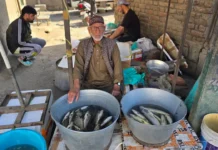
Behind the production statistics are people, around 5,200 registered fishermen on Wular Lake alone, 1,282 fishermen in Sopore constituency alone, and tens of thousands of small farmers and traditional fishers across the 10 districts. The PMMSY framework has a specific social security component: group accidental insurance, livelihood support, and nutritional assistance.
The number of fishers receiving livelihood and nutritional support under PMMSY has grown sharply, from 13,266 in 2021-22 to 25,418 in 2024-25. Employment through the fisheries value chain, including infrastructure creation and scheme-linked activities, has been extended to over 5,000 families.
However, a notable gap emerged in the Rajya Sabha earlier this year: Jammu and Kashmir does not appear in the list of states receiving the national fisheries accident insurance rollout that has disbursed Rs 54 crore to over one crore fishers across the country.
Ecology and Enforcement
The cold, oxygenated rivers and streams that make Jammu and Kashmir ideal for trout are also vulnerable. Illegal riverbed mining, unregulated fishing, chemical use, and industrial discharge all threaten aquatic habitats. The department has registered over 1,800 cases under the Fisheries Act in the last two years, a number that reflects both the scale of the problem and the seriousness of enforcement.
Anti-poaching teams operate in all districts. District-level anti-poaching committees have been notified. Surveillance is intensified during spawning seasons. The department coordinates with district administrations, police, and the Geology and Mining Department for joint enforcement.
On the conservation side, an initiative that attracted notice last year was the successful import and breeding of genetically improved Brown Trout germplasm from Denmark. Twenty thousand improved Brown Trout fingerlings were released into the upper reaches of the Sukhnag, Doodganga, and Shaliganga streams in Budgam. The Brown Trout, regarded as the angler’s fish of choice, is also central to Jammu and Kashmir’s ambitions in eco-tourism and recreational fishing, both of which are now managed through online angling registration systems.
On seed quality more broadly, Jammu and Kashmir imported 13.40 lakh genetically improved eyed ova of both Rainbow Trout and Brown Trout from Denmark during 2024-25. The Rainbow Trout seed is being developed into superior broodstock to achieve long-term self-reliance in high-quality seed production.
What Next?
The official ambition is bold: double fish production through modernisation of hatcheries, RAS and Bio-floc technology at scale, improved post-harvest management, and export orientation. The 2025-26 target is over 31,000 tonnes of total fish and over 2,900 tonnes of trout. A National Vision 2030 plan aims to double trout and mahaseer production across the Himalayan states.
Three structural developments in early 2026 signal that this is more than rhetoric. First, the Rs 111.66 cr central infusion. Second, the announcement of the Rs 100 crore Integrated Aquaculture Park at Kokernag, which will house broodstock management, hatcheries, processing, and marketing infrastructure under one roof. Third, the Khyber Aquaculture RAS facility in Ganderbal, which, if it delivers its stated 1,500 tonne annual output, would alone represent a meaningful addition to the current trout production base.
The institutional groundwork is also being laid. There are now 26 registered Fisheries Cooperative Societies across Jammu and Kashmir. One Fish Farmer Producer Organisation, Glacial Trout Farmer Producer Company Limited in Anantnag, is registered with the Ministry of Corporate Affairs. A cooperative in Kulgam has been developed as a model for replication. The National Fisheries Development Board has sanctioned Rs 252 lakh under its Margdarshika initiative to support these societies.

The 88 training programmes conducted in 2025-26 alone under the ATMA scheme, reaching 1,056 farmers, give a sense of the grassroots extension effort underway. A scientific study with SKUAST-Kashmir on ichthyofaunal biodiversity and catch-per-unit effort is building the knowledge base. A livelihood study by IIM is mapping further economic engagement opportunities.
What is clear is that the sector is no longer drifting. It has a direction, money behind it, and institutional attention from Delhi and Srinagar alike. The fishers of Wular, the trout farmers of Anantnag, the RAS entrepreneurs of Ganderbal, they are all part of a transformation that, if it holds course, could make this region something genuinely significant in India’s aquaculture map.
The waters are rising. The question is whether the boats are ready.