In 1830, Lhasa, a Kashmiri trader’s battered notebooks became evidence of a clandestine war waged not with muskets but with ink and inkpots, mapping mountain passes, logging troop strength, and charting the fragile borderlands between empire and exile. Ahmad Ali’s fall from respected merchant to accused spy would redraw the rules of Himalayan commerce and ignite a new age of shadowy surveyors under Qing watchful eyes, Muhammad Nadeem writes

On a drenching August night in 1830, the lamps of Lhasa guttered under an unrelenting monsoon. In the murk of a Tibetan jail cell, Ahmad Ali, once a respected Kashmiri merchant, pressed a silver-tipped reed against the ragged paper. Outside, the clang of distant gongs and the faint chant of monks at the Jokhang Temple mingled with the drip of water through the cracks in the stone. Each drop jolted him back to the reality that had brought him here: a lifetime spent on the razor’s edge between commerce and espionage, loyalty and betrayal.
By dawn, Ali’s petition to Brian Houghton Hodgson, the Acting British Resident in Kathmandu, would begin its slow journey northward. Describing himself as “a dependent and servant” of the East India Company, his petition sought rescue from Qing prison under charges of spying for the British, a spy whose greatest sin, he protested, was a few notebooks crammed with innocuous trade observations. But as the Qing authorities would soon discover, those notebooks contained not only caravan routes and price lists, but also fragile maps of border passes, troop dispositions, and glimpses of the Chinese presence in Lhasa. To them, Ali was no mere merchant; he was a threat.
Traders and Translators
Ahmad Ali was born around 1790 into a Kashmiri Muslim merchant family whose origins extended back at least two centuries. His ancestors had first established trading depots in Patna, Dhaka, Kathmandu, and far-flung Lhasa and Xining, carrying goods, otter skins, silk, spices, and tea across Himalayan passes that no map fully captured. Writing half a century later, scholar Matthew W Mosca would observe that Kashmiri merchants “were perhaps the most geographically dispersed foreign trading community within the Qing Empire, active throughout Tibet, Qinghai, and Xinjiang”.

In Kashmir itself, long before Ahmad Ali’s birth, Muslim merchants had been intermediaries between Mughal India and the Tibetan plateau. They spoke Persian, the region’s lingua franca, and often learned local dialects. Some married Tibetan women, their descendants, the Argons of Ladakh, would trace lineage to Kashmiri forebears. Kashmiris served as coin-minters in Ladakh and as court translators for the Dalai Lama’s emissaries. By the early 18th century, Tibetan art even bore Kashmiri influence in its intricate woodwork and gilding.
Education in Persian law and commerce prepared Ahmad Ali to take his place among these trans-Himalayan bankers. But it was Patna, on the Ganges, that became his base. There, in the bustling bazaar, he managed an agency that traded otter skins from Bengal for Tibetan gold. By his twenties, he spoke Urdu and Persian with ease and had cultivated a network of agents up the mountains into Nepal and Lhasa.
Moorcroft’s Offer
The Napoleonic Wars and the East India Company’s growing appetite for intelligence had thrust Kashmiris like Ali into the crosshairs of the empire. In 1814, William Moorcroft, a veterinary surgeon turned clandestine explorer, was searching for reliable informants on the war with Nepal. Moorcroft needed detailed knowledge of passes and troop dispositions; Ali’s family house had long supplied goods and news across the region.
“This man balances between the two interests. He fears for his property in Nepaul, and he fears losing his connection there, should the British arms not be successful.” Moorcroft sent a memorandum to his superior in Calcutta on September 14, 1814. “ Whether it would be worthwhile to secure such a man as this, by the promise of his property being respected, or by anything else, you are a better judge than myself.”
Moorcroft’s cautious praise, however, was undercut by suspicion: he noted Ali’s “countenance, gesture … a struggle between hope and fear.” But Ali was persuasive. He claimed his firm was “domiciliated” in Lhasa, respected by both the Dalai Lama and Qing Ambans; he had free access to the grand durbar, where he received tea from the pontiff’s hand. From this perch, he told Moorcroft, he had learned that the Raja of Nepal had asked the Qing Emperor for troops and treasure “to wage war against the Feringees”, the British. Moorcroft later obtained a copy of Ali’s Persian letter, in which the emperor’s reply, promising assistance but refusing to allow Nepali coinage to circulate, sent stirrings of alarm through Calcutta.
For his intelligence, Ali demanded remuneration commensurate with risk. He had already lost a shipment of perishable furs, he argued, and his agents in Lhasa faced suspicion. He wanted his debts covered, perhaps a steady stipend; he hinted at honours and rank. Letters from Ali to Moorcroft survive in the India Office Records, their formulas deferential: “Your slave by birth … in humble duty.” But beneath the obsequious tone lay a merchant’s calculation: his information was valuable, and he would not part with it for free.
Despite Moorcroft’s enthusiasm, the Company never formalised the arrangement. Moorcroft himself lost favour and died in Bukhara in 1825, leaving Ali’s undertakings stranded between promise and reality.
Jesuit Convoys and Kashmiri Interpreter
In the early eighteenth century, two Italian Jesuit missionaries, Ippolito Desideri and Manuel Freyre, traversed Ladakh en route to Lhasa. Alongside their entourage of pack animals, they relied on Kashmiri merchants not only as caravan bankers but as indispensable interpreters. These Kashmiris escorted the Jesuits through arid high passes and bustling bazaars alike, negotiating with Ladakhi authorities on their behalf and facilitating introductions at the Dalai Lama’s court. Their role as “cultural middlemen” presaged Ahmad Ali’s blend of mercantile and diplomatic functions.

Long before Moorcroft sought Ali’s help, the East India Company dispatched George Bogle to Lhasa in 1774. Accompanied by surgeon Alexander Hamilton and a mysterious Tibetan agent, Purangir Gosain, Bogle became the first Briton to dine at the Dalai Lama’s table. Rumours of Gosain’s dual loyalties, some claiming he was a Kashmiri “pilgrim-spy”, hint at the precedent for using local intermediaries. Bogle himself died of cholera soon afterwards, but not before fathering two daughters by a Tibetan bride, a subtle reminder that spies and merchants often wove themselves into the very fabric of the societies they are deployed to.
From as early as the tenth century, Kashmiri craftsmen were prized for their intricate woodcarving and gilt-metal work, imported to embellish Tibetan monasteries. These artisans settled in Lhasa, intermarrying with natives and leaving a lasting imprint on thangka frames and assembly halls. The term Kachee, originally denoting Kashmir, came to be used for all Muslim artisans in Tibet, underlining how Kashmiri technique and aesthetic sensibility became inseparable from Tibetan religious art.
Entrepreneurship and Misfortune
By 1820, Ali’s commercial house had suffered reverses. His principal agent, Abdullah, returned to India; his brother Ashraf struggled to keep the Lhasa outpost afloat. In 1827, Ali himself journeyed to Lhasa to settle accounts. A raw outsider, he spoke no Tibetan; he entrusted day-to-day operations to Abdullah and, later, to a Tibetan-born Kashmiri named Fazlullah Fakroo.
But partnerships fray. Ashraf and Abdullah accused Ali of embezzlement; Ali countered that they had bribed local judges. A Tibetan minister (bka’blon), called on to adjudicate, ordered a forensic review. One local Kashmiri leader testified that Ali’s “Muslim custom” required a fraud-proof written settlement before funds changed hands, which Ali claimed was never honoured. Ashraf, facing ruin, brought a debt suit; Ali countersued. When accounts were audited, Ali was found liable for 10,000 “silver coins,” while Abdullah was owed nearly 3,000 taels of silver. His shop’s merchandise was seized. Bankrupt and friendless, Ali abandoned commerce and sought asylum in Lhasa’s small Kashmiri Mosque, surviving on charity.
The Turning Point
The Qing-appointed Amban in Lhasa supervised an intelligence network that monitored three privileged merchant groups, Newaris, Andijanis, and Kashmiris, on the assumption that all others (Europeans, Russians) posed a threat. These Ambans maintained lists of foreign headmen, levied monthly declarations of no “unauthorised correspondence,” and staffed checkpoints at Gyantse and Dingri. Though Kashmiris were initially deemed “neutral,” the very existence of these regulations set the stage for Ali’s eventual denunciation when his proprietary notebooks surfaced.
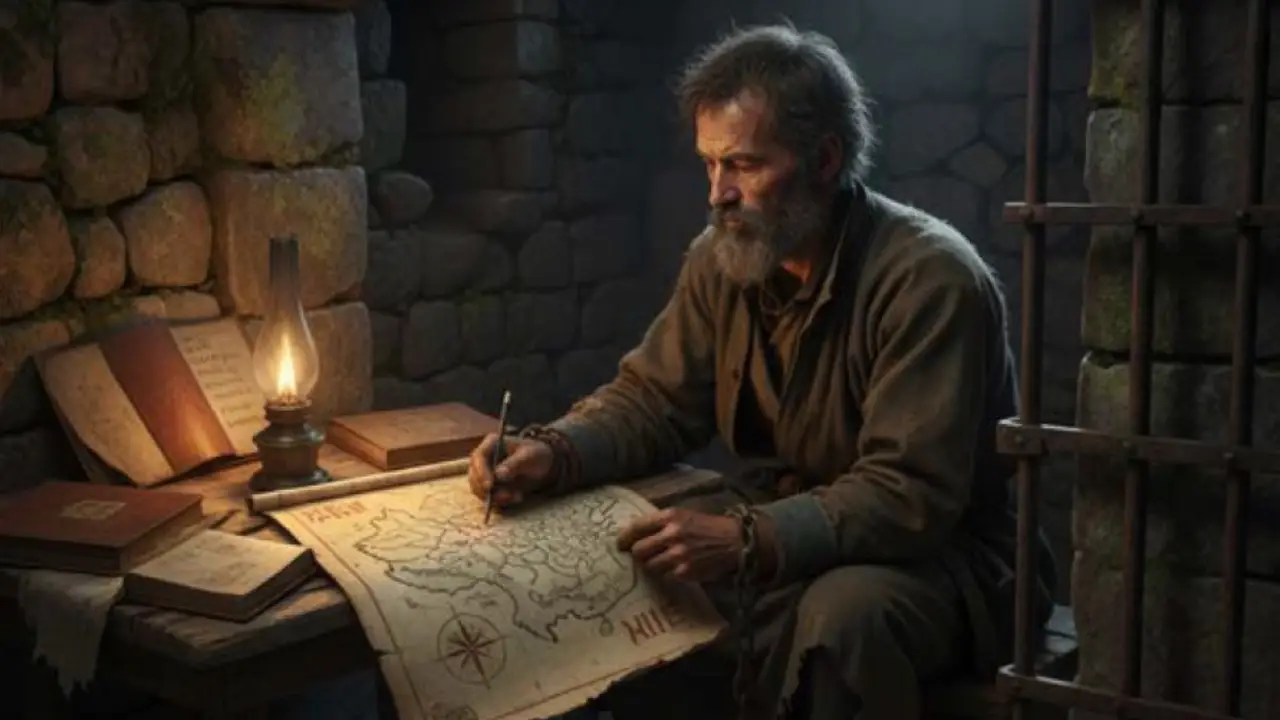
Ali may have believed that his notebooks, sketches of caravan routes, notes on Qing troop dispositions, and questions posed to his agents were innocuous. He treated them, he later said, as material for a trade manual, “according to the customs of my homeland,” for Kashmiri merchants to use in future journeys. But his erstwhile partner Fazlullah saw a weapon in those notes. Confronted by a Qing garrison officer, Fazlullah “fomented quarrels” (as his brother later told Hodgson) and got him committed to prison.” Pretexts followed: Fazlullah deposed that Ali had asked “too many questions” about the core territories (neidi) and shown “notes taken of suspicious particulars.”
On August 21, 1830, Ali was arrested. Qing officers confiscated three notebooks, two in Persian and one in English. They assembled a panel of translators, Chinese Muslims from Sichuan and Qinghai, local Tibetan interpreters, and Kashmiri merchants, to pore over every word. For two months, they worked “day and night” to decode lines describing passes, altitudes, troop numbers, the Qing Finance Department’s accounting procedures, and the routes linking Lhasa, Sichuan, and Gansu. Even a British questionnaire, given years earlier to another Kashmiri merchant bound for Tibet, turned up among the papers. Only the English passages remained undeciphered.
Ali endured gruelling interrogations. He acknowledged gathering information for Moorcroft, whom he called Eliyamu Mo’ergere, but insisted the project had died with Moorcroft’s death in 1825. He denied transmitting anything to the British, claiming he had never left a single iota of intelligence “across the Himalayas to any power inimical to the British.” He swore he had no secret agents, no covert couriers, only notebooks destined for print in some future trade guide. Ambans and commissariat officials found this implausible: why would Moorcroft give him a blank notebook if he planned only to write a civilian book? Had not Habibullah’s unfinished questionnaire come from the British Resident in Kathmandu? The evidence, they concluded, pointed to espionage.
Yet the Qing did not execute him, nor did they exact severe corporal punishment. To do so might alarm all Kashmiri traders, the very intermediaries through whom Tibetan markets remained open. Instead, in counsel with the Daoguang emperor, they resolved to deport Ali and his immediate circle, his brothers Ashraf and Abdullah, back to India, while expelling them permanently from Tibet. A formal amban missive would describe Ali’s “confession” and strand of evidence, but invoke imperial clemency. Ali himself was confined to a remote temple under guard, kept alive but broken.
Diplomatic Manoeuvres
In Kathmandu, Brian Hodgson waited in obscurity. When Ali’s petition reached him in early 1831, Hodgson discovered that his predecessor’s careless letter of 1816, denying Ali had been a British agent, had been quietly filed away. Equivalent denials now seemed the only safe path. Autumn rains prevented immediate action, but word arrived in April that the Qing authorities had ordered Ali’s release. He would be escorted across the Nepalese border and placed under British care. Hodgson dutifully sent an elephant and porters to meet him at the Arun River.
During a terse interview in June 1831, Ali admitted that Moorcroft was indeed dead and that he had never received an official commission. The amban’s letter, already translated into Persian, was delivered to Hodgson: it described Qing grievances but had the ring of a diplomatic fiction intended to preserve Sino-British calm. Hodgson’s reply, sent via Sikkim, disavowed any knowledge of Ali’s “sanad,” insisted that his notes were “publicly known” through Chinese gazettes, and chided the Qing for “foolish anxieties.” There is no record that this rejoinder ever reached Beijing. By mid-1831, Ahmad Ali “vanished from the annals” of the Himalayas.
When Hodgson sought Nepal’s powerful Prime Minister, Bhim Sen Thapa, to press the Qing for Ali’s release, he was told the spy had already slipped through Lhasa’s gates. Thapa’s intervention, relayed by Newari and Kashmiri merchants, underscores how Himalayan politics pivoted on personal relationships, not just formal diplomacy. That Ali emerged unscathed, despite Qing doubts, suggests Thapa leveraged his rapport with both Nepalese and Tibetan courts to ensure the merchant’s safe passage southward.
Upon Ali’s return, his confiscated silks and ceremonial robes were evaluated by Alexander (Sándor) Csoma de Kőrös, soon to compile the first Tibetan-English dictionary, and accessioned into the Asiatic Society Museum in Calcutta. Meanwhile, Hodgson, lauded as the “father of Himalayan studies,” not only championed vernacular education across India but is said to have married a Kashmiri woman during his Kathmandu tenure. Charles Allen’s biography, The Prisoner of Kathmandu, credits him with building schools, translating folk songs, and weaving his own life into the cultural tapestry of the region that once imprisoned Ali.
Aftermath
What became of Ali after his delivery to Kathmandu remains obscure. Some say he returned to Patna, his health broken, his reputation ruined. His family’s house, once on the verge of monopoly, never again occupied the lofty position it once held. Merchants who had once toasted him at the durbar now whispered of his downfall. The notebooks, assessed by Alexander Csoma de Kőrös, the Hungarian scholar living in Calcutta who had compiled the first Tibetan-English dictionary, were placed in the Asiatic Society’s Museum. Their pages, once charged with promise, became curiosities in a colonial archive.
Yet Ali’s case cast a long shadow. For the Qing, it inaugurated a new era of surveillance over Kashmiri merchants: every scrap of correspondence would pass through amban inspectors; passports and population registers would track movements; frontier posts at Gyantse and Dingri would stop every Kashmiri caravan and rifle their goods and letters. The formerly fluid network of traders was now a tightly monitored wire.
For the British, Ali’s fiasco prompted a shift in strategy. Overt recruitment of Kashmiri merchants was abandoned; instead, a new breed of “pundit” came to prominence, native surveyors dispatched undercover as pilgrims or pilgrims-cum-traders, mapping out the Himalayas with hidden sextants and coded signposts. The tragic figure of Ahmad Ali, the proud merchant who overreached, became a cautionary tale: in the great geopolitical game at the peak of the Great Games, only those who could vanish utterly in plain sight would survive.