In Jammu and Kashmir, the fort in the heart of the Poonch town is perhaps the only historic monument that embodies the architectural interventions from Muslims, Sikhs, Dogras and Europeans in the last 220 years, Syed Shadab Ali Gillani found during his recent visit to the region
At the centre of the town, the Poonch Fort, referred locally as Qila Poonch, overlooks almost everything that Poonch is all about. The last remnant of the erstwhile Poonch State, this immense structure, spread over an area of approximately 7,535 square metres, stands on a commanding knoll not merely as a relic of stone and mortar, but as a silent, enduring witness to the layered and often turbulent frontier history of Jammu and Kashmir.
Even in its current dilapidated state, the Fort’s sheer scale and the intricacy of its remaining architecture still powerfully invoke the grandeur of the not-so-distant rulers and the genius of the architects who fashioned it. In its golden age, it was the definitive symbol of regional authority and prestige. Now, its crumbling walls and decaying ramparts tell a compelling narrative of rise, conquest, fall, and the persistent struggle for preservation. It is a structure that, despite its deep wound,s refuses to be forgotten.
A Power Palimpsest
The Fort is not a single architectural monument, but a historical palimpsest, a layered manuscript where one era of construction overlays and subtly alters the work of a preceding one. Its unique, amalgamated architectural style, a fusion of Muslim, Sikh, Dogra, and even European influences, is a direct result of the successive dynasties that claimed and modified the structure over the course of three centuries. Unlike the contemporaries of their era, the masters of Poonch deliberately opted for add-ons rather than destroying the relic they had inherited or wrested from their predecessors. In Kashmir, the rule in earlier medieval Kashmir was to erase the identity of the past and create a new identity.
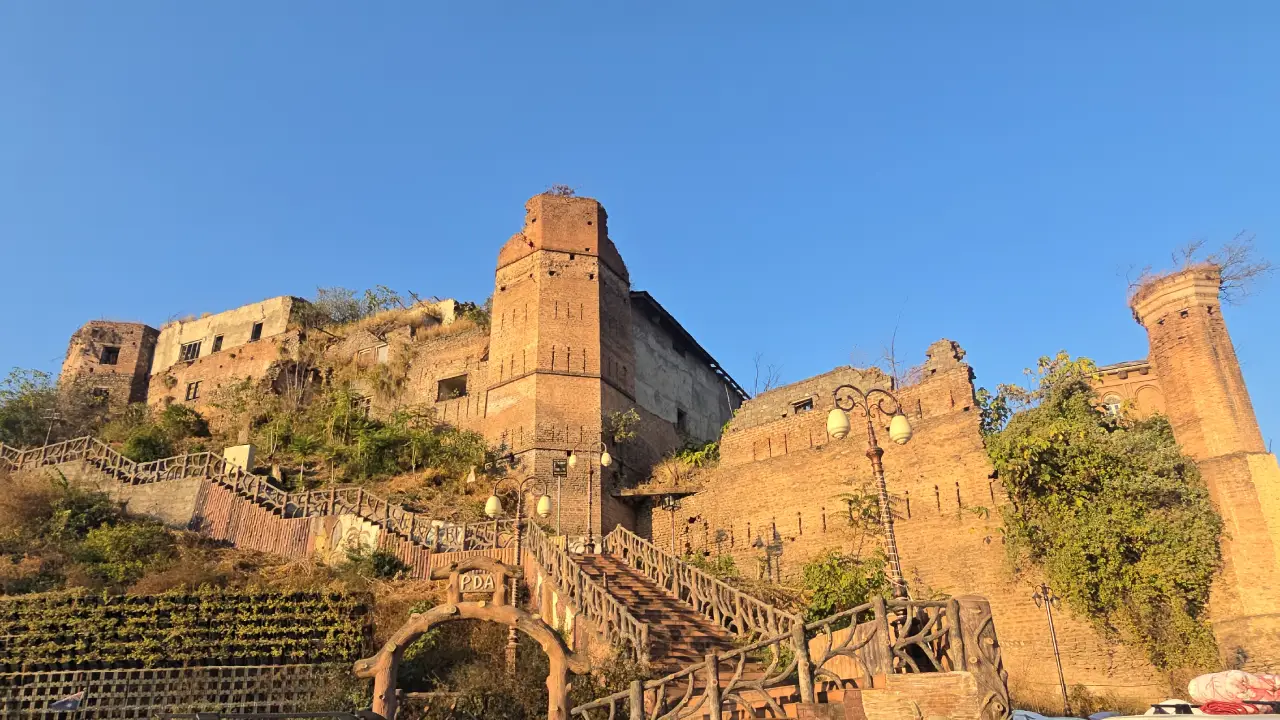
Its foundation was first laid in the early 18th century, a project initiated by the region’s Muslim rulers. Historical accounts suggest that Raja Abdul Razak Khan established the foundation, also cited as Abdur Razzaq Rathore, in 1713. An erstwhile freebooter, Khan controlled the state, expanded his territory during his nearly half-century rule, and completed the lower portion of the fort, which forms the resilient, indigenous core of the structure. He died without completing it. The Choudhary clan was established as the ruling elite by the Mughals in the sixteenth century.
It was then continued and completed by his son, Raja Rustam Khan, who saw the major phase of construction finished between 1760 and 1787. This early phase defines the base and much of the original layout, reflecting the traditional Muslim court aesthetic of the time, heavy stone, solid structure, built to endure.
In 1819, the Lahore Durbar founder, Maharaja Ranjit Singh, captured Poonch when he was on his way to the Kashmir invasion. He subsequently granted it as a jagir to the Dogra noble Dhyan Singh, elder brother of Gulab Singh. It was during this era that the second significant layer of architecture was etched onto the citadel. Respected Pir Panchal region historian and a resident, KD Maini, said that after Maharaja Ranjit Singh conquered Kashmir in 1819, his officers secured the region and its citadels. From approximately 35 years, up to 1850, the northern portion of the fort complex was constructed.
This section distinctly showcases the robust, martial architectural style favoured by the Sikhs, a clear visual break from the gentler curves of the initial Muslim construction. This addition cemented the fort’s role as a formidable defensive stronghold on the volatile Pir Panchal rim.
After Ranjit Singh’s death in 1839 and Dhyan’s brutal assassination in court intrigues in 1843, the region passed to Gulab Singh under the Treaty of Amritsar in 1846, which created the princely state of Jammu and Kashmir under British suzerainty. Poonch thereafter remained a subsidiary fief held by Dhyan Singh’s descendants.
The third and final major phase of construction belongs to the Dogra period. The regime initiated sweeping renovations that introduced an entirely new, almost jarring stylistic element.
From 1852 to 1947, the front portion of the fort complex was built. This specific renovation, driven by Dogra rulers like Raja Moti Singh, who renovated the fort between 1850 and 1892, hired European architects and engineers. The resulting frontage displays a unique and curious blend of local mountain strength and British-influenced colonial design, a stately, perhaps formal, face to a rugged, indigenous body. This fusion makes the Poonch Fort a rare and telling example of how far the imperial gaze extended, and how varied cultural currents converged in this remote military outpost. “The base of the fort was built by a Muslim, then another portion was built during Sikh rule, and the last portion was built by Dogras,” Maini said. “This is perhaps the only fort which preserves so many influences.”
Ruined Secretariat
For over 220 years, the Fort was far more than a defensive structure. It was the dynamic epicentre of the political and administrative life of a major region bordering Kashmir. Under the reign of Raja Baldev Singh, the Fort was formally designated as the Secretariat of the Jagir, the nerve centre from which the region was governed. While the official royal residence was shifted to the newer Moti Mahal, the Fort remained the seat of bureaucratic power, buzzing with the daily activities of court and government.
This tradition of active use continued well into the modern era. For much of the 20th century, the Fort continued its life as a functional space housing numerous government offices. By the fall of the last century, the Fort was home to almost 28 departments of the Jammu and Kashmir government. Then the earthquake happened, and part of the Fort collapsed under its own weight, and most of the offices were moved out.
However, the Muhfiz Khana, the revenue record room of the region, was retained. Electricity was cut off as part of the precautions, and entry was regulated. Now, only the Tehsildar office and a library are functional in the building, as the condition of the fort has deteriorated.
This continuous administrative occupation, while ensuring the structure was not entirely abandoned, often led to unsympathetic, ad-hoc repairs that further complicated its architectural stratigraphy (the study of rock layers) and masked its original genius.
The transition from a living monument to a threatened relic was sudden and brutal. The year 2005 delivered a devastating shock in the form of a massive earthquake that ripped through the region. This disaster severely damaged the ancient structure, pushing this historical monument, which locals affectionately nicknamed Pikaqula, to the very brink of ruin and utter destruction. The resulting damage was so profound that large sections of the building began to crumble, and tragically, many of the walls are still disintegrating slowly today.
Battle for Revival
The aftermath of the earthquake initiated a desperate, though often under-resourced, new chapter focused on conservation. Funds were intermittently allocated for repair, records show a restoration project in 2006-07, and a later, more ambitious plan in 2011-12, yet these earlier interventions proved fundamentally insufficient to permanently halt the structural decay.
The tragedy is further compounded by persistent encroachment: even now, illegal residents live under the unstable shadow of its decaying walls, posing a risk to both themselves and the priceless heritage they inhabit.
Yet, this citadel, so steeped in history, is not yielding its story easily. Recognising the Fort’s critical state and its immense value for regional identity and the vital tourism economy, the government of Jammu and Kashmir has recently mounted a significant, decisive push for its revival. The UT administration approved a fresh, comprehensive restoration, preservation, and maintenance program in mid-2024. Officials said the government allocated Rs 3.40 crore for façade restoration of the fort. Though one crore of funds were released, it was not immediately known if anything was done.
The restoration strategy is a multi-pronged effort: it involves detailed structural consolidation, careful removal of unauthorised encroachments to reclaim the monument’s historical precincts, meticulous restoration of vulnerable architectural elements, and the necessary development of basic visitor infrastructure. For administrators and local commentators alike, this investment is far more than a maintenance chore; it is an effort to revive Poonch’s cultural economy, anchor urban improvement, and proudly display its enduring identity.
Residents and conservationists repeatedly stress that the success of this monumental undertaking hinges on a meticulous, comprehensive approach that finally acknowledges all the factors contributing to the structure’s destruction: climate change, poor drainage, the relentless growth of wild vegetation, and, most crucially, decades of human negligence. The consensus is clear: preservation and immediate restoration are paramount to maintain the ancient and historical identity of Poonch.
The Fort, standing proud despite the accumulation of scars from three centuries of conflict and neglect, is a priceless heritage. As the substantial new funding arrives and the restoration teams begin their work, the challenge is clear: to ensure that this renewed investment leads to genuine, sensitive conservation that protects the monument’s complex historic fabric and guarantees that the magnificent Citadel of Time will continue to tell its remarkable, layered story for generations to come. Otherwise, as many residents fear, this priceless heritage may yet be erased, its reality limited only to the increasingly faded pages of history books.
Lost Forts
However, what is interesting in the case of Poonch is that the Qila Poonch is the only fort in the town that was built with an avowed objective of managing the Jagir. All other earlier, mostly lost to history, were built as part of Kashmir’s defence, as Poonch historically has remained the Valley’s outpost. Mani agrees that most of the battles that were fought over Kashmir were decided and contested outside Kashmir and mostly in Poonch.
In the local folklore, too many forts are being talked about. Though neither of them has survived, these forts are key to understanding the history of Kashmir better. Even though these medieval forts do not exist, they survive in narrative, history and folklore.
The Surankote
Surankote, now a bustling town in the Pir Panchal range, owes its very name to a fort that once dominated the landscape from a high mountain peak. Almost nothing of that fortress survives today. What stood as the Kote in 1036 AD has since collapsed into scattered stones on a windswept ridge overlooking the Suran River. Yet the site’s memory persists, embedded in the town’s name itself: Suran for the river, Kote for the fort that guarded it.
The vanished fort is more than a local legend; it is part of the subcontinent’s recorded historical geography. In the Rajatarangini, the chronicle names the settlement as Sawernik.
When MA Stein travelled through the region in 1892, he identified this Sawernik with present-day Surankote, placing it firmly within the domain of the Lohara rulers. The chronicle also records a significant episode from 1132 AD, when King Mallarjjuna of Loharkot was arrested upon reaching Sabarnika, believed to be Surankote. This moment in the narrative demonstrates the strategic value the location once held, positioned along routes that mattered to power and control nearly a thousand years ago.
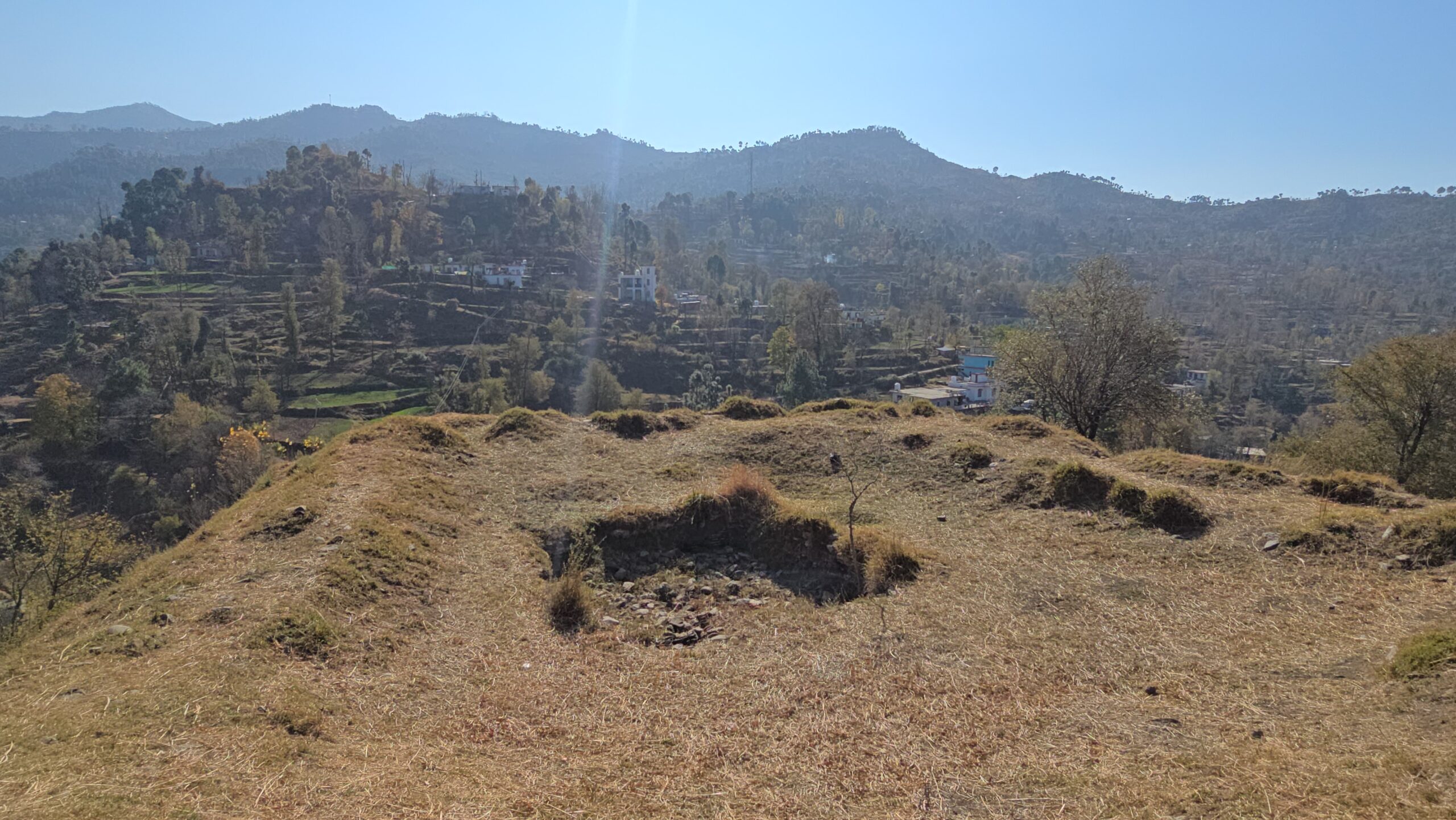
In contrast to the well-preserved fort in Poonch city, the Surankote Kote has almost entirely disappeared. The hilltop today is not an organised heritage site but an abandoned plateau of weathered stones.
Residents, who know of the fort only through oral tradition, express disappointment at the neglect. “We have heard about it, but right now, you will only see stones. The government did not pay any attention to it,” is the common refrain.
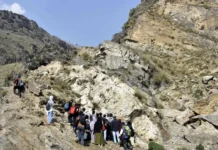
The ascent to the site itself tells a story of abandonment: there is no road, only a trekking path winding upward, marking the long years of institutional indifference.
What remains of the Kote is minimal, but its absence throws into sharper relief the long arc of Surankote’s history, from a strategic outpost in the Lohara period to a thriving town that has outlived the very fort that gave it a name.
The Loharkote
Not far away from Surankote is a major location, which is fundamental to Kashmir’s history. It is Loharkot, an early medieval hill fort in the Loran area, which occupies one of the most strategically important positions in the entire Pir Panchal range.
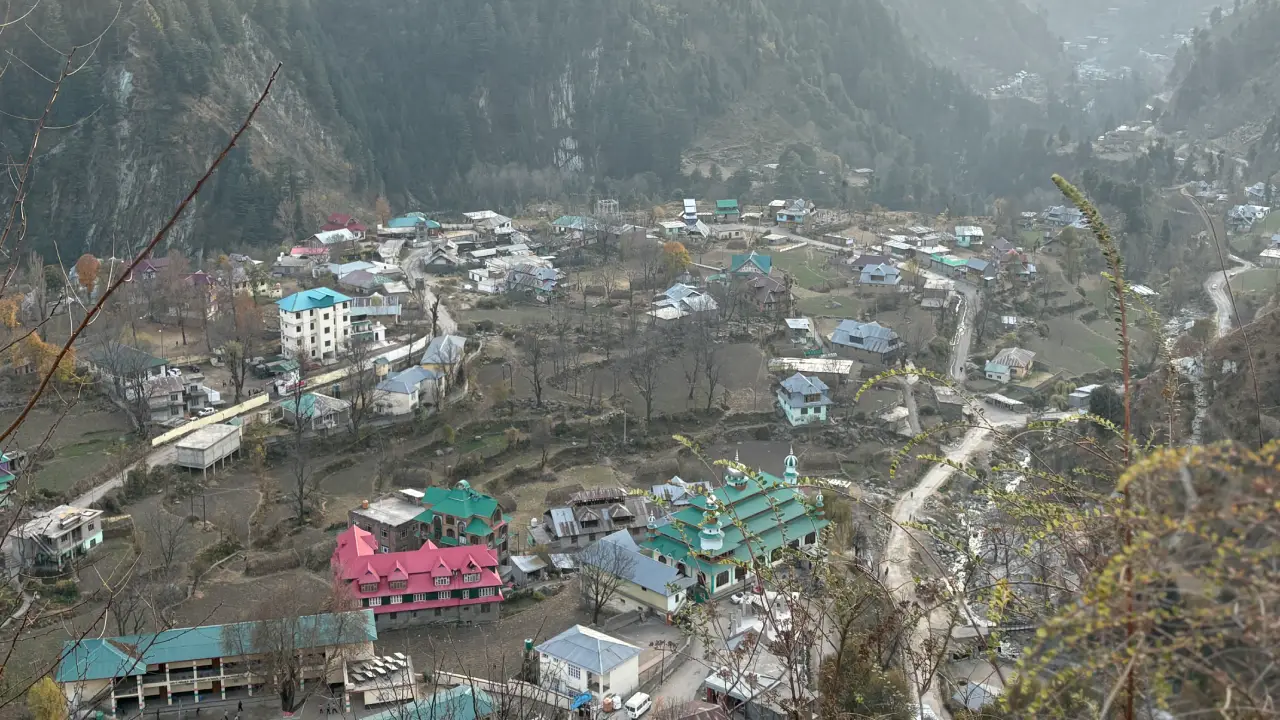
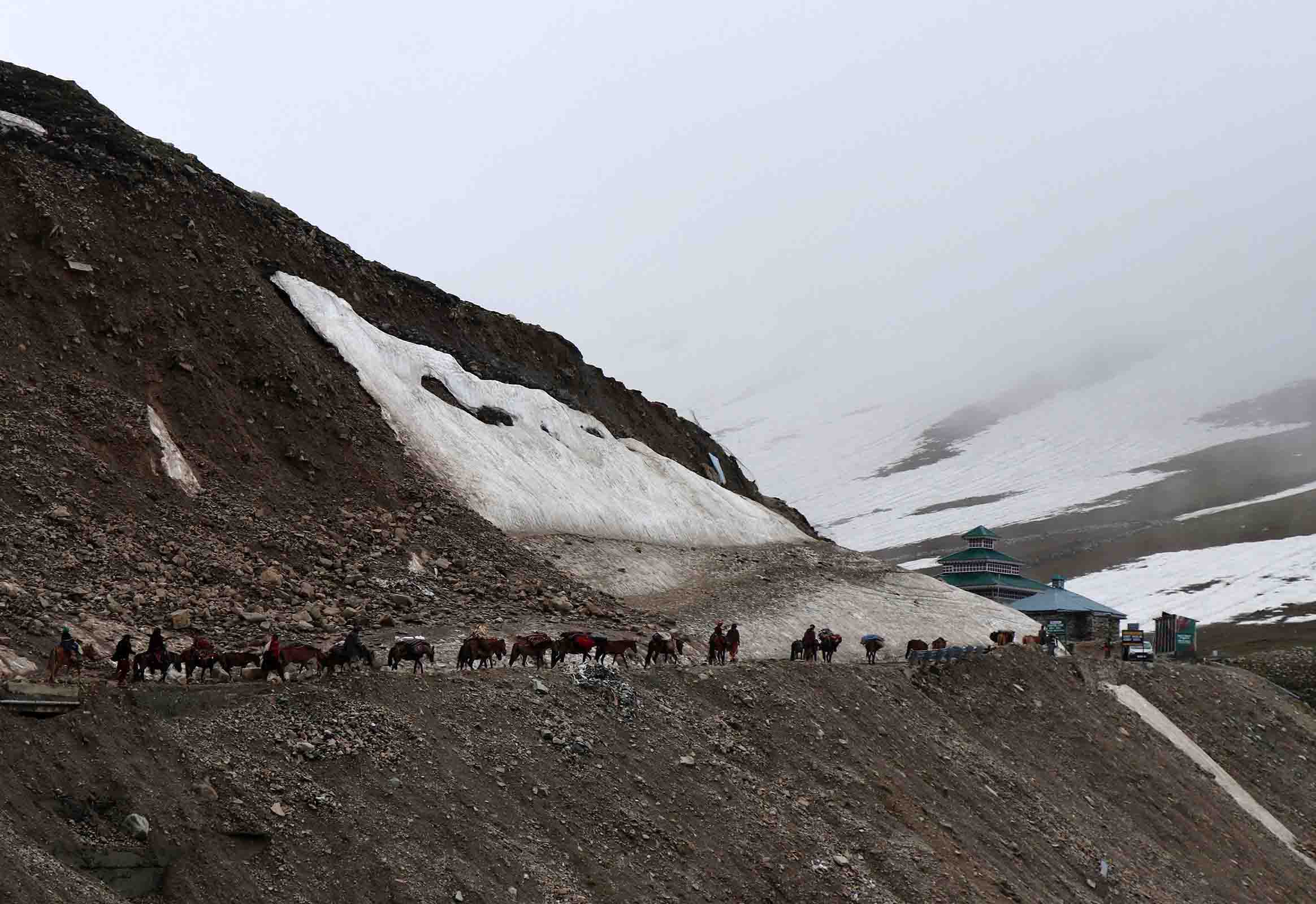
For centuries, this rugged corridor served as Kashmir’s southern shield, a narrow gateway through which armies, caravans, and emissaries from the plains of western Punjab would ascend toward the Valley. Long before roads and tunnels shaped the modern geography of the region, Loharkot stood as the principal chokepoint: a natural rampart and a man-made citadel that together formed Kashmir’s first and most formidable line of defence.
The fort is inseparable from the history of the Lohara dynasty, the ruling house that supplied kings to Kashmir in the 11th and 12th centuries. Medieval chronicles, most notably Kalhaṇa’s Rajatarangini, identify Loharkot as the dynasty’s original hill-seat, controlling the ancient passes into the Valley. It was here, on the southern slopes of the Pir Panjal, that the Loharas amassed power, secured the mountain approaches, and shaped the political currents that eventually carried several of their rulers to the throne of Kashmir.
Loharkot’s historical weight is most dramatically underscored by the events of 1015 AD, when Mahmud of Ghazni marched into the Pir Panjal with a large force, intent on conquering Kashmir. Loharkot was the fortress that blocked his ascent. For weeks, the Ghaznavid army attempted to overcome the defences, only to be worn down by fierce Kashmiri resistance and severe mountain weather.
Mahmud, undefeated elsewhere across the subcontinent, withdrew in frustration. The failed siege etched Loharkot into the military memory of the region as an impenetrable bottleneck, one of the few places that halted the advance of an empire-builder whose campaigns otherwise reshaped early medieval India.
The geography explains part of this outcome. The fort commanded the steep approaches, river valleys, and trade routes that linked the plains with the Valley interior. Though the earliest fortifications now survive only as traces and overgrown masonry, the terrain’s strategic value endured. Later fortresses in the surrounding region, including the imposing Poonch Fort, reflect the continuing importance of these highland defences, a relevance that extended well into the 20th century during the prolonged Siege of Poonch in 1947–48.
Historian K D Maini, a leading historian of the region, offers additional insights into Loharkot’s layered past. He describes the site, 31 km north of Poonch on the banks of the Dara Tosh Maidaan, as a decisive military node that once served as the sole passage into Kashmir.
Maini traces the origins of the Lohara house to a local chieftain and horse-trader, Raja Nar, who rebelled against the Kashmir monarchy and established his authority in 850 AD. His lineage culminated in the rise of Rani Didda, the formidable ruler who governed Kashmir from 980 to 1003 AD and laid the foundations for a dynasty that would rule the Valley for nearly two centuries.
Maini emphasises Loharkot’s fame and fearsome reputation: “This fort was famed because it controlled the invasion route into Kashmir. In 1015, Mehmood Ghaznavi, who tried to attack Kashmir, had never failed anywhere but failed here and later returned empty-handed after a long struggle.”
The fortunes of Loharkot declined under the Mughals. When the empire annexed Kashmir in 1586, it deliberately chose to bypass the traditional Loharkot route, favouring the more manageable Dara Pir Panchal road for the movement of troops and supplies. The old route was closed, guards were posted to prevent passage, and Loharkot gradually slipped from active military use into abandonment.
For modern researchers, the Rajatarangini remains the principal textual guide to Loharkot’s early history. Yet a comprehensive archaeological investigation is still required to distinguish the remains of the original Lohara stronghold from the later 18th and 19th-century fortifications in the region. Such work would significantly advance the understanding of this pivotal fortress, an ancient mountain citadel that once thwarted a world-conquering emperor and shaped the political destiny of Kashmir.