

It was the end of the world for young Amir when he lost his eyesight during the 2010 unrest. He resigned himself to his fate. He was sure that love would soon turn into sympathy. But his childhood sweetheart surprised everyone, including Amir, by marrying him against her parents’ wishes. Bilal Handoo narrates the bravest account of the traumatic love
In the bustling old town of north Kashmir’s Baramulla district, Amir and Nadia married quietly. There were no wedding celebrations. No firecrackers. No lavish feasts, as is the trend in Kashmir. But it was no ordinary wedding either. Amir and Nadia are no ordinary couple. Amir, an aspiring painter who lost his eyesight during the 2010 uprising, made newspaper headlines for his unflinching courage in the face of tragedy. His wife, Nadia, on the other hand, stood by her childhood sweetheart even when his future looked dark. She surprised everyone by marrying Amir despite her parents’ threat to disown her. But in the end, love triumphed.
Having feelings for each other since childhood, their parents dreamed of their marriage till Amir wasn’t leading a blind man’s life. It was one pellet fired at him by government forces on September 18, 2010, that shut down his vision forever.
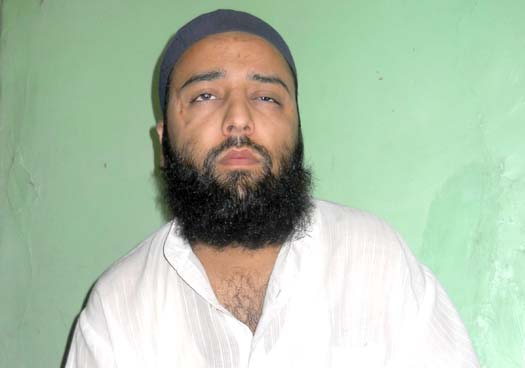
Amir Kabir Beigh, of old town Baramulla, looks much older than his actual age of 21. He has gained some weight ever since he lost his eyesight, which has curtailed his movement outside. The family of this once adventurous, loving youth recently shifted from Mir Sahib locality of old town Baramulla – where anti-establishment feelings run very deep, as per locals – to nearby Taweed Gunj.
Narrow alleys, crowded households and grocery shops in Taweed Gunj bear a stark resemblance to Srinagar’s old city. In one of the medieval households at the back of this locality, Amir lives a hushed life with his family.
In one of the rooms of this ‘withered’ mud house, Amir is spending his days memorising the Holy Quran. “I want to memorise it all,” Amir, clad in a white traditional Khan dress, says. It is during his Quranic session that his family allows him to stay alone; the rest of the time, he remains with them. “They don’t allow me to sit alone, as they love my presence,” he says.
After a while, his mother, Jehan Ara, entered the room with a smile on her face. Her smile and friendly nature couldn’t arrest the frequent silences that loomed large in the room. It was hard to ask a twenty-year-old and his mother to narrate once again: What happened that day when the pellet hit him? What did they go through after he lost his eyesight? And how is Amir finding life in darkness? All these questions and more came out of my mouth hesitatingly.
I was not the first reporter who was about to listen to ‘woebegone accounts’ of the family, and I won’t be the last one, given the nature of human tragedy Amir has experienced in his early life. His mother smiled to greet one more stranger in her home, who had come to refresh her agony and that of her family. Like her son, she too has apparently learned to put up a brave face and mustered the courage to rewind the events once again.
His mother was hospitalised on the day when he was hit by a pellet. Like most parts of Kashmir then, the old town of Baramulla too rocked with clashes between youth and government forces. Later that day, Amir went to purchase medicine for her mother. “As I reached near the market, the policeman standing on the other side of the road fired a pellet at me, which hit my face and exploded,” he recalls. Silence again fell in the room. He dropped his head down as if to overcome the sudden pain inside him. There was no moisture in his eyes. He sighed, but sighed at length, and then he again broke the silence.
“With the flash of light, everything went dark for me,” he says. Pellet specks had entered most parts of his upper body. When he was taken to Srinagar for treatment, he was first operated upon for his stomach, which was badly bruised. The next day, he was pleading with surgeons at Srinagar’s JVC hospital to operate on his eyes, as the dark cover in front of his eyes was taking a toll on his nerves. But the doctors turned down his plea!
“Only a day before, I was given anaesthesia, and medicos said that repeating the same dose would have a serious consequence on my health,” Amir, who frequently wipes his left eye with a white handkerchief to ease out itching, recalls.
The hospital authorities decided to delay his operation for one more day, which meant that Amir had to live one more day without light, as his badly injured eyes were covered with a bandage.
But he hardly had a hunch that his ordeal had just begun. A day later, an operation was performed, and after some days, he made the medicos, patients, and attendants in the hospital shed helpless tears for him. He was hopeful that he would be able to see things after the operation. But to his woes, the darkness remained relentless when the bandage over his eyes was lifted. He wailed, cried, and mourned hard by finding himself sightless, but he had no alternative but to swallow the bitter pill.

“Born blind is one thing, but losing sight after having seen the world is simply devastating for a person,” Nadeem, 22, elder brother of Amir, who looks years younger than him, says.
His family, who survives on the income earned by selling used clothes in the busy market of the old town, had to shell out all their savings to arrange for his treatment; besides, they took a loan. He was first flown out to New Delhi, then Indore and finally to Chennai for treatment, but damage control of his eyes had already gone out of the scope of eye surgeons. He was told a ‘blunt truth’ that his eyes, his amber eyes, had lost sight permanently. It was during his stay in Chennai that his left eye was replaced with an artificial one. “Such was the severity caused by the pellet that his left eye was damaged on the spot,” says Jehan Ara, his mother, who showed me his X-rays and some of his photographs clicked before tragedy struck him.
The caption of one of his photographs read: Live like a legend. It was clicked some fifteen days before he was rendered sightless. “Ten or fifteen days before I lost my eyesight, I went on an extensive adventurous trip around Kashmir,” he says. “Since adventure attracted me always, I saw so many beautiful places around the valley. And just when I was nurturing a dream to work for National Geographic, I lost sight of my adventure, forever.”
Initially, the loss was colossal for him. He would cry, wail and yell over the sudden change in his life. “But time is a great healer,” Nadeem, his brother, says. “He learned to endure it with his devotion towards the Holy Quran, which helped him to ease his mental burden and lessen his frequent depression bouts.”
In between, Amir’s wife, Nadia, entered the room. Veiled from head to toe, she looks much younger than Amir. She is pursuing her Bachelor’s degree from Baramulla Girls Degree College. It was one month after Amir lost his eyesight that she knew about it. “I couldn’t do much but cry for days together,” says Nadia, while lowering her head. Being relative to Amir’s family, she made many attempts to meet him, but each time he would avoid her. “He was deliberately trying to create a rift between us,” she says, “as he was under the impression that he wouldn’t do justice to our relationship anymore.”
But she kept persisting and pressing her will till he couldn’t avoid her anymore. They started to weave a dream for their marriage, but Nadia’s parents wouldn’t accept a blind man as their son-in-law. Their relation soon ran into rough weather. “Earlier they had no problem with him, but as he lost his sight, they objected to the marriage,” Nadia says.
Both Amir’s and Nadia’s families hail from Sultanpur, located some 33 km from the main town of Baramulla. Amir’s family moved to old town Baramulla some 24 years ago to seek better prospects for life. Being relatives of each other, both families had decided on Amir-Nadia’s marriage. But things didn’t remain the same after the son of the Beigh family lost his sight. Back home, Nadia would nag her parents for the marriage. And then one day, her father dropped her off at Amir’s home by telling them: Now take care of her. But later that day, he took her back home.
The matter took a new twist when Nadia decided to live with Amir in his home. This led her parents to lodge a police complaint against Amir’s family. The police called both families, along with Amir and Nadia, to the police station. After verifying all angles involved in the case, including the age of the girl, the police handed Nadia over to Amir’s family. “I never wanted to leave him alone and will never do that,” she says, “But at the same time, it hurts to find my parents not on talking terms with me. I know one day they will realise their daughter took the right decision.”
Her friends back in college are terming Nadia a “rare and exceptional” girl who stood by her commitment to Amir. “My friends think that I did some out-of-the-world thing, but as a matter of fact, I just did what I should have done,” she says. On the other side, Amir says Nadia’s obliging nature makes it hard to avoid her.
After the marriage, Amir’s sense of responsibility towards life, parents and Nadia is only growing. With his family still surviving on modest earnings made from selling second-hand outfits, Amir wants to lend a helping hand, but for the moment, he is far from getting any help.
It was late afternoon when I bid him adieu, but he insisted stranger to spend some more time with him. Most of his friends don’t meet him anymore, as they are yet to come to terms with his tragedy. He opened the door and stepped out like a normal person. And just when I tried to lend my helping hand to him, he made me quiet by saying: “Mye chu wyenje ghaash wentey barkaraar.” (My inner sight is still intact).







I would like to help them any, this is inspiration. Kudos to the girl who isn’t materialistic anyway.
Please let me know if i can be of any hep
True love does exist, you just need to be lucky enough !!!
May Allah (SWT) bless both.. Hats Off to the girl!
Wow! Wt a sacrificing & sympathetic nature of Naida
Take a bow! We Kashmiri, always believed in Power of Love, not Love for Power. Love can do wonders and this story gives us the hope. Bravo, still we have girls like Nadia, full of dedication & self sacrifice. You won NADIA, Shine 🙂
No words for Nadia
Woww! Stunned to read this story! What a girl! Love can do anything…just realized it! I wish them a beautiful life ahead…aameen
oh my god!! that’s terrible :-O
i can’t believe this ..!!
I wish Amir’s eye sight come back 🙂
And my solute to his fiance Nadia who is now his wife, she showed the best sample of true love. ..
Atleast in our kashmir ,some people know whats true love <3
Hats off 🙂
May Allah azwajal help you in cementing your relation.. and make you one of the best couple..
May Allah’s Blessings Be Upon You ;(
and infact here are so many such stories in this “Valley of Wolves”
#LostParadise #FREE KASHMIR
Allah does good to good
may ALLAH keep them happy always……..
This story moved me,,,,really no words….May Allah re-send light to his eyes. True Love Never Fails
Slaute to braveheart Nadia
True Love Never Dies