An Indo-French study of Ahansar Lake reveals that Mughal-era land reclamation, advanced hydro-engineering, and agricultural expansion around 1600 CE isolated Kashmir’s floodplains. This disrupted the Jhelum River connection and altered lake ecosystems.
SRINAGAR: An Indo-French study of sediments from Kashmir’s Ahansar Lake has found that human intervention, particularly agricultural expansion and water-management works during the Mughal period, may have fundamentally altered the lake’s connection with the Jhelum River around 1600 CE.
The study, which reconstructs approximately 750 years of the lake’s environmental history, identifies a major shift from river-borne mineral sediments to organic matter produced within the lake. The researchers argue that climate variations alone cannot explain the transformation and that changes to the surrounding landscape and water systems were likely major drivers. The findings have been published in Catena, an international scientific journal, by Elsevier on June 19, 2026.
Ancient Record
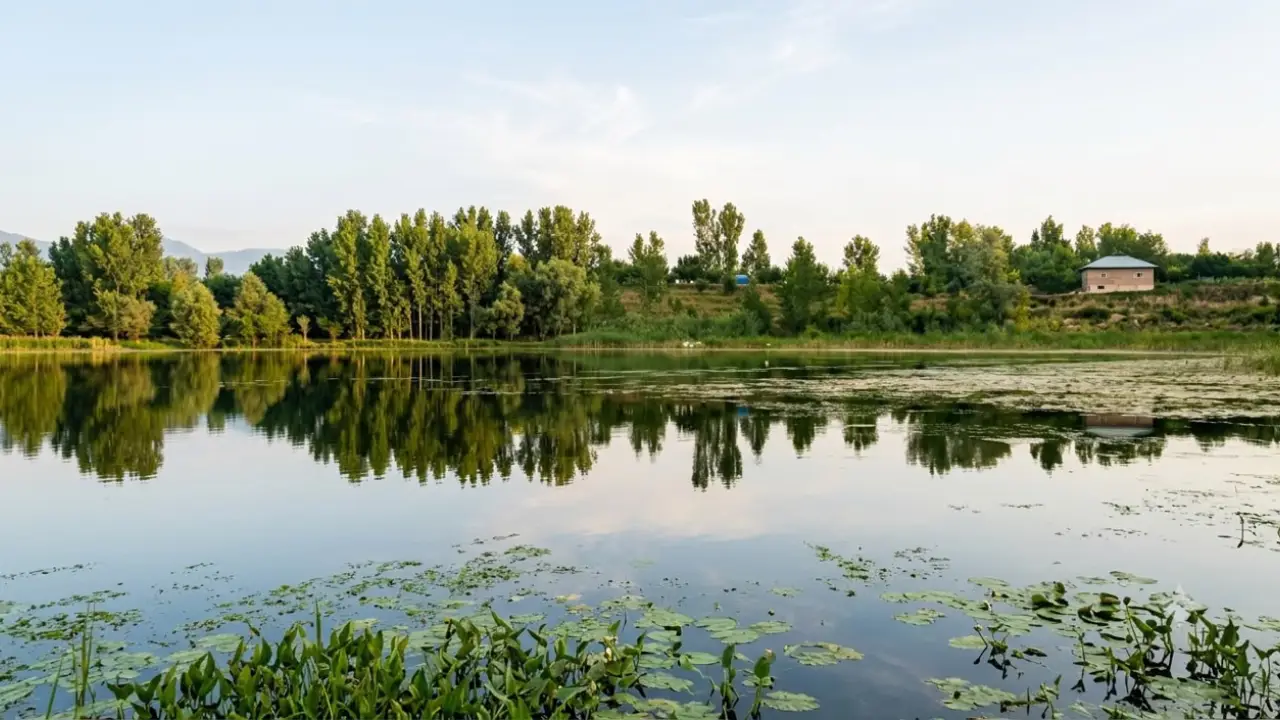
Ahansar Lake, situated in the Jhelum basin near Mansbal, preserves evidence of a landscape shaped over centuries by the movement of the river and its associated watercourses. The lake is a remnant of the former river-lake system in which the Jhelum’s meandering course, erosion and deposition of sediments continually reshaped the valley floor.
The study, Historical floodplain transformation of the Kashmir Valley recorded by sedimentological and geochemical analyses of Lake Ahansar sediments, examines how this natural system changed as human settlements expanded and land was progressively brought under cultivation.
To reconstruct the lake’s past, the researchers extracted a 268-centimetre-long sediment core in September 2023. By analysing the composition of successive layers, their chemical characteristics and their age, they traced changes in the material entering the lake and the biological processes taking place within it. These findings were then compared with historical records and evidence of water-management and agricultural changes in Kashmir.
The research was conducted by Aasif Mohmad Lone, Debajyoti Paul, Elodie Brisset, Anchana Pulikkal, Hema Achyuthan and Vincent Rinterknecht. Lone is affiliated with the Indian Institute of Technology Kanpur, CEREGE in France and the Department of Civil Engineering at Manipal Institute of Technology, Manipal Academy of Higher Education. Paul and Pulikkal are affiliated with IIT Kanpur, while Brisset and Rinterknecht are associated with CEREGE, which brings together France’s CNRS, IRD, Aix-Marseille University and INRAE. Achyuthan is affiliated with Anna University, Chennai. Lone and Brisset are the corresponding authors.
Major Transition
The sediment record reveals two distinct phases in Ahansar Lake’s environmental history. The first, extending from approximately 1285 to 1600 CE, was dominated by mineral material carried into the lake from the surrounding catchment and river system. The second, from around 1600 CE to the present, shows a marked shift towards organic matter generated largely within the lake.
The transition is dated to around 1600 CE, although the researchers’ chronological model places the likely interval between 1510 and 1635 CE.
The change is significant because it indicates that the lake’s relationship with its surrounding landscape was fundamentally altered. Before the transition, river-borne material supplied a substantial proportion of the sediment accumulating at the lake bottom. Afterwards, this supply declined while organic matter and carbonates formed within the lake became increasingly important.
In simpler terms, the lake appears to have moved from a system strongly influenced by the river and its sediment supply to one increasingly governed by its own internal biological processes.
The researchers interpret the reduction in sand and several mineral elements, including silicon, aluminium, iron, titanium and zirconium, as evidence of a weakening connection between Ahansar Lake and its surrounding watershed.
River Separation
The study proposes that the changing relationship between the Jhelum and Ahansar Lake could have resulted from changes in the river channel and the reclamation of adjoining wetlands. A deeper or more stable river channel would have reduced the frequency with which floodwaters spread into low-lying areas, while the conversion of wetlands into agricultural land could have further altered the natural movement of water.
The authors consider human-driven changes to the floodplain a particularly plausible explanation for the transition. Historical maps from 1859 and 1945 also document the weakening of the lake’s connection with the Jhelum.
Today, Ahansar Lake is hydrologically isolated from the river, although an artificial outlet on its western side regulates the discharge of excess water into the Jhelum.
The researchers suggest that the changes observed at Ahansar may have parallels elsewhere in the Kashmir Valley, where lakes, wetlands and abandoned river channels formed part of a once more interconnected floodplain system. They caution, however, that comparable changes in other lakes would require further investigation.
Mughal Intervention
One of the study’s most striking findings is the coincidence between the lake’s environmental transition and a period of extensive landscape transformation during Mughal rule. The researchers identify the period between approximately 1610 and 1770 CE as one of intensified change in their sediment records.
This period coincided with the expansion of agriculture and the development of hydraulic infrastructure in Kashmir. Canals, water diversions and other engineering works altered how water moved through the valley, while efforts to extend cultivation brought additional land into agricultural use.
The researchers draw on historical accounts, including material associated with Abu’l Fazl’s Ain-i-Akbari, alongside other studies of Mughal-era water management and economic activity. They note that water infrastructure served several purposes, including irrigation, transport and the management of agricultural landscapes.
Such interventions could also have affected the natural connections between the Jhelum, its floodplain and adjoining lakes. Reclaiming wetlands and modifying watercourses would have changed the movement of sediment and water, potentially reducing the supply of river-borne material reaching Ahansar Lake.
The study therefore links the environmental changes recorded in the lake to a wider period of human activity that reshaped the Kashmir Valley.
The authors nevertheless stop short of attributing the transformation to any single ruler, canal or engineering project. They acknowledge that the absence of detailed, site-specific archaeological evidence limits their ability to demonstrate precisely how the landscape was modified and which interventions were directly responsible.
Climate Evidence
The researchers also examined whether climate change could account for the lake’s transformation. Their analysis considered the Little Ice Age, a period of cooler conditions associated with changes in precipitation and glacier behaviour across parts of the Himalaya.
Previous regional studies have linked this period with wetter conditions and increased discharge in the Jhelum basin. If climate alone had driven the changes at Ahansar, the researchers expected the sediment record to reflect the effects of increased river activity and the associated supply of mineral material.
The evidence, however, did not follow that pattern consistently. Instead, the lake showed declining mineral inputs and increasing organic matter and carbonate formation during the period of transition and afterwards.
The authors also compared the lake’s record with existing reconstructions of temperature and precipitation. Their findings suggest that Ahansar did not respond to regional climate variations in the same way that might have been expected from a lake more directly connected to river flows.
They conclude that climate variability alone cannot explain the changes. Human modification of the catchment and the weakening of the lake’s connection with the river appear to have become important influences on its environmental development.
The finding does not exclude climate as a factor. Rather, it suggests that changes in land use and water management may have altered the way the lake responded to climatic conditions.
Chemical Evidence
The research also examined the chemical composition of the sediments to understand how the sources of organic matter and the lake’s internal processes changed over time.
Measurements of carbon and nitrogen isotopes helped the researchers distinguish between material originating outside the lake and organic matter produced within it. Their results indicate that biological production within Ahansar became the principal contributor to organic matter deposited in the lake during the later phase.
Changes in nitrogen isotope values suggest that nitrogen sources and cycling processes also varied over time. These changes may reflect a combination of catchment conditions, agricultural activity and biological processes within the lake, although the researchers do not identify one definitive cause.
The study also records increased lead enrichment in the sediments. The authors suggest that this may reflect atmospheric deposition associated with expanding regional economic and industrial activity, but they present this as a possible explanation rather than a conclusively established source.
Together, the chemical findings indicate that the lake’s transformation involved not merely a reduction in the sediment entering it from the river, but also changes in its chemical environment and biological productivity.
Present Concerns
The historical findings have implications for the present condition of Ahansar Lake and other water bodies in the Kashmir Valley. The paper notes that Ahansar is currently classified as eutrophic; a condition associated with high nutrient levels and elevated biological productivity. Eutrophication can contribute to excessive algal growth and deterioration in water quality.
Agricultural expansion, urban development and changes to natural drainage systems continue to exert pressure on Kashmir’s lakes and wetlands. The study places these modern concerns within a longer history of human modification of the valley’s water systems.
By showing that the lake’s relationship with the Jhelum changed substantially over several centuries, the research highlights the importance of understanding a lake as part of a wider catchment rather than as an isolated water body. Changes to river channels, wetlands and adjoining agricultural lands can affect the quantity and composition of water and sediment reaching a lake, with lasting consequences for its ecological functioning.
Conservation Lessons
The authors argue that reconstructing the environmental history of Himalayan lakes can help guide their future management. Understanding how a lake reached its present condition is important for identifying the factors that continue to influence its ecology and for designing appropriate conservation measures.
The study also highlights the cultural and environmental value of Kashmir’s low-altitude Himalayan lakes, many of which occupy landscapes shaped by centuries of interaction between human settlements and natural water systems.
Its central finding is that Ahansar Lake underwent a major environmental transition around 1600 CE, coinciding with a period of intensified agricultural expansion and hydraulic intervention during the Mughal era. The sediment evidence supports the interpretation that human activities substantially altered the lake’s relationship with the Jhelum, although the precise mechanisms and the contribution of individual interventions remain uncertain.
The research thus offers a longer perspective on the changing relationship between Kashmir’s people, agricultural landscape and water resources. It suggests that the future of the valley’s lakes depends not only on managing the water within them, but also on understanding and protecting the wider river and wetland systems of which they are a part.