SRINAGAR: For three days last week, the Kashmir controlled apparently from Muzaffarabad, the PoK, went dark. Internet services were cut, mobile networks throttled, and a strict curfew was imposed. What eventually emerged from the communications blackout was a picture of serious violence: at least 15 people killed, 11 of them civilians, as dozens were injured. Thousands were reported to have marched on the streets, defying the government as the region convulsed by its third serious unrest in years.
At the centre of the crisis is the region’s Joint Awami Action Committee, a civil society coalition of traders, transporters, lawyers and students founded in September 2023 in Muzaffarabad, the regional capital. The group had called a region-wide long march for June 9, to press the government on a 38-point charter of demands. The renewed demands were raised at a time when the region is slated to go for elections in July to its assembly. In fact, it was the assembly that became the major issue.
Instead, it found itself banned under anti-terrorism legislation days before the march was due, its leaders placed under reward notices of Rs 10 million, and its supporters facing mass detentions across the region. The post haste, Islamabad, that is the de facto ruler of the region, called tens of thousands of armed personnel, issued a travel advisory, and imposed the communications blackout. This converted the planned protest into an open confrontation.
The Action Committee
The Committee’s origins lie in the mundane desperation of household economics. In May 2023, residents of the region began protesting against soaring electricity bills and the shortage of subsidised wheat flour, the kinds of grievances that rarely register in national capitals but define daily life in a mountainous territory with limited economic options.
By August 2023, the disparate protests had found organisational form. In September, hundreds of activists from across the region gathered in Muzaffarabad to formally establish the Committee. The movement reached its first major flashpoint in May 2024, when a long march toward the capital descended into violent clashes that left at least five people dead, including a police officer. The crisis was suspended after Pakistan’s Prime Minister Shehbaz Sharif agreed to reduce electricity tariffs and flour prices, with billions of rupees allocated in subsidies.
That was the first unrest in recent years, and the focus was on why Pakistan is stealing energy while the residents are asked to pay hefty tariffs.
The peace lasted months. By August 2025, the Committee announced a renewed lockdown, this time broadening its demands well beyond economics. More than 10 people were killed in October 2025, when the Committee revived the agitation. The two sides started talking again, and by the last week of May, the talks failed.
The Fault Line
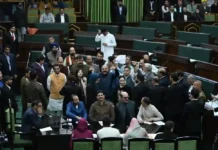
The current standoff is no longer primarily about utility bills. The demand that has crystallised the crisis, and the one the government has flatly refused, concerns 12 seats in the region’s 53-member Legislative Assembly that are reserved for Kashmiri refugees. The region is home to thousands of people who migrated from Jammu and Kashmir in 1947 and 1965, and later in the 1990s. They live in cities such as Karachi, Lahore, Rawalpindi and Sialkot.
The Committee argues that this arrangement is structurally undemocratic. Of the assembly’s 53 seats, only 33 are directly elected from within the territorial jurisdiction of the PoK. The 12 refugee seats, voted on outside the territory by an electorate dispersed across more than two dozen districts of Sindh and Baluchistan, form a bloc large enough to determine who forms any government in Muzaffarabad, without the participation of people who actually live there. This, the Committee asserts, gives whoever controls federal or provincial political machinery the ability to deliver the bloc, effectively deciding a region’s government from a distance.
The government and defenders of the current arrangement offer a different framing. The seats, they argue, are not a privilege but a constitutional commitment to Kashmiris displaced by partition and subsequent conflict. Abolishing them, they claim would weaken Pakistan’s Kashmir case. There are voices within the region that support the status quo. Even those defending it admit to the shortcomings. These mohajir populations are scattered and have ethnic issues as well. Reports appearing in the media suggested that barely 30,000 people have Kashmir origins, unlike 434000 who have Jammu origins, and all these populations are scattered and settled across the mainland.
If the government agrees to the Committee’s demand, then the UK-based Mirpori population, who are the main residents of Birmingham, will also lose a lever to interfere with the governance in Muzaffarabad.
On June 8, the day before the planned long march, the Supreme Court of the region issued an advisory opinion confirming that the refugee seats enjoy constitutional protection and cannot be abolished except through a formal constitutional amendment. The ruling effectively closed the legal route for the Committee’s demand and intensified the pressure ahead of the march.
Tragically, Pakistan has used the same route to kill the local political class of the PoK literally. Although they were mostly nominated, rulers in Muzaffarabad between 1947 and 1975 were state subjects representing political parties rooted in the region. It started changing in 1975, and the last local political party that ruled the region was for the 2006-2011 term, when Sardar Atique Khan ruled the region. In the last three terms, Pakistan’s main political parties, the People’s Party, the Muslim League and the Tehreek-e-Insaf ruled the region. Right now, when the preparations are underway to hold elections, the possibilities of a regional political force emerging to the top are hugely questionable.
The Violence
As the legal window closed, violence erupted. The worst occurred in Rawalakot, the administrative capital of Poonch district, on the other side of the LoC
According to official figures, 11 people were killed in the initial violence, including seven civilians and four security personnel. The civilians were identified by name: Usman Sabir of Koiyan village, Fahad Barkat of Rehara village, ex-serviceman Wasaid Siddique of Parrat village, Naqash Zardad, Jamshed Ashraf, Muhammad Rasheed and Tariq Resham from various villages in the district. Security personnel killed included SHO Muhammad Inayat and three constables. By June 11, with clashes also reported in the city of Kotli, ,and the death toll had risen to 15. The death toll has gone up to 20, according to news gatherer AFP.
The killings have been condemned widely. Amnesty International described the crackdown as “violent and sweeping,” citing internet shutdowns, mass arbitrary arrests and deadly use of force as an “alarming deterioration of human rights in the region.”
India strongly condemned the violence and urged the international community to hold Pakistan accountable. “There are reports of severe police brutality in Pakistan-occupied Kashmir in which several protestors have been killed and many injured,” Ministry of External Affairs spokesperson Randhir Jaiswal told reporters. “We hope the international community will hold Pakistan accountable for its misdeeds and abuses.”
He also accused Pakistan of spreading misinformation to divert attention from alleged human rights violations in the region. “We continue to see in this context a pattern of fake news and videos emanating from Pakistan. It is a desperate attempt by Pakistan to cover up its own failings and deflect attention from its human rights abuses,” he said.
More than 50 British parliamentarians have reportedly written to UK Foreign Secretary Yvette Cooper expressing concern over communication blackouts, arrests and deteriorating conditions in the region. The United States Embassy in Islamabad and other countries, including the United Kingdom, Australia and Canada, also issued advisories related to the security situation.
Where Things Stand
The region is on strike, and the government agencies are hunting for the leaders of the Committee. They have actually put a bounty on their heads, a substantial Rs 1 cr, one for each of the four top leaders – Showkat Nawaz Mir, Khawaja Mehraan Arshad, Umar Nazir Kashmiri and Sardar Amaan Khan. The exact situation is not known as Islamabad has imposed an information blackout in the region. Newspapers being published in the region are not accessible in India, despite the fact that major media houses have not taken the region seriously in recent history.
Global media coverage suggests the region is witnessing massive marches in support of the Committee’s demands. June 11, tens of thousands of people remain on the march. Official estimates put a single protest convoy at more than 10,000 people, four kilometres outside Rawalakot, with local authorities saying it will not be allowed to proceed to Muzaffarabad. Mosque loudspeakers have been broadcasting requests for residents to stay indoors. Helicopters have been flying surveillance flights over both Rawalakot and Muzaffarabad. Local markets remain shuttered, though it is unclear whether this reflects solidarity with the strike or the simple logic of fear.
Regional rulers have asserted that they are open to dialogue, as 35 of the 38 demands have been accepted or are under implementation, a claim the Committee disputes. The Committee, the leaders of which are on the run, have stated that many commitments were accepted in the recent past only in principle, but have yet to be acted upon. The two sides last held inconclusive talks in late May.
The region continues to be on the boil. Elections for the regional Assembly are scheduled for July 27, less than seven weeks away. They were already politically significant. They are now freighted with something heavier: a question about who the people of the region elect to serve. It is too early to foretell a situation, but things are gradually eroding from an over-confident Islamabad.