by Mariya Qadri
Baba traverses a wide spectrum of themes, which emerge organically within her work. Her poetry engages intimately with the particularities of female experience, resilience, and survival in an age defined by ennui.
“If silence could strike temple bells
All gods would descend in my arms tonight!”
— Dr Aaliya Mushtaq Baba, Tonight

In her debut poetry collection, Ode to Silence, Dr Aaliya Mushtaq Baba lends voice to a world shaped by observation, introspection, and the eloquence of quietude. Her poems resonate with the inner lives of those who witness existence with keen silence, attempting to decipher its enigmas. The collection meditates on the poetic lexicon of silence—a daunting yet profound stillness that articulates philosophy to those who dare to listen. In the preface, Baba writes, “… I have come to understand that silence, too, has a language of its own, one that poetry allows me to translate.” This collection marks a confident entry into poetry, not merely as a reflection of personal perception, but as a manifestation of generational consciousness, negotiating the delicate terrain between silence and voice.
Annihilation
My silence
Found some abyss
To drown itself
Between
The expanse of prose and
The confinement of poetry.
Baba is not merely a poet who writes; she is an artist who paints with symbols, conjuring vivid, imagist landscapes that evoke deeply emotional and visual experiences. In her opening poem, A Room of One’s Own, she articulates her creative identity:
A tired soul I am.
I know not how to write.
I paint signs,
On spilt milk on the floor.
Her imagery is both original and evocative. In Autumn, she writes with painterly precision:
A bagful of chinar… Autumn is a heartbreak…
Why would leaves turn gold wrinkles;
Wise yet brittle.
In Dear Kashmir, she offers an image both raw and luminous:
In the midst of dark mud,
An island of white sheen.
Through such lines, Baba captures the profound beauty and wisdom that inhabit her verse. She never sacrifices the sacred madness of poetry to the rigidity of intellect; rather, she offers a compelling synthesis of both. Her poetry is impassioned yet poised, suffused with the kind of tranquil madness that grants verse its soul. In the Introduction, she declares:
I am a poem that howls in alien / letters.
Let us just sit composed /
Like I was not mad, I have done / that all my life.
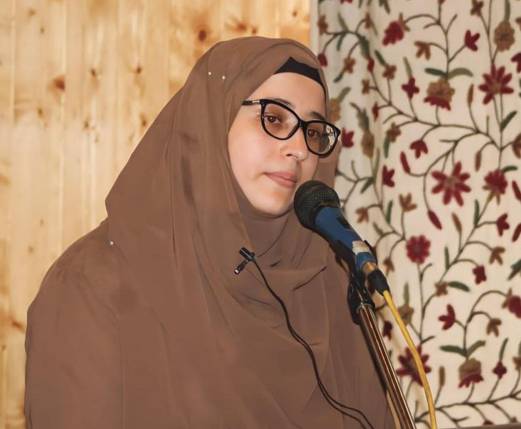
Baba traverses a wide spectrum of themes, which emerge organically within her work. Her poetry engages intimately with the particularities of female experience, resilience, and survival in an age defined by ennui. She probes existential, environmental, and solitudinous concerns with both emotional intelligence and philosophical depth. Her style frequently leans towards the aphoristic, offering lines that stand alone as distilled reflections on life’s enduring paradoxes. In Grave, she writes:
Smiles stay and / words too, yet we say / ghosts are untrue! / The wonder of life is not / death but life itself. / With what dexterity man deftly / weaves permanence / out of such transience.
In Ode to Silence, Baba dares to assert both her voice and the collective identity of her people, particularly that of Kashmiri women. Should it receive the attention it warrants, this collection could well herald the emergence of a new genre: Kashmiri women’s poetry in English.
(The author is currently pursuing a Master of Arts degree in English at the University of Kashmir. Ideas are personal.)