The 1971 India-Pakistan war is often remembered for the forced divorce of Bangladesh, but the conflict’s western front remains a largely overlooked chapter. Major General Vijay Singh’s book attempts to shed light on this forgotten theatre. Muhammad Nadeem reviews the book, examining how it navigates the tension between personal memory and military history
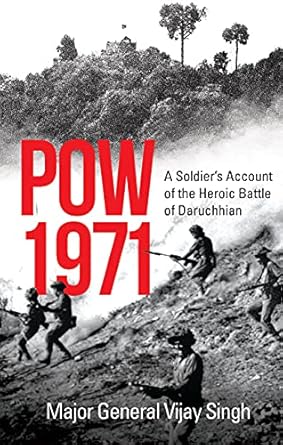
POW 1971: A Soldier’s Account of the Heroic Battle of Daruchhian, by Major General Vijay Singh, is structured in four distinct parts that chronicle the night assault at Daruchhian Top, Major Hamir Singh’s hospitalisation in Rawalpindi, his internment at Lyallpur POW Camp, and his emotional return to India.
Family Business
The opening section offers an almost minute‐by‐minute reconstruction of the December 13, 1971 operation, in which Company 14 of the Grenadiers attempted to seize a dominating feature along the Ceasefire Line, a plan later criticised as “too complicated” by the then GOC of 25 Infantry Division, Kundan Singh. Singh’s narrative lays bare the sequence of tragedies that befell the assault: from the minestrike that maimed Major Harbans Chahal to the loss of Company C’s Major Dogra under machine‐gun fire, and finally Hamir Singh’s isolation as the sole remaining company commander.
Singh relays his father’s ordeal in a Pakistani military hospital. Confronted with isolation and even blindfolding, born of suspicion that he might be a commando, Hamir experiences moments of both animal‐like objectification, “like a caged animal in a zoo” and unexpected humanity, such as the Pakistani sentry who confesses, “my heart aches in sadness.”
Singh describes life in Lyallpur Jail, attempts at ideological segregation along religious lines, the resilience of shared Indian Army secular traditions, and Hamir’s leadership in organising games and prayers for fellow POWs. The final chapters focus on repatriation: the anxieties of facing widows and parents of the fallen, the reconciliation of battlefield memories with peacetime reckonings, and the enduring legacy of a family steeped in military service.
Throughout, interwoven memories from Hamir Singh’s past, such as his lineage as the son of Kalyan Singh, himself a WWII POW, imbue the account with generational resonance and expose themes of duty, honour, and the cyclical nature of similar fates.
Viewpoint
Vijay Singh employs a dual register combining clinical military reportage with vignettes of personal experience. The battle sequences are recounted with tactical precision, unit designations, radio communications, and command critiques are laid out systematically, yet they are punctuated by emotional details, such as Hamir’s injuries or the battle cry Sarvada Shaktishali that drives them forward under lethal fire. This interplay mirrors the oscillation between war’s objective mechanics and its subjective horrors.
The prose is fitting for a military memoir, yet it does not shy away from sensory immersion: the “thick forests and heavy undergrowth” of Poonch, the “devastating fire” stanching Company A’s advance, or the incidents through which curious onlookers peered at the Hindu officer in Rawalpindi. These descriptions show reader empathy without undermining factual rigour.
Emotional peaks, such as the descriptions of widows confronting the fate of their loved ones, are portrayed with restraint. Singh avoids overt sentimentality, allowing moments like the confirmation of Muslim burial rites for a Pakistani officer’s widow to unfold without embellishment. This approach maintains a level of credibility but also risks muting the emotional impact, potentially limiting the reader’s engagement with the personal costs of war.
Filling The Gaps
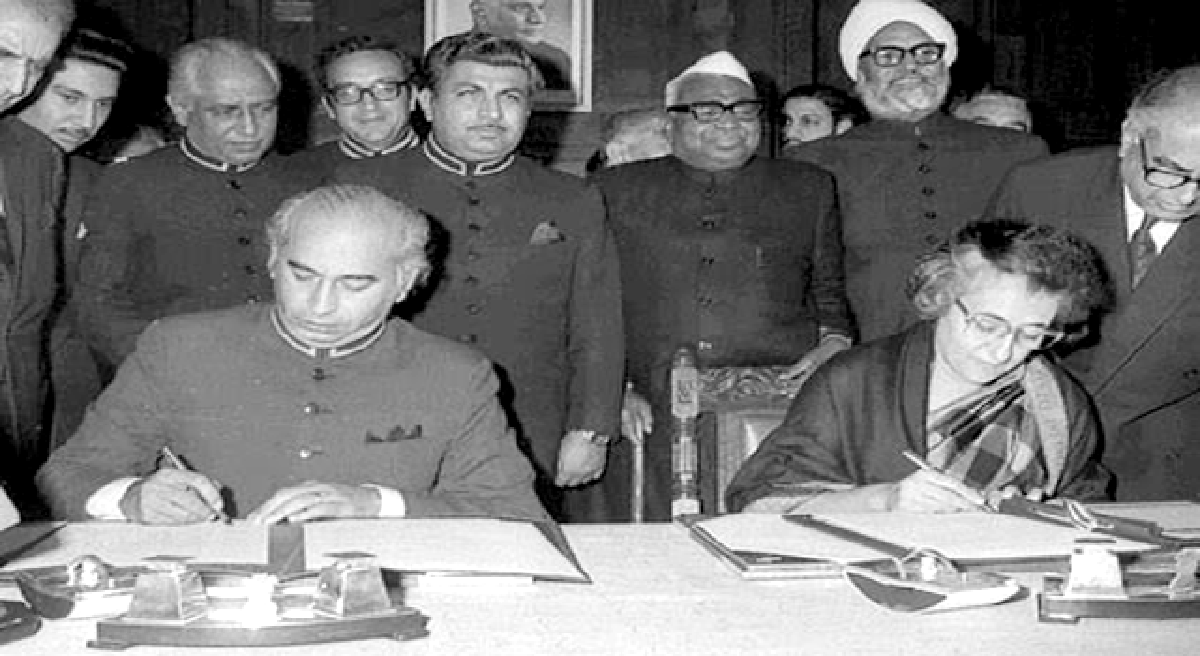
Singh’s focus on the western theatre of the 1971 war, a front often overshadowed by the partition of Bangladesh, addresses a lesser-explored aspect of the conflict. He attempts to substantiate his father’s recollections through primary battle reports, radio logs, and archival documents, aligning them with official records. However, his reliance on a limited set of sources raises questions about comprehensiveness, particularly given the lack of external verification or corroboration from Pakistani records. While Singh includes critiques from figures like Major General Kundan Singh regarding the complexity of the operational plans, the analysis remains largely confined to the Indian perspective, leaving significant gaps in contextual understanding.
Singh’s account includes instances of interpersonal dynamics across enemy lines, challenging conventional portrayals of unmitigated animosity. While these details humanise the Pakistani side and underscore Geneva Convention ideals in practice, they remain isolated instances.
The first-person oral history seems to create limited focus and constrain the narrative, offering little insight into broader strategic considerations, such as high-level political decisions or larger military objectives. Singh’s deliberate emphasis on a micro-historical account of failure, captivity, and survival rather than battlefield triumphs is a notable choice, but it also restricts the book’s scope
The use of primary source material is extensive, as Singh draws upon his father’s war diaries, radio transcripts, and personal correspondences. This insider access provides granular details of the battlefield experience, yet the reliance on such a singular perspective raises concerns about balance.
Fiascos
Despite its strengths, the book has its limitations. A major concern is the potential for familial proximity bias. As the son of the protagonist, Vijay Singh may, perhaps unconsciously, amplify his father’s heroism or soften critiques of controversial decisions. While he mentions that he has cross-checked facts, a more explicit reflection on this positional bias would enhance the narrative’s transparency and scholarly integrity.
The aftermath of the operation is only briefly touched upon. The psychological consequences for survivors, their post-war military trajectories, and the broader experiences of veterans’ communities remain underexplored. A deeper engagement with these dimensions could have expanded the book’s relevance, offering insights into how war shapes lives long after the last bullet is fired.
POW 1971 seeks to contribute to South Asian military historiography by focusing on lesser-known engagements on the western front. Its blend of tactical analysis and personal narrative provides a case study of operational failure while also documenting aspects of POW management, hospitalisation, ideological segregation, and repatriation protocols.