by Malik Kaisar
Looking back now, that mischievous moment, however embarrassing, imparted a lesson I have carried with me ever since—the importance of attentiveness and self-discipline in all aspects of life, no matter the circumstances.
Ramadan is a sacred month of fasting, prayer, and reflection observed by Muslims around the world. From dawn until dusk, one abstains not only from food and drink but also from negative habits and actions. It is a time of self-discipline and spiritual renewal, fostering empathy and gratitude. Beyond personal devotion, Ramadan offers an opportunity to reconnect with faith and extend kindness to those less fortunate. It is a moment to step away from the routines of daily life and focus on what truly matters.
As this blessed month returns, childhood memories resurface—memories of a time when I had yet to cross the threshold into adolescence. In those early years, Ramadan was less about spirituality and more about adventure, mischief, and the occasional life lesson. Recalling those moments now, I realise how they subtly shaped my understanding of this sacred month and its deeper significance.
A Simpler Time
Back then, Ramadan was marked by a simplicity that now feels almost rare. There were no extravagant iftar spreads, no social media showcases of feasts, and no frenzied market rushes for special foods. The focus remained on spirituality and humility. Like every household, ours encouraged children to wake for sehri and observe the fast with sincerity. I still recall rising eagerly before dawn, rubbing sleep from my eyes as I joined my siblings and cousins for the pre-dawn meal. The hurried bites of food, the last sip of noon chai—the salted pink tea beloved in our home—before the Fajr adhan echoed through the air, and then the mad dash to the mosque to secure a coveted spot on the first floor. As it is even today, mosques during Ramadan, especially in the initial days, were brimming with worshippers.
As a child, fasting felt more like a test of endurance than an act of devotion. I counted the hours, watching the clock in anticipation of sunset, willing the day to pass more swiftly. I did not yet grasp the essence of Ramadan, but imitating my elders, persevering through the fast, and experiencing the discipline it demanded slowly instilled within me an appreciation for its deeper meaning.
Childhood Mischief
One memory, both amusing and mortifying, remains particularly vivid. One afternoon, my friends and I set off for Chattabal to buy a cricket ball. It was the first and only time I crossed the Jhelum River via a traditional veer, an experience that etched itself permanently into my mind.
On our way back to the playground, having saved a little money, we decided to buy dates for Iftar. We wrapped them in paper, tucked them into our pockets, and hurried off to our cricket match. Engrossed in the game, caught up in its intensity, I reached absentmindedly into my pocket and, without thinking, ate every single date I had intended for iftar. When the match ended, the realisation struck me like a thunderbolt—I had broken my fast! A wave of guilt swept over me, and I silently berated myself for such carelessness. Determined to keep my mistake a secret, I glanced at my friends, only to notice something peculiar—their pockets were empty too.
When I asked them about it, they exchanged sheepish glances before the truth dawned on all of us. We had each succumbed to the same absentminded indulgence. Shock gave way to laughter, and soon we were clutching our sides, unable to contain our amusement at our shared folly. We were half-ashamed, half-amused, caught between guilt and hilarity. Looking back now, that mischievous moment, however embarrassing, imparted a lesson I have carried with me ever since—the importance of attentiveness and self-discipline in all aspects of life, no matter the circumstances.
Taapi Sehar
Fasting as a child was both a test of endurance and a game of wit. Our parents were strict yet understanding, aware that school and play left us struggling by midday. In this delicate balance between discipline and leniency emerged the ingenious concept of Taapi Sehar—a playful loophole for children like me. If hunger became unbearable, we would sit outside in the sunlight and eat something, confidently declaring that since we were eating in daylight, we were still technically fasting. It was a harmless indulgence, a humorous way to cope with hunger. I can still picture myself and the neighbourhood children feasting under the open sky, proudly announcing, “We are fasting—just having Taapi Sehar!”
Chasing the Perfect Iftaar
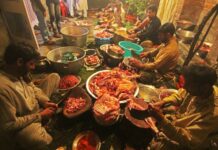
One of the great thrills of Ramadan was the search for the most generous Iftaar offerings at local mosques. Throughout the school day, whispers spread among us about which mosque had the finest feasts—tasty dates, refreshing babri tresh (basil seed drink), sweet firni, or the much-loved halwa-tchot, a dessert served on bread.
Excited, we would rush to these mosques, only to be met with reality—half of a date and a barely filled glass of basil seed water. Disappointed yet undeterred, we never abandoned the chase. Even when we returned empty-handed, the adventure itself made it worthwhile. The next day at school, we would tease one another about our failed hunts, turning our misadventures into stories to be retold with laughter.
Turbulent Times
The early 1990s in Srinagar, especially in the old city, were fraught with turmoil. Yet Ramadan remained a time of unity and solace. Our parents, ever watchful, seldom let us wander far, especially as dusk approached. If they found us idling on the streets, they would call us home with a sternness that left no room for argument.
I remember spending Sundays at a neighbour’s house, watching films with friends. Whenever a song played, the elders would quickly lower the volume and remind us, “It is Ramadan. Listening to music will invalidate your fast.” At the time, their words made little sense to me, but I respected their sincerity and simplicity.
A Month of Unity and Compassion
More than anything, Ramadan was a season of togetherness. In my neighbourhood, people shared meals without pretence, exchanged dishes without ostentation, and looked out for one another with genuine care. My mother, like many others, would prepare extra food for the neighbours, and in return, plates of homemade treats would arrive at our doorstep. It was a tradition woven into the fabric of our lives, a sense of community that seems increasingly rare in today’s hurried world.
Ramadan also instilled in us the value of compassion. As children, we did not fully understand the struggles of those less fortunate, but as we grew older, we came to realise the significance of charity. Whether through Zakat, Sadaqah, or a simple act of kindness, Ramadan reminded us of our duty to help those in need and to be grateful for the blessings we often took for granted.
Reflection and Gratitude
As we sit down for Iftaar once again, there is much to be thankful for—the journey, the memories, and the lessons learned along the way. The childhood moments, so innocent and light-hearted, now carry a deeper meaning. They remind us not only of the joy of those early years but also of the growth that has come with time.
Ramadan, in its essence, is a journey—one that transcends mere abstinence from food and water. It is a period of self-reflection, patience, and growth. Even those early, playful experiences, laced with innocence and mischief, contributed to my evolving understanding of faith, discipline, and gratitude. As I look back on those childhood Ramadans, I realise that, even then, the seeds of a deeper awareness were being planted—an awareness that continues to shape my relationship with this sacred month today. Ramadan, beyond its rituals, is a journey—one that shapes our hearts and souls with each passing year.
(The author is a graphic designer at Kashmir Life and the creative head and director at MK Creations. He also works at Delhi Public School, Srinagar, and previously served as a layout designer at The Rising Kashmir. Ideas are personal.)