by Asad Mirza
The integration of robotics and smart infrastructure forms part of Saudi Arabia’s Vision 2030, which seeks to modernise society and diversify the economy through innovation.
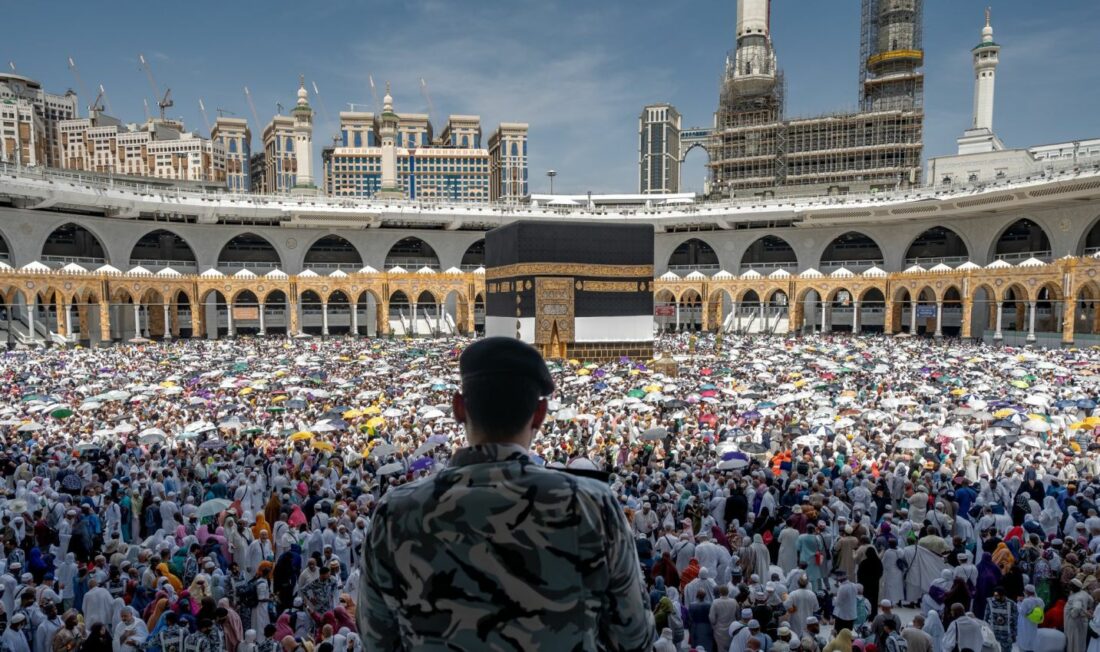
As millions of pilgrims prepare to converge on Islam’s holiest site for the 1446 AH Hajj season, Saudi authorities have unveiled a sophisticated array of technological systems aimed at improving the management of worshippers at the Grand Mosque in Makkah.
Pilgrims from across the world have already begun arriving at the Holy Mosque and will soon move on to the surrounding pilgrimage sites in Makkah, Saudi Arabia. Managing this vast influx of people and ensuring their safety remains the foremost concern for the Saudi government. As of 26 May 2025, more than one million international pilgrims had entered the country, with Saudi officials confirming that 1,070,000 arrivals had been recorded by that date. India’s quota for the 2025 Hajj stands at 175,025, with the Ministry of Minority Affairs overseeing the majority of the arrangements.
In recent years, Saudi authorities have introduced several innovative measures to manage the expanding crowds and to mitigate the harsh heat, thereby making the pilgrimage more secure and accessible. Among the latest developments for this year is the deployment of an AI-powered robot at Makkah’s Grand Mosque, designed to offer real-time religious guidance in eleven languages. This move reflects an ambitious integration of tradition with modern technology, introduced as pilgrims begin their spiritual journey.
The AI-powered Manara Robot, launched by Hajj organisers, marks a significant shift in how religious support is delivered during the pilgrimage. Installed at the Grand Mosque, it provides real-time religious counsel in multiple languages, underscoring the kingdom’s ongoing strategy to enhance the Hajj experience through technological advancement. While rooted in centuries-old tradition, the presence of such a device illustrates Saudi Arabia’s effort to modernise the infrastructure of Hajj without compromising its sacred character.
According to the Saudi Press Agency (SPA), the robot’s design enables it to communicate in eleven languages, including Arabic, English, Urdu, Bengali, and Malay. This ensures a broad section of the global Muslim population can access religious guidance in their native tongues, removing linguistic obstacles from the spiritual process.
The robot functions through an extensive database of religious rulings, or Fatwas, addressing common Sharia-related queries. This makes it a dependable resource for frequently asked questions. For issues that extend beyond the database’s range, the robot connects pilgrims directly to qualified scholars through live video calls, thereby maintaining the reliability and doctrinal integrity of religious instruction.
The Manara Robot features an Islamic ornamental design, echoing the architectural grace of the Two Holy Mosques. It is equipped with a 21-inch touchscreen, high-resolution cameras, and a 5G wireless network, enabling efficient interaction and navigation within the mosque. This confluence of cultural tradition and advanced engineering marks a notable step in incorporating technology into religious practice.
To support effective crowd management, ground sensors and gate readers have been installed at strategic entry points of the mosque, allowing for real-time monitoring of pedestrian movement and ensuring the orderly flow of worshippers. Artificial intelligence-based surveillance systems identify areas of potential congestion, enabling authorities to redirect foot traffic and reduce the risk of overcrowding. This method enhances safety while maintaining the solemnity of the pilgrimage.
The Manara Robot is part of a broader national initiative to integrate robotics and artificial intelligence across sectors. Earlier this year, Saudi Arabia introduced Sara, its first humanoid robot capable of conversing in Arabic and English. Sara has been designed to reflect the Kingdom’s cultural and social identity through AI-mediated interaction.
Beyond the Grand Mosque, efforts to ease the pilgrimage continue. In Arafat, over 84,000 square metres of roads have been resurfaced using locally produced recycled materials that reflect up to 40 per cent more sunlight, helping to lower surface temperatures by around 12 degrees Celsius, according to the Saudi Press Agency. This measure supports reduced energy consumption, lessens air pollution, and improves heat control in densely populated areas.
A 4,000-metre cooled pedestrian route now leads to Mount Arafat. Constructed with vibration-reducing paving, the path improves accessibility for people with disabilities and their companions. The use of flexible rubber asphalt has expanded by 33 per cent, now covering 16,000 square metres between Namira Mosque and the Arafat Train Station. This material enhances shock absorption and ensures a safer and more comfortable passage, particularly for elderly pilgrims.
Further improvements include a 1,200-metre green corridor featuring trees, mist-cooling systems, and water fountains, developed in collaboration with the Abdulrahman Fakieh Charitable Foundation. These developments reflect the Kingdom’s continued investment in technological solutions to elevate the pilgrimage experience. The integration of robotics and smart infrastructure forms part of Saudi Arabia’s Vision 2030, which seeks to modernise society and diversify the economy through innovation.
As Saudi Arabia increases its investment in artificial intelligence and robotics, the consequences for its cultural and economic spheres are far-reaching. The country is positioning itself as a pioneer in the integration of technology within religious settings, potentially establishing a model for others to observe.
The deployment of the Manara Robot at the Grand Mosque in Mecca reflects the Kingdom’s ambition to unite spiritual observance with technological innovation. As millions prepare for the Hajj pilgrimage, the robot stands as a marker of a new phase in religious practice, one that honours tradition while adapting to modern demands. These developments prompt a broader question: in what ways might technology reshape spiritual experiences across the world in the years ahead?
Such innovation may find application beyond Mecca. Similar tools could be adopted at large gatherings elsewhere, including religious events in India such as those at Vaishno Devi Mandir and Tirupati Balaji Temple, which regularly attract vast crowds during major festivals. Comparable possibilities exist in Vatican City, where during the recent 2025 papal conclave, an estimated 45,000 people assembled in St Peter’s Square, a space limited in size.
(The author is a senior commentator based in New Delhi, focusing on national, international, defence and strategic affairs, environmental concerns, interfaith engagement, and media consultancy. Ideas are personal.)