A powerful, fact-based tribute chronicling a soldier’s life, ultimate sacrifice, and his family’s quiet, unwavering pursuit to preserve memory and demand justice
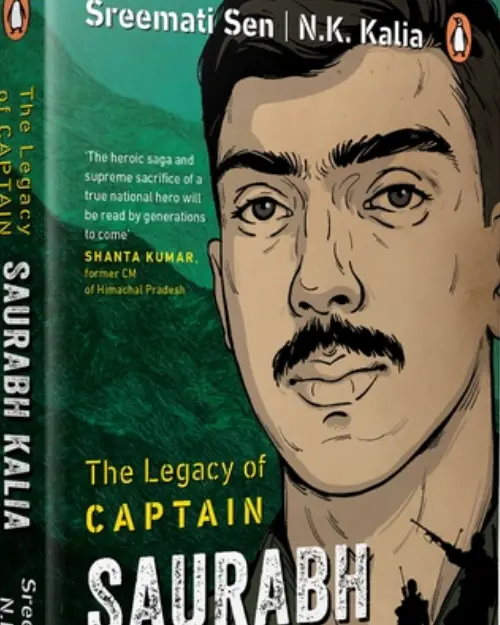
Sreemati Sen and NK Kalia’s The Legacy of Captain Saurabh Kalia is more than a biography. A solemn act of remembrance, it is a gracefully restrained narrative chronicling the life, sacrifice, and enduring legacy of Captain Saurabh Kalia, the young Indian Army officer, who was the first to give his life during the Kargil War.
The Penguin India book begins with tender, textured details of Saurabh’s early life in Palampur, a quiet town nestled amid Himachal’s tea gardens and Dhauladhar ranges. The authors meticulously establish the Kalia family’s modest yet value-rich world, portraying a childhood framed by discipline, warmth, and a steady sense of purpose. His father, Dr NK Kalia, a scientist, and his mother, Vijay Kalia, a government officer, created an environment grounded in education and patriotism. The book does not shy away from small, domestic joys, birdwatching walks along the River Neugal, chess games at night, and the gentle teasing between brothers, which serve to humanise a figure often remembered only through the prism of his final days.
As Saurabh matures, his aspirations take clear shape. A brilliant student with a degree in science from the Agricultural University of Palampur, he yearned for uniform. The narrative charts his disciplined progression through the Indian Military Academy in Dehradun to his commissioning into the 4 Jat Regiment in 1998. The timeline of events is carefully structured, and the writing remains firmly rooted in official records and family testimony, resisting the temptation to fictionalise thoughts or dramatise moments that cannot be verified.
Deployment
The deployment to Kargil in late 1998 placed Saurabh and his men at the edge of a simmering conflict. The high-altitude terrain, brutal winters, and lack of basic supplies are described with stark simplicity. The book offers a moment-by-moment reconstruction of the reconnaissance mission on May 15, 1999, during which Saurabh and five soldiers ventured into the Bajrang post sector, an area that Pakistani forces had covertly infiltrated. What followed was brutality. Outnumbered and outgunned, the patrol was captured and held for 21 days.
The authors present the grim reality of those three weeks with quiet reverence. There is no sensationalism. The evidence, gleaned from post-mortem reports, recovered personal effects, and official communication, is treated with dignity and restraint. This careful tone underscores the horror of what Saurabh endured, yet it also elevates his endurance and silence into an emblem of strength.
When Saurabh’s remains were returned, Palampur became a city in mourning. The book’s descriptions of public grief, the thousands lining the roads, the broken-hearted silence, the folded hands, and salutes capture the seismic emotional force of his return. The moment his mother walked behind his casket, defying social convention, the personal and national sorrow merged. These scenes form the emotional core of the book and are described with clarity and care.
The Biography
From this point, The Legacy of Captain Saurabh Kalia shifts from a biographical narrative to a documentary of remembrance. The Kalias’ grief does not fade; it evolves. The establishment of the Saurabh Van Vihar park, a memorial room in their home, and institutions bearing his name serve not just as tributes but as acts of public pedagogy. Dr Kalia’s relentless quest for justice, through letters, media outreach, and diplomatic pleas, emerges as one of the book’s strongest subplots. His demand for accountability from international agencies and the Indian state underscores a parent’s refusal to allow his son’s torture to be forgotten or politically ignored.
In documenting these efforts, the book brings into sharp focus the legal, moral, and diplomatic complexities of modern warfare. It touches upon parliamentary debates, military protocol, and the fragile honour systems that govern prisoner treatment during conflict. Though it does not delve into political analysis, the very inclusion of such details makes the book more than a personal story.
The Style
The authors’ approach is journalistic yet elegiac. The narrative remains linear, tightly focused, and devoid of unnecessary digressions. Their use of factual precision rather than emotional flourish works in favour of the story. The final chapters revisit the Kalia home in Palampur, where mourning has been slowly replaced by mission. The Kalias continue to host school groups, share Saurabh’s story, and live out the values he embodied.
In the broader landscape of Indian war literature, this book occupies a special space. It neither mythologises nor reduces its subject. It speaks with dignity and trusts the reader to recognise the enormity of what Saurabh’s life and death signify. It encourages readers to examine not just the horror of war, but the quiet power of family, the slow work of memory, and the unspeakable price of duty.
The Legacy of Captain Saurabh Kalia is not just about a soldier who died young. It is about a family that chose to keep his promise alive, a town that made his memory part of its daily rhythms, and a country that must not forget the bloodstained cost of its freedoms.