The once beautiful garden now appears poorly maintained, with walls collapsing and an overall air of neglect. The pillared pavilions and royal bathrooms are no longer visible. Although the octagonal arcade, renovated during the reign of Ranbir Singh, still stands, it too suffers from poor maintenance, reports Babra Wani
Tucked away in the foothills of Kashmir, down south, Verinag is a town named after its famous spring, which has been a beacon for tourists travelling to Srinagar. This natural wonder is also the primary source of the river Jhelum.
The spring’s tranquil beauty was not lost on Mughal Emperor Jahangir, who in 1620 erected an octagonal stone basin and an arcade surrounding it. His son, Shah Jahan, later added a picturesque garden to the site. Legends hold that the spring is remarkable for never drying up or overflowing. Its waters flow from a steep mountain spur, forming a picturesque scene surrounded by pine trees and evergreen vegetation.
The site’s historical significance has been formally recognised by the Archaeological Survey of India, which has declared Verinag Spring and the adjoining Mughal Arcade a Monument of National Importance. Jahangir’s intervention transformed the spring from a shapeless pond, with water spilling out at various spots, into a breathtaking sight. He commissioned carvers from Iran to sculpt stones for an octagonal tank, collecting all the water in one place.
The spring, a site of pre-Islamic sacred significance, was transformed by Jahangir into a breathtaking oasis. In 1620, during the 15th year of his reign, Jahangir created an octagonal tank and garden, as recorded on a stone slab set into the spring’s southern wall.
Jahangir’s affinity for Verinag was so strong that he wished to be buried there. However, Empress Nur Jahan refused, and today, none of the original pavilions remain.
In His Memoirs
In his autobiography, Tuzuk-e-Jahangiri, Jahangir recounts his visits to the Verinag spring. He describes the site as an octagonal reservoir, approximately 20 yards by 20, surrounded by the remains of a place of worship for recluses. The spring’s water is remarkably pure, with a depth that Jahangir measured using a cord with a stone attached.
Jahangir’s account reveals his fascination with the site. After ascending to the throne, he ordered the construction of stone walls around the spring, the creation of a garden with a canal, and the building of halls and houses nearby. His vision was to create a destination that would be renowned among travellers worldwide.
The spring, he notes, is the source of the Bihaṭ (Vyeth) River. In the language of India, he mentioned, vīr-nāg means snake, suggesting that a large snake once inhabited the site. He recalls visiting the spring twice during his father’s lifetime.
The spring’s surroundings, Jahangir observes, feature the remains of a place of worship for recluses, complete with cells cut out of the rock and numerous caves. The water, he remarks, is exceedingly pure, with a depth that was initially unknown. To measure it, Jahangir ordered a cord with a stone attached to be thrown into the spring, revealing a depth of no more than one and a half times the height of a man.
Following his accession to the throne, Jahangir oversaw the construction of stone walls around the spring, the creation of a garden with a canal, and the building of halls and houses nearby. His ambition, it seems, was to create a destination that would be renowned among travellers worldwide.
Seven years later, his son Shah Jahan, a fellow admirer of natural beauty, added cascades and aqueducts to the garden, enhancing its allure. He also built hot and cold baths to the east of the complex, although little remains of these structures today.
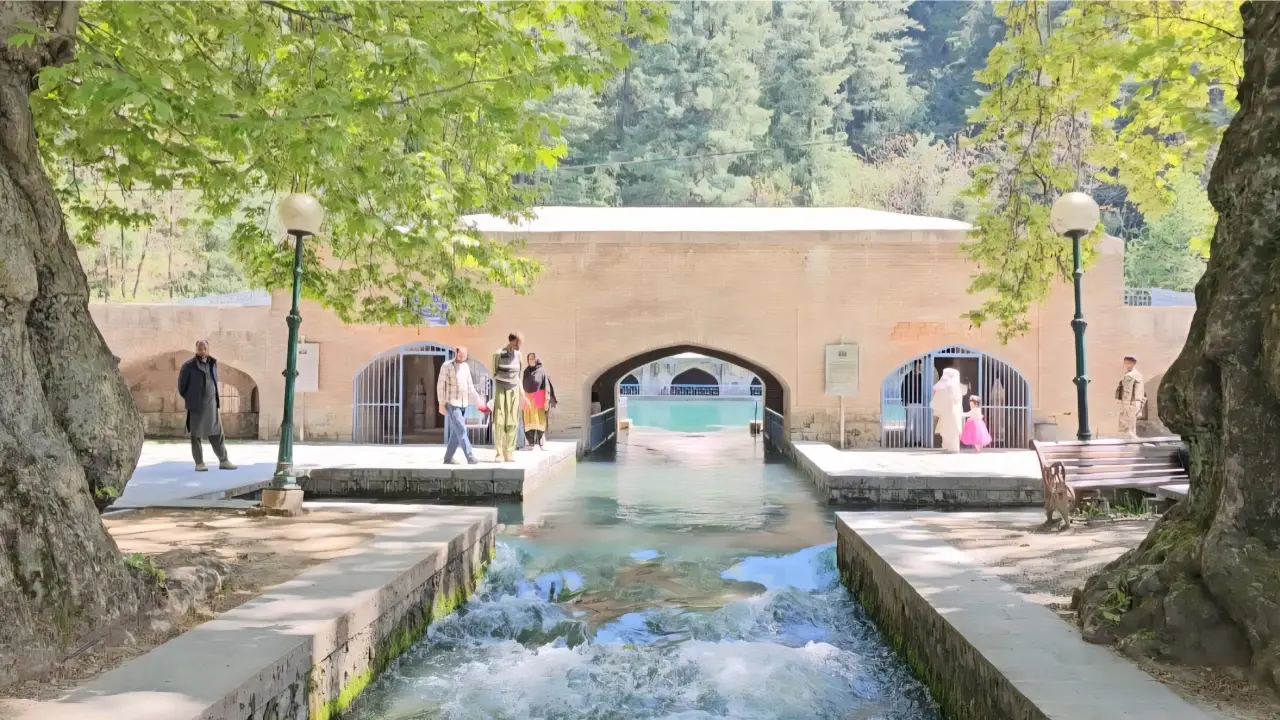
The octagonal spring itself is a marvel, containing crystal blue water home to a variety of large fish. The Persian sculptures on the surrounding walls offer clues about the spring’s design, but its secrets remain hidden. Water collects in a pool encircled by arched recesses before flowing down a 300-yard canal into the Bihat River.
Verinag Garden stands out as the only Mughal garden not designed in the traditional Islamic Charbagh style. Instead, it is situated in a picturesque setting around a hillside spring. This site has long been considered sacred in Hindu tradition, with Verinag believed to be the source of all springs. Abul-Fazl, the Mughal author of Ain-I-Akbari, noted the presence of numerous stone temples to the east of the Garden.
Jhelum’s Fountainhead
The spring is the main source of the river Jhelum. A main canal, approximately 12 feet wide, runs through the garden’s centre, connecting to a second watercourse beneath the building.
In his book, Gardens of the Great Mughals, Villiers-Stuart, C M vividly describes the allure of Verinag. “Camped under the cheers of the ruined garden, where the pine forest runs down a steep limestone spur to the tank in which the spring rises, it is easy to understand the romantic charm of Verinag,” he wrote in 1913.
Verinag, meaning “the secret spring”, according to Stuart, is part of the site, which held a special spell for Jahangir and his wife Nur-Mahal, who built a palace by the bright blue-green pool. The pool was home to sacred carp, some of which bore gold rings inscribed with the Queen’s markings. He has recorded that the octagonal tank built around the spring was designed to be the centrepiece of the palace buildings. This architectural feature was typical of Mughal design, where “no Omrah‘s (ruling elite) house at Delhi was complete without its fountain court”. The grand scale of the design is evident in the twenty-four arched recesses surrounding the reservoir, some of which contain small stairways leading to rooms above.
The cornice, though partially destroyed, showcases the fine craftsmanship of the building. The water rushes out of the large arched crypt on the north side, flowing under the chief facade of the house. As Villiers-Stuart poetically describes, “The stream, flashing through the gloom, lights up the dark arches with a flickering green magic like a mermaid’s cave, beyond which lies the serene upper world of the sunlit water court.”
Iqbal Ahmad, in his book Discoveries of Kashmir, laments the decline of Verinag’s charm. “Today, Verinag has lost its past allure,” he has recorded. Until 1988, the site was well-maintained, but the deteriorating situation in Kashmir took its toll. Neglect by the government and public has led to human vandalism and the crumbling of its ancient structures.
Poor Maintenance
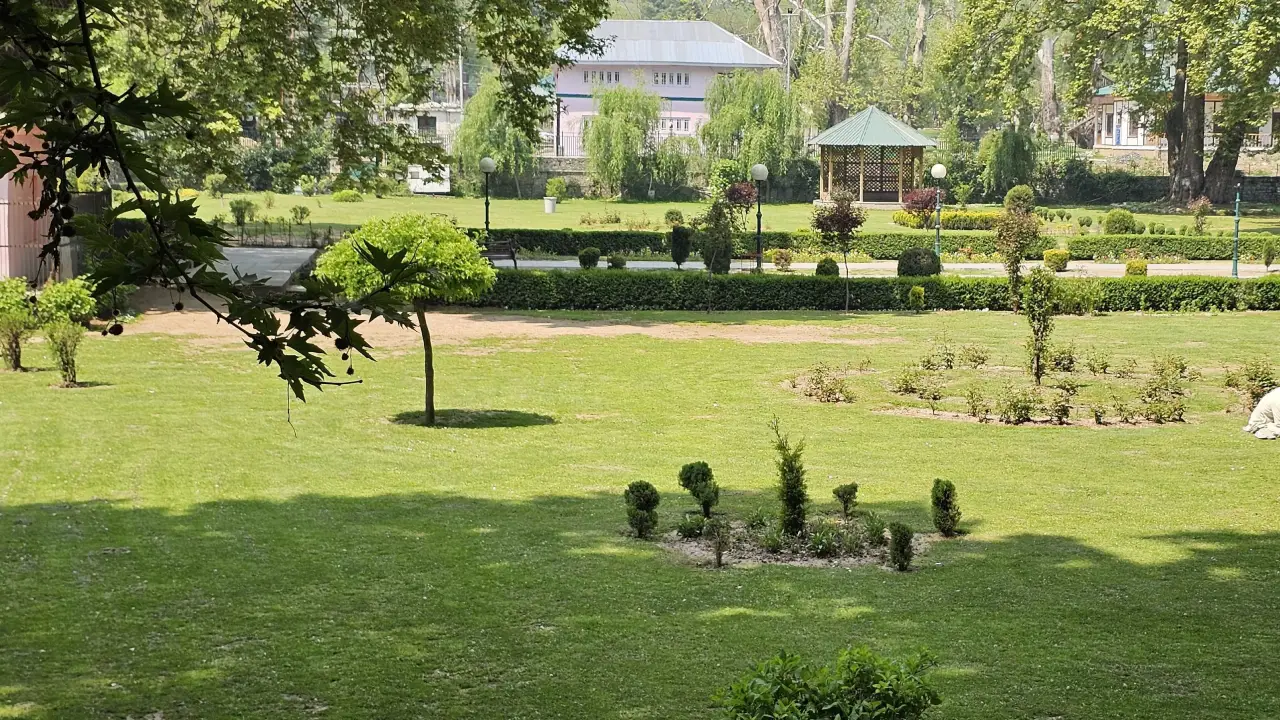
The once beautiful garden now appears poorly maintained, with walls collapsing and an overall air of neglect. The pillared pavilions and royal bathrooms are no longer visible. Although the octagonal arcade, renovated during the reign of Ranbir Singh, still stands, it too suffers from poor maintenance.
The Verinag spring has also been referred to as Nilakunda in Kalhana’s Rajtarangini. According to this ancient text, the land is protected by Nīla, the lord of all Nāgas, whose regal parasol is formed by the circular pond with the Vitastā’s newly rising stream as its stick. The text also notes that Gauri, having assumed the form of the Vitastā, still retains her characteristic inclination.
Verinag Garden, like other traditional Kashmiri gardens, is situated on a steep hillside with a water source at its pinnacle. The conventional Charbagh design had to be adapted to accommodate the site’s terrain, as the water source shifted from the typical central location to the highest point.
To address the challenges posed by the site’s topography, the garden’s designers opted for a central water axis, minimising the customary streams. This modification resulted in a unique blend of traditional Persian garden design and the natural landscape.
Garden Details
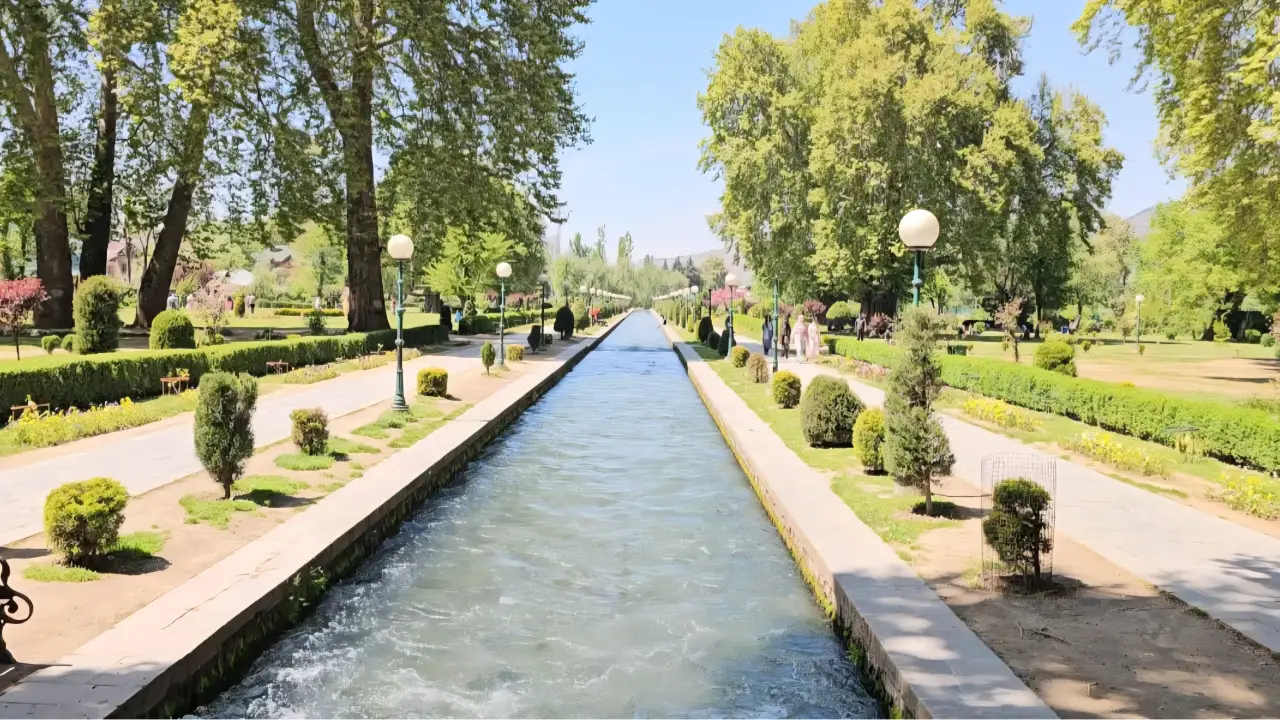
The garden’s rectangular design measures 460 meters by 110 meters, stretching down the slope of a hill with a slight deviation from the south-north axis. A water canal bisects the garden along its long axis, transporting water from the southern end to the Jhelum River at the northern end. This main canal intersects with an east-west canal at its southern terminus, with garden entrances located at the east and west ends of this canal.
A walkway connects the gates to the octagonal pool, accessed via a colonnade of 24 arches. The pool’s crystal-clear water, home to a variety of carp, is sourced from a spring deep below. The water drains from the pool into the main axial water canal, measuring 305 meters in length and 3.65 meters in width.
Originally, the garden featured some baradaris, which have since disappeared. Also missing are some toilets of the Mughal era. The garden underwent significant repairs during the Dogra dynasty in the 1870s. One of Verinag’s notable features is the seamless integration of the surrounding landscape with the formal geometry of the garden. The densely covered hills provide a striking backdrop to the arcaded pavilion surrounding the spring, while the blue-green waters teem with fish. As the water combines with the natural stream of the Jhelum River, the formality of the garden’s design gives way to a more natural, serene ambience.