by Iqbal Ahmad
Kashmir’s myths, historical records, coins, and architecture reveal centuries of interaction between Greek, Persian, and Indian cultures, establishing the region as a long-standing civilisational crossroads
Indeed, there are various stories based on ancient myths and traditions about this land, presently called Kashmir or Kasheer. Among these myths, one speaks of Kashyapa or Kashyap Rishi, a saintly figure believed to have drained the waters of a lake once called Satisar.
Similarly, another myth suggests that it was Prophet Solomon, regarded as the prophet of jinn (demons), who directed the demon of this lake to release its waters, making the land suitable for human habitation. There is still a place in Srinagar known as Solomon’s Throne, believed to be named after this prophet.
Scientifically speaking, these are interesting mythological tales that lack concrete historical evidence. Geologists and archaeologists, on the other hand, hold that climatic and geological changes over time gradually drained the waters. A major factor is believed to have been a devastating earthquake near Baramulla, which removed natural bottlenecks and allowed water to flow out.
Historically, the earliest mentions of ancient Kashmir are found in Greek and Persian records. Ancient Greek sources refer to this mountain-locked land as Kasperia, identified with Kaspapyros of Hecataeus of Miletus and Kaspatyros of Herodotus. It is also believed to correspond to Ptolemy’s Kaspeiria.
In local historical records, however, it is referred to as Kashmira. Kalhana, the first historian of this land, mentions it as Gandhara, Kashmira, indicating its association with the Janapada of Gandhara, present-day Kandahar.
The term Kashmira appears to be a derived or altered form of Kaspeira or Kaspapyros. Locally, it is known as Kasheer, and the people and tribes living on its borders also refer to it by this name.
Foreign records also mention its principal river, now known as the Jhelum. The ancient Greeks called it Hydaspes, while Alexander the Great referred to it as Bidaspes. Persians knew it as Behat, and in Sanskrit texts it is called Vitasta or Vedasta. Locally, it is popularly known as Vyeth, which appears to be a derivative of the Persian term Behat. There are also two small settlements along its banks named Vethpur and Behatpur—one near Srinagar and the other in the Bandipora area—suggesting the Persian influence on the river’s present name.
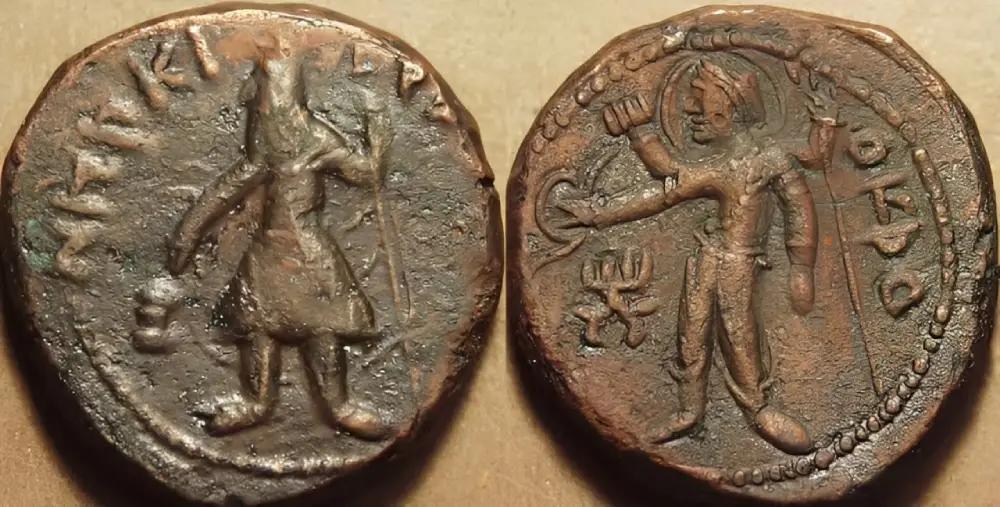
Kashmir has historically maintained cultural, trade, and commercial links not only with Central Asia but also with Persia, China, and the Greek and Roman worlds. Indo-Greek, Indo-Scythian, and Kushan coins found in the region depict various local deities, particularly Shiva with his bull and trident. Kashmiri pashmina and silk textiles were highly favoured by Roman and Greek elites and remained popular in Europe until the late twentieth century, with many preserved in museums.
Ancient records note that King Darius (circa 522–486 BC) invaded the Indus region around 518 BC. Alexander the Great is recorded to have invaded north-western India, defeating King Porus at the Battle of Hydaspes in 326 BC. Historians believe his route may have passed near the confines of Kashmir, then under the rule of Abhisara (covering present-day Poonch and Nowshera).
Alexander crossed the Indus near Ohind (modern Attock) in 326 BC. Numismatic evidence depicts two kings in combat—one on an elephant and the other on horseback—identified as Porus and Alexander. Abhisara is said to have submitted to Alexander, who subsequently placed Porus in charge of territories between the Beas and the Jhelum, while extending Abhisara’s authority towards Kasperia.
Although Abhisara’s control over Kashmir is not firmly attested in other sources, numismatic findings suggest Greek presence in regions bordering the valley, indicating possible contact with Kashmir. Before returning, Alexander allowed some of his troops, mainly Greek garrisons, to settle in frontier areas near Kashmir.
Local records also mention invasions by the Mlechhas and Yavanas, identified with Bactrian and Indo-Greeks. Two notable Greek rulers mentioned are Demetrius and Menander. Demetrius is described as ruling territories that included parts of southern Kashmir. Menander is said to have held discussions with the Buddhist monk Nagasena at a place located about 12 yojanas from Kashmir.
These discussions, recorded in the Milindapanha, are believed to have taken place near the Zabarwan hills, close to present-day Harwan, around 19 kilometres from Srinagar. Other Greek rulers whose coins have been found in the region include Eucratides, Apollodotus, Strato, Zoilos, Hippostratus, Antialcidas, Agathocles, Pantaleon, and others. Coins of the Indo-Scythians and the Kushans have also been discovered.

These coins display not only Greek scripts but also Indian motifs and deities, indicating a synthesis of cultures and the influence of Indian Shaivism and Buddhism. Notably, names such as Shiva and Buddha appear in Hellenised forms like “Oesho” and “Boddo.”
Archaeologists have also identified strong Greek influences in ancient Kashmiri stone architecture. Alexander Cunningham, who conducted early studies of these remains, noted similarities between Kashmiri temple architecture and Greek styles. In his essay, An Essay on the Aryan Order of Architecture as Exhibited in the Temples of Kashmir, he observed that many temples resembled Greek structures more than typical Indian ones, suggesting that such similarities were unlikely to be coincidental.
Thus, Kashmir finds mention in ancient Greek records, which also named its rivers and geography. Above all, it emerges as a region where diverse cultures have intersected and interacted over centuries.
(The author is a retired archaeologist. Ideas are personal.)