by M J Aslam
Choub, a Persian-origin word, symbolises power and authority in Kashmiri culture. Historically used for discipline, taxation, and trade, it also appears in traditional accounting and medicinal practices, reflecting socio-economic structures.

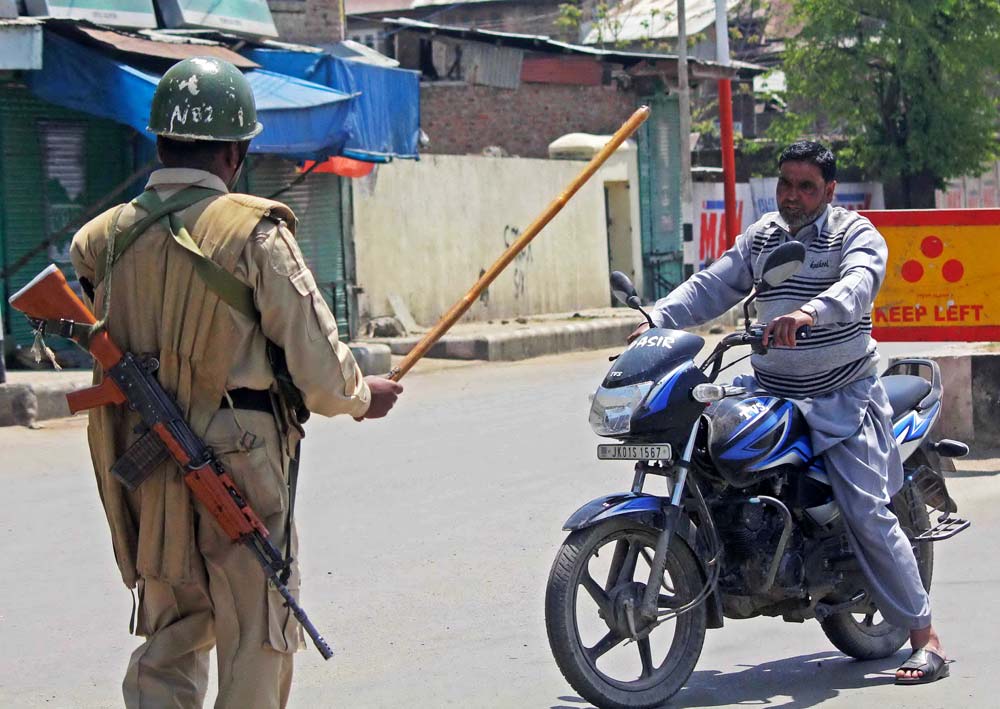
Choubis a Persian word that fundamentally denotes a wooden stick, rod, mace, twig, shoot of a tree, beam, or similar objects. With its roots in Persian etymology, Choubalso carries connotations of beating. In Kashmiri, the phrases Choub Khi’yn or Choub Di’yn translate to being thrashed or thrashing someone, respectively. Historically, the Choub, as a stick or staff, symbolised power and authority, often associated with figures such as policemen, Tehsildars, or teachers.
In schools, it was common for children to be subjected to the stick by teachers as a means of enforcing discipline, alongside the use of Soi (stinging nettle) as a form of punishment for so-called errant behaviour. Fortunately, such practices have since been mostly abolished.
Choub, or Chabuk, was also employed as a whip to hasten horses or cattle. The term Chouban, referring to a herdsman or horse keeper, is linguistically related to Choub. Its meaning expands when prefixed to certain nouns or verbs, such as Hunis Choub, Kharas Choub, or Zaminas Choub. In Kashmiri, the phrase Zan ditik or zan piye hunis choub describes the act of harshly beating someone, akin to beating a dog, without the perpetrator feeling any guilt or shame.
The thrasher could be anyone—a policeman, parent, spouse, relative, or even a stranger—inflicting blows with a stick or without, using fists, slaps to the face or head, kicks, or other forms of physical violence, whether inside or outside the home, on the road, or elsewhere. This act is also referred to as mar dyun. Meanwhile, zaminas choub signifies exertion, exercise, or effort that is ultimately futile. What, after all, does one achieve by striking the ground with a stick?
Choub, whether represented by a stick, mace, whip, hammer, or similar object, has historically symbolised authority or power—from the gavel of a judge or auctioneer to the club manager’s tool, the chabuk of a Jagirdar, or even the kamcha wielded by a horse or cart driver to control their animal. In essence, Choub embodies power and authority over weaker beings.
A vestige of medieval tradition persists in some high courts of India, where an attender, known as apiyada, jamadar, or simply a peon, clad in official attire, walks ahead of a judge to ensure the order as the judge proceeds from their private chamber to the courtroom and back. This footman, typically holding a staff, maintains a respectful distance while escorting the judge. I witnessed this practice myself at the Karnataka High Court in 2008.
Choubdar of Kashmir
With its roots in Persian, the term Choub-dar referred to an individual in old Kashmir who carried a mace or staff during the collection of revenue from villagers. Also known as a piyada, he led the way for a team of revenue officials visiting each village.
This team, operating under the authority of the Wazir e Wazarat(district level) and Daftar e Diwani(state or province level), comprised a host of officials, including the Tehsildar, Nib Tehsildar, Thanedar, Kardar, Mukhdam, Patwari, Shakdar, Chakladar, Lambardar, Tarukdar (orTarazu-dar), Harkara, and Doom. The Choub-dar invariably accompanied this team, which was headed by the Tehsildar of the time.
Brandishing his stick, or Choub, he issued orders to the impoverished villagers and demanded their share of grain for the Maharaja. Though he wielded no formal power or authority, the Choub-dar was a symbolic figure, defined by the staff he carried in service of his masters. On occasion, he may have even used the stick against the peasants.
There is a related proverb in Kashmiri that goes as follows: Kur Gayi Lori Rusti Choubdar. It suggests that a daughter was, and remains, in her parents’ home like a Choubdar without a mace. Daughters have always been the darlings of their parents, the most cherished and deeply respected members of Kashmiri households, both in the past and present. Indeed, daughters have been dignified members of families across all societies, from East to West and North to South.
The proverb appears to have been used in a light-hearted manner, drawing a comparison between this honoured member of the household and the Choubdar of old, who issued orders without wielding a Choub in her tender hands—orders that parents obeyed much like the poor villagers of old Kashmir once did.
Choub Khat
The term Choub was also associated with a traditional method of accounting in old Kashmir, known as Choub Khat. This system was employed by bread-sellers or milk-sellers to maintain separate accounts with each household in their mohalla or village, where bread or milk was provided on credit.
A Choub, a small, polished, sturdy, and straight stick, typically about a foot in length, was kept by the household and used by the milk-seller (Go’ir) or bread-seller (Kan’dar). The seller would carve tiny v-shaped marks into the stick with a sharp knife, arranged in vertical rows. This stick, utilised for this archaic yet practical method of record-keeping, was referred to as Choub Khat.
This unique method of maintaining customer accounts was largely a response to widespread illiteracy and poverty among Kashmiri Muslims, despite the availability of paper and account books. The practice persisted in the valley until as recently as four or five decades ago.
Herbal Connection
The term Choub also features in the names of certain medicinal shrubs native to the valley. One such example is Choub e Kuth, the aromatic root of Kut (saussurea lappa), known as Kuth in Kashmiri. In Persian, it is referred to asQust or Kust, beginning with either of the two alphabets, qaf or kif.
This medicinal root, derived from the costus plant, was exported from Srinagar, Kashmir, to Lhasa via Leh. The oil extracted from Kuthwas used both as incense and as an insect repellent for agricultural purposes. The plant formed a significant part of the trade between Kashmir and Punjab, and its presence was unmistakable along the Jhelum Valley route, where loads of the shrub emitted a sweet, violet-like fragrance that could be recognised from afar.

The higher reaches of northern Kashmir were abundant in the production of Choub e Kuth, which was gathered during the summer months by shepherds and herdsmen. Sir Lawrence has provided a detailed account of this plant, noting that it was a state monopoly and generated substantial profits for the region. The product was exported to ‘Hindustan’, and from ports such as Bombay and Calcutta, it was supplied to the Red Sea and China, where demand was particularly high. Choub e Kuthwas valued as an excellent remedy for preserving clothes from insects and was widely used in perfumery.
Sir Lawrence also highlights its medicinal properties, describing it as a tonic, aromatic, and stimulant, effective in treating coughs, asthma, fever, dyspepsia, and skin diseases. Additionally, the term Choub forms part of the name of another plant, Smilax China, a shrub or tuberous root imported into Kashmir from China.’
The renowned Choub Chini or Choub e Cheenwas regarded as a sovereign remedy by all the Hakims of old Kashmir for treating serious ailments such as prolonged fevers. Another notable root, Choub Kar, was produced and exported from Kashmir to Punjab. Its oil was used to alleviate neck stiffness, and it was applied to the hind legs of horses to straighten and strengthen them, as curvature in a horse’s legs was considered a significant flaw. Additionally, a special variety of haldi(turmeric) was exported from Kashmir and Punjab to East Turkistan, particularly Yarqand, where it was known as Zard-Choub. This indicates that, much like in Kashmiri, the term Choub had also found its way into the Yarqandi Chagtai language.
End-word
Choub symbolises the enduring inequality between the strong and the weak, the powerful and the powerless.
(The author is a historian. Ideas are personal.)