by Sri Varshith Kumar Reddy E
A thousand years of Kashmiri economic policy, and four ideas the Valley has yet to try.
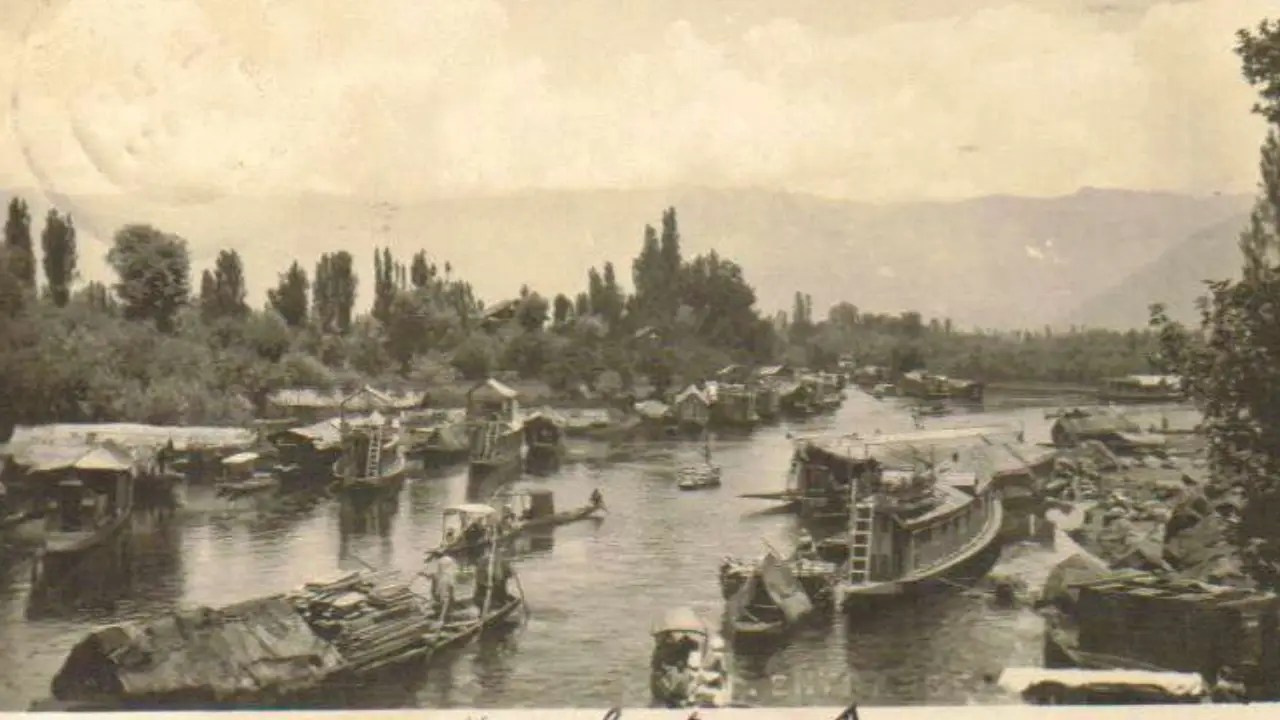
Kashmir’s economic past is usually told through its rulers. It is better told through two questions that every regime had to answer: who controls the water, and how much of the harvest leaves the field. The answers varied enormously, and so did the prosperity that followed them.
Taming the Vitasta
Kalhana’s twelfth-century chronicle, the Rajatarangini, treats flood control as a matter of state. During Avantivarman’s reign, the engineer Suyya was given a free hand to remove the boulders that choked the Vitasta. The river was regulated, and the floodplains drained. Suyya also shifted the river’s junction with the Sindhu to a point near Srinagar and carried the combined waters through the Wular lake.
Kalhana’s pages also show what happens when this fails. In one famine, a khari of husked rice sold for 1,050 dinnaras. Chronicle figures like this should be read as testimony, not statistics, but the pairing of famine and flood is clear enough. In an agrarian valley, engineering was the first form of social security.
The Sultan
The fifteenth century supplies a different template. Sultan Zain-ul-Abidin ruled from 1420 to 1470, and his reign is recognised as a period of significant economic development and cultural flourishing. Scholars point to his role in craft education and in preserving traditional crafts. The wider Sultanate economy was rooted in agriculture and revenue while becoming more connected to the Persianate world. Skills, not conquest, were the engine.
Later regimes pressed on the field. When the Valley joined the Mughal Empire in 1586, land revenue was in theory one-third of the produce, but in practice it came to two-thirds. The Sikh era left a detailed record. A recent study of Sikh taxation describes a worked example from a village in Pargana Audvin. Of 90 kharwars of produce, the government took 45 as its share, plus 15 more as trukki and abwab, for a total demand of 60. Revenue was farmed out annually, and farmers who missed the target to Lahore were often jailed, which pushed them to squeeze the peasants harder.
The Shawl
The Valley’s most celebrated product became its most heavily burdened one. By the 1820s, the revenue the state drew from shawl weaving exceeded that from all other sources combined. The Afghan governor Haji Karimdad Khan created a department for the purpose, the Dagishwali Mehkama, which ran a state-owned factory system. Under the Dogras, a tax of 48 chilki rupees fell on each weaver, collected through a farmer of the shawl revenue, and a 25 per cent duty on every shawl was added. Officials collecting it often added another 25 per cent. A weaver earned seven or eight rupees a month.
The system also tied the craft to a distant geography. Kashmir earned net revenue of Rs 12 lakh a year from imports of Tibetan wool, and when those imports slowed, the Maharaja made up the shortfall by taxing weavers harder. A scholar of Kashmir’s craft economy lists silk, saffron, paper, tobacco, wine and salt among the products held as state monopolies. The consequence was predictable: looms fell in number, and weavers who could escape left for the Punjab. The weavers’ agitation of 1865 is remembered by some historians as an early labour protest. Its causes were fiscal, not ideological.
Settlement, Power and Reform
The correction came in stages. Walter Lawrence carried out the first systematic land-records settlement in 1889, under Maharaja Pratap Singh. His settlement favoured hereditary occupancy rights, cash collection of revenue, and a fixed demand for each holding. The Glancy Commission, appointed in 1931, recommended restoring proprietary rights to cultivators. A 1933 order then conferred those rights, including sale and mortgage, which was the first time in Dogra rule that the peasant was declared full owner.
Technology arrived in the same era. The Mohra hydroelectric station on the Jhelum was commissioned in 1905, after the major floods of 1903. Its power ran dredgers meant to reclaim flood-affected land and supplied the silk factory in Srinagar. Its design also did two jobs at once: a canal fed the turbines and also supplied water to farmers for irrigation. It is a rare early example of the Valley treating power, flood control and farming as one system.

Independence deepened the break with the older tax state. In July 1950, the Big Landed Estates Abolition Act capped holdings at 22.75 acres, aiming to transfer estates to “actual tillers”. One scholarly account puts the expropriated area at 4.5 lakh acres. A 1976 Agrarian Reforms Act then set a ceiling of 12.5 standard acres. A rights group reported in 2020 that the 1950 Act had been abolished, and an LSE commentary has framed the later direction as a move from “land to the tiller” to “land to the highest bidder”. Judgments on that shift differ.
What Exists Today
Present policy carries echoes of this record. The Jhelum–Tawi Flood Recovery Programme’s first phase was sanctioned at Rs 399.29 crore, and a second phase is planned at Rs 1,623 crore. A comprehensive river morphology study was announced in 2025. In 2026, the J&K government moved to revive the Mohra plant, approving a tender to engage a transaction adviser for renovation and upgrade of the 10.5 MW project. On craft, Pashmina from J&K received a Geographical Indication tag in 2023, and the Craft Development Institute runs a Pashmina testing and quality certification centre. On industry, the Centre approved a Rs 28,400 crore scheme running to 2037, with incentive caps of Rs 5 crore and Rs 7.5 crore depending on the zone.
Four Ideas for Debate
These are proposals, not claims about current law. Each draws on a verified precedent above.
A river-and-canal trust. Suyya’s works treated drainage as a public good, and Mohra’s canal showed that one channel could serve both turbines and fields. A statutory village water trust could take custody of local channels, with maintenance funds released against measured drainage and irrigation outcomes.

A master–apprentice stipend. Craft education was central to the Sultanate’s economy. A multi-year stipend for certified master artisans, paid per apprentice who completes training, would extend that tradition beyond product certification.
A weaver’s tax-and-wage floor. The shawl economy collapsed when taxes outran wages. A statutory floor, under which total levies on a craftsperson never exceed a set share of declared earnings, would turn that lesson into law.
A published levy schedule. The Sikh-era example shows how trukki and abwab could stack on top of the state’s share, and Dogra shawl officials added their own surcharge. A single public list of every fee a farmer or artisan can face, with legal caps on new ones, would make that stacking visible.
The Lesson
Kashmir’s strongest policies treated water, skill and secure tenure as investments, and Mohra showed that technology could serve all three at once. Its weakest ones treated the harvest and the loom as revenue targets. Both instincts remain available to any government that governs the Valley.
(The author is a pracademic working on government policy and public institutions. Ideas are personal.)