by Nasir Hamid Khan
New US-India trade terms slash import duties on apples and raise carpet export tariffs, raising fears of market losses, farmer distress, and economic risks for Kashmir.
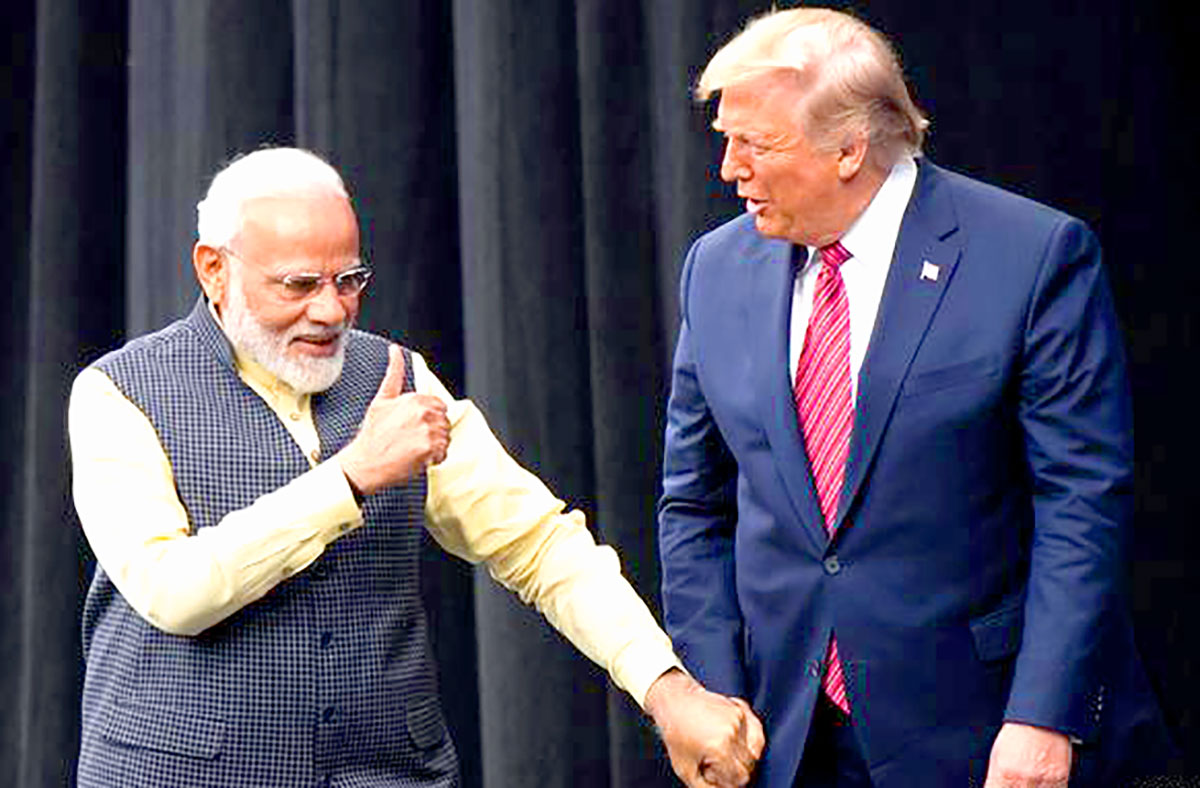
On February 3, even when details about the trade deal were being sought in the Parliament of India, the Kashmir Chamber of Commerce and Industry came out with a press statement which, among others, hailed the leadership of Commerce Minister Piyush Goyal and declared that the deal was a “landmark step” which would be a “major boost not only for the handmade carpet sector but for the entire handicraft industry of Kashmir.”
On February 7, Piyush Goyal made public the details of the deal on his X account, and a cursory look indicates that Kashmir’s economy would be among, if not at the top, of the worst-hit. Read with the February 2 declaration of President Trump, the following facts vis-à-vis Kashmir emerge:
India has agreed to reduce tariffs on imports of industrial goods, food and agricultural products to zero per cent. These include tree nuts, fresh and processed fruits and “additional” products.
The United States would impose a “reciprocal” tariff rate of 18 per cent on exports from India. These include textiles, apparel and artisanal products.
India also agrees to address long-standing non-tariff barriers to trade in US food and agricultural products.
The United States affirms that it intends to take into consideration, during the negotiations of the BTA (Bilateral Trade Agreement), India’s request that the United States continue to work to lower tariffs on Indian goods.

To understand the impact of the waiver of duty to zero, we need to look at the previous history of the apple trade. Till 2019, the US paid a duty of 50 per cent on the export of apples to India. As a retaliatory measure for Washington increasing tariffs on Indian steel and aluminium products, India in 2019 imposed an additional 20 per cent duty on US apples and walnuts, and Rs 20 per kg on almonds, on top of the existing 50 per cent duty.
India agreed to remove the additional duty of 20 per cent on US apples when Prime Minister Modi visited the US in June 2023 under one of the six World Trade Organisation disputes India and the US resolved. In response to protests by farmers of Himachal Pradesh and Kashmir, Piyush Goyal had then clarified that there was no duty reduction on apples and only the retaliatory 20 per cent duty had been removed. On the contrary, he stated that the government had imposed a minimum import price of Rs 50 per kg on imports of apples from all countries except Bhutan.
The rationale given by Piyush Goyal was that “…this will ensure that no one can flood Indian markets and hurt our farmers.” It was reiterated that there was no reduction in the MFN duty on apples, walnuts and almonds, which still applied to all imported products, including US-origin products.
The Minimum Import Price (MIP) of Rs 50 per kg for apples from the US and other countries (excluding Bhutan) was imposed to protect domestic farmers from flooding and predatory pricing. The government maintained that the 50 per cent duty and MIP were sufficient to protect domestic farmers. It is not yet clear whether the MIP would remain in operation after the new trade deal and whether that would be enough to protect domestic farmers.
Given that Apple imports from other countries would still attract a 50 per cent duty, the United States would therefore exclusively control the Indian apple market, in other words, a monopoly.
Domestic growers have pointed out that only 7-8 tonnes of apples per hectare can be produced in India, whereas 40-70 tonnes per hectare are produced in countries like the US, Iran, New Zealand and China owing to better geography, advanced technology and mechanisation. As per press reports, on February 4, much before the details of the trade deal were made public, reading economic devastation in President Trump’s message, Himachal Pradesh apple growers had already called for a mass agitation.
The necessity of protection for domestic farmers can be gauged from a study of the impact of the 20 per cent retaliatory duty on US apples from its imposition in 2019 till 2023, when it was lifted. It had a significant impact on trade dynamics, shifting market share away from the US towards other nations.
The fall was so drastic that imports of US apples declined from 1,27,908 tons in 2018–19 to 4,486 tons in 2022-23. The annual import of apples globally has been stable in the vicinity of 239-305 million USD, estimated at around 5 lakh tons and projected to be 6 lakh tons. During the period 2019-2023, the dominant US market share was taken over by countries like Turkey, Italy, Chile, Iran and New Zealand, reflected in imports from countries other than the US increasing from 160 million USD in 2018–19 to 290 million USD in 2022–23.
With an annual yield ranging between 25-28 lakh tons, India is the 7th largest producer of apples, and approximately 80 per cent of this yield comes from Kashmir. The industry, with its direct and indirect ventures, is Kashmir’s largest employment generator, providing 400 man-days of work per year per hectare of orchards, employing 3.5 million people and contributing 8 per cent to our GSDP in 2023-24.
The waiver of duty on US apples would not only wipe out all other countries from the Indian market but also pose an existential threat to domestic farmers. In effect, the move has the potential to hand over an annual market of 30–35 lakh tons to the United States. I do not see how our farmers would compete with the industrialised, advanced farmers of the United States. They are 200 years ahead. So far, there is nothing to protect them from predatory pricing and flooding of markets.

Now, coming to the imposition of tariffs on the export of carpets, which stood at 2.90 per cent till recently, before retaliatory duties of 25 per cent plus 25 per cent penal duties took it to 52.90 per cent. Unlike India, which not only removed the retaliatory duty of 20 per cent on apples imposed in 2019 but completely waived off the original duty of 50 per cent, the United States has chosen to retain the duty at a whopping 18 per cent, more than six times what it originally was. To top it, it has been termed a “reciprocal tariff rate.”
To my mind, only the President of the United States who announced the deal, or the President of the Kashmir Chamber of Commerce and Industry who welcomed it, would be in a position to explain the reciprocity of the deal and how a six-fold increase to 18 percent could be termed a landmark step that would “enhance global competitiveness of Indian products, particularly Kashmir.” By this logic, the higher the tariff, the more competitive we become. By welcoming the 18 per cent tariff rate, the Kashmir Chamber of Commerce and Industry has also closed the doors for negotiating a reduction or waiver of tariffs for products of Kashmir, the distressed state of our economy, they were duty-bound to watch over and protect.
It reminds me of lines from Malcolm X’s interview of March 1964, where in response to a question about progress, he said: “If you stick a knife in my back nine inches and pull it out six inches, there’s no progress… Progress is healing the wound that the blow made.”

The least our Kashmir Chamber of Commerce could have done was to acknowledge the existence of the knife of the 18 per cent tariff on our products and work for its removal. It could have opposed the waiver of duties on US apples, walnuts and almonds and brought to the notice of the authorities that it would have devastating consequences for our farmers and others dependent on this vital industry. The devastation of the apple crop during the 2025 floods, when apples were thrown on roads, ditches and waterbodies, is a sight whose pain no Kashmiri can forget. The impact of the trade deal on another critical sector of agriculture is so far ambiguous.
It is time that the Kashmir Chamber of Commerce and Industry understood that it is meant to be the foremost watchdog of the economic interests of Kashmiris, not a body whose silence on critical economic and social issues has only resulted in irreparable damage to Kashmir’s interests.
I find it appropriate to end an article on the US-India trade deal with the much-famous American-English ending: “Thank you for your attention to this matter!”
(Secretary General of Amar Singh Club, the author is a former Senior Vice President, Kashmir Chamber of Commerce and Industry. Ideas are personal.)