The Last Knot unsettles precisely because it defies conventional narrative expectations. There is no tidy conclusion, no heroic triumph or daring escape but Shabir Mir compels readers to inhabit the same uncertainty that torments his protagonist, writes Khan Muzamil
When I first read Shabir Ahmad Mir’s The Plague Upon Us, I felt as though my adulthood was navigating the harsh, unyielding spheres of survival. Now having just finished his second novel, The Last Knot, I am transported back to my childhood — to those nights when I would plead with my parents to tell me a story. And they would oblige, though not with tales of sweetness, but rather with narratives laced with Rantas and Haapat. These stories would make me laugh, yet they also sent shivers down my spine, leaving me trembling and on the verge of losing control.
Some stories transcend the mere recounting of events; they become haunting metaphors that gnaw at the soul long after the final chapter has been closed. The Last Knot is one such story — a labyrinthine tale of love, oppression, rebellion, generational trauma, and the relentless human pursuit of freedom. At its core lies the motif of suffocating legacy and societal control, set against the irrepressible human urge to dream, to seek deliverance, to escape. The novel is not merely about one man’s struggle against fate; it is also a reflection of the collective struggle of those who have long lived under the shadows of domination, both familial and imperial.
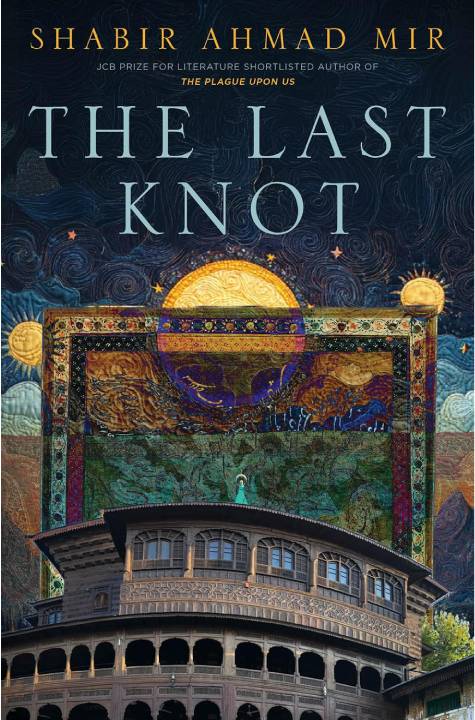
The story unfolds in the heart of nineteenth-century Srinagar, where a young carpet weaver is bound to his craft, tying thousands of knots each day. With every knot, he is drawn deeper into the snare of a life of submission. Yet, unlike the generations before him, he harbours a dream — a vision of creating a carpet that would defy the very earth beneath him and take flight. A carpet that might, in its defiance, liberate him from all that ensnares him.
The city, however, stands as a reminder of restraint. Each morning, the cannon from the fort pierces through the air, scattering pigeons into the sky. Their frenzied flight is a haunting reflection of the protagonist’s own suffocation — a desire to break free, yet constantly drawn back to the ground. The city watches, and remembers. The scattered feathers that fall back to earth are a reminder that even wings cannot always guarantee flight.
Yet freedom comes at a price. As the weaver soon discovers when he dares to disrupt the taalim. his defiance shatters the silence of his world, compelling him to flee the karkhan in pursuit of something intangible yet profound — hope. Beneath the shadow of Haer Parbat, he encounters Abli Bab, a thumbless former maestro, who speaks of a legendary flying carpet. This carpet, adorned with Solomon’s star and woven from silk dyed in an immortal blue lost to time, is said to have once soared through the skies, defying both the laws of nature and the chains of servitude.
The weight of Haer Parbat, the fort, that stands atop it only grows heavier with the flow of the narrative. The fort stands as an unmovable vulture, with its talons digging into space and time. “They even control time,” the protagonist reflects, as the midday cannon blast echoes through the air. This one-line-chilling and profound expresses the very nature of imperial power, where even time is regimented by its masters.
Mir’s mastery lies in his portrayal of suffocation which is both physical and existential. The apprentice weavers, in much the same predicament as the protagonist, are trapped in an interminable cycle of tying knots, “like bewitched silkworms who must suck on the threads of the weft balls hanging from the loom.” Time has become a prison for him as it is frozen not by days or hours but by the slow and excruciating making and unmaking of a carpet. It is a horrific metaphor of generational bondage through which the loom never stops, only the knots change hands.
The most harrowing weight of all is carried by the protagonist himself. His refusal to conform — his desire to tie knots that break the ground — is perceived as madness. “Weave,” they tell him. “Tie the knots and let it be.” But in his mind, the loom has turned into a grotesque prison. Even his own master, the wusteh, is unsettled by his disobedience: “What madness is this?”, he cries. The protagonist, however, knows better. He is not mad; he is simply unwilling to accept the world as it is.
The book is layered with silences — deliberate, haunting silences. There is silence when the Rangur refuses to dye blue. The silence when the fort cannon explodes to declare the day’s beginning. Silence when the protagonist watches Heemal pour water into her father’s cauldron. The silence when the knots are tied day after day, month after month as if measuring “the void of eternity in handfuls.” Mir captures the unspoken suffocation of an entire society through these voids of sound, where what is not said is more powerful than what is.
An Elusive Carpet
The weaver is spellbound. If such a carpet could exist once, why should it not be recreated? In that moment, he seals his fate, determined to tie the final knot that will break the shackles of his existence. Yet the path ahead is perilous, fraught with secrets, betrayals, and the unbearable weight of destiny. Disguising himself as a moutt, he attempts to blend into the city’s chaos, only to stumble into the lives of a rangur and his daughter, Heemal. It is here, amidst cauldrons of boiling dyes, that the weaver encounters a deeper mystery — the rangur refuses to dye anything blue.
The rejection of blue is not just a rejection — it’s a rejection of hope itself, it’s like saying that hope has no place here. Like a man possessed, the rangur proclaims, “There is no blue here. There can never be.” This ghostly proclamation echoes not only throughout the dyeing room but also through the protagonist’s own despair. He sees colour after colour animated on its surface, but the absence of blue — the colour of flight, the colour of expansiveness — gnaws at him like a ceaseless nightmare.
In a moment of shocking agony, the protagonist jumps into the river and screams, “Where is the blue?” The sound clawed against the indifference of the surrounding world. It is such a visceral moment that it bleeds off the pages into reality – his desperation has an almost tangible quality. The weaver, still with all his paint and madness behind him, understands that in his pursuit possibility of creating a flying carpet, he is not merely seeking to escape; he is quietly defying the injustice surrounding him. To create a flying carpet would be to surmount every chain fastening him down.
Why does the rangur avoid blue, a colour that embodies the infinite sky, the boundless expanse of freedom, and the promise of flight? Is it mere superstition, or does it conceal something far more profound? The answer remains as elusive as the weaver’s quest itself. Yet his growing bond with Heemal awakens something within him — an ache, a new kind of imprisonment. Love, with its invisible chains, binds him just as Heemal is trapped under her father’s authority and the crushing weight of her unfulfilled desires. Without words, they recognise in each other a shared yearning for liberation.
Yet the world is unkind to dreamers. The imperial forces soon catch the scent of the runaway weaver, and the towering walls of Haer Parbat cast an ominous shadow over his aspirations. Still, the weaver presses on, resolute in his determination to realise the unimaginable — a carpet capable of flight. What was once a mere task has now become an act of devotion; each knot he ties is a prayer, and every thread he spins is a defiance of fate.
Exploring Trauma
In The Last Knot, Shabir Mir does not merely recount a tale; he crafts a sweeping exploration of generational trauma, unfulfilled love, and the enduring ache of longing. Each character is steeped in conflict. There is the wusteh, who believes no one should defy tradition; the rangur, who harbours a thousand unspoken fears of free will; and Heemal, whose very existence is a quiet act of rebellion. Yet it is what is absent — the colour of flight, infinity, and hope — that emerges as the most potent metaphor in the novel. Mir’s prose is richly layered with Kashmiri folklore and cultural symbolism, weaving a tapestry as intricate as the carpets his characters create.
Silence pervades The Last Knot, evoking the most unsettling emotions. Each character is bound by an intangible force that transcends the mere absence of sound. Heemal never speaks, her voice stifled by her father’s control over every facet of her life. The rangur maintains an unbroken silence about the colour blue, his reticence heavy with unspoken meaning. Even the protagonist, disguised as a moutt, cloaks himself in a persistent silence. It is through this pervasive quiet that the greatest rebellion emerges — an invisible defiance that speaks louder than words.
As the weaver nears the completion of his carpet, the narrative grows taut, mirroring the tightening threads upon the loom. Will the carpet take flight? Can the weaver escape the fate that seems so inexorably bound to him? The shadow of imperial forces looms ever closer, threatening to crush him as they have crushed countless others before. Mir resists the temptation of facile resolutions, immersing the reader in an almost unbearable emotional tension. Like the weaver, we are left clutching at the fraying threads of hope.

Defying Convention
The Last Knot unsettles precisely because it defies conventional narrative expectations. There is no tidy conclusion, no heroic triumph or daring escape. Through his unconventional structure, Mir compels readers to inhabit the same uncertainty that torments his protagonist. As the weaver, one feels a profound fascination with blue, a colour that embodies both the yearning for liberation and the elusive promise of flight.
The novel resonates deeply with the broader socio-political context of Kashmir, though Mir never addresses the conflict directly. The rug, the loom, the silence, the absence of blue — all become potent metaphors for a land that has endured centuries of subjugation. This is a literary tour de force that demands more than passive reading; it calls for introspection, for a reckoning with the weight of history and the ache of unfulfilled dreams.
By the final pages, the tension is almost unbearable. The carpet is complete. The imperial forces draw near. The question hangs in the air like a held breath: will the carpet fly, or will it remain earthbound, like the crushed aspirations of generations past? Mir offers no definitive answer, only the haunting reverberations of the wusteh’s taalim, the weaver’s shattered dream, and the unending longing for blue.