High in the Karakoram, beyond the reach of satellites and modern roads, lies the Aryan Valley, home to the Brokpas, a people whose origins are shrouded in myth and history. Here, under the shadow of ancient peaks, younger generations embrace change, the valley stands at a crossroads, caught between the pull of heritage and the tide of modernity, writes Humaira Nabi
Crossing the bridge over the surging Suru River, a sharp left from the centre of Kargil leads to a serpentine road that winds its way up the mountainside. The ascent is steep, the road clinging precariously to the rocky slopes, where even a minor miscalculation could prove fatal. Loose gravel crunches under the tyres as the terrain shifts from barren cliffs to a starker, windswept expanse. The landscape, at first desolate, begins to soften. Hardy alpine grasses and low shrubs take root in the stony soil, their muted greens and yellows lending a faint vibrancy to the otherwise unyielding surroundings. In the distance, herds of cattle graze on sparse vegetation, appearing as dark specks against the vast green expanse.
At 13,338 feet, the road reaches its highest point at Humbuting-La. Here, the cold is piercing, seeping through even the thickest layers of fabric. The wind, a force of its own, howls through the pass, lashing against travellers with a ferocity that feels capable of lifting them off their feet.
After an hour-long drive over a road battered by deep potholes and sharp bends, the Karakoram range emerges on the horizon. Its jagged peaks rise like the spires of an ancient fortress, standing sentinel over a secluded valley—one that remains untouched by modern technology, as if beyond the reach of satellite coverage and the well-worn routes that connect Leh and Kargil.
This is the Aryan Valley, a cluster of four villages, Dah, Hanu, Garkun, and Darchik, hidden within the folds of the mountains.
A People Set Apart
Dah and Hanu fall within the Leh district, while Garkun and Darchik belong to Kargil. The inhabitants, known as the Brokpa, trace their lineage to an ancient Aryan ancestry, a belief reinforced by oral histories passed down through generations. Their language bears striking similarities to the dialects of Gilgit, supporting theories of migration centuries ago.
For millennia, the valley’s isolation fuelled speculation, myths, and even baseless rumours of cannibalism. Though ethnologically Indo-Aryan, some believe the Brokpas carry traces of Greek ancestry, possibly remnants of Alexander the Great’s army, who remained in the region after his departure.
The first recorded encounter between the Brokpas and the Western world occurred in 1830 when British explorer Godfrey Thomas Vigne ventured into the closed belt. In his accounts, he described the Brokpas as possessing distinctly European features, blonde or red hair, blue eyes, and exceptionally fair skin. He speculated that they were either the descendants of Alexander’s Greek soldiers or the original Aryan race from which all Indo-European peoples had emerged. The earliest known reference to the Brokpas appears in The Jammu and Kashmir Territories (1875), written by Frederic Drew, a geologist in the service of the Maharaja of Kashmir.
View this post on Instagram
The Fragrance of Juniper
The first breath upon entering the Aryan Valley carries the unmistakable scent of juniper, an aroma that lingers as if woven into the fabric of the land itself. The people, both men and women, possess striking features distinct from the broader Ladakhi population. The men are tall, with deep brown eyes, while the women are often fair-skinned, with hazel or light brown eyes. They wear woollen garments woven at home, embroidered with intricate patterns. Women braid their hair and adorn it with pearls and beads, while their outerwear, sometimes heavy capes, is densely embellished with medals, buttons, coins, bones, and trophies, symbols of status and cultural pride.
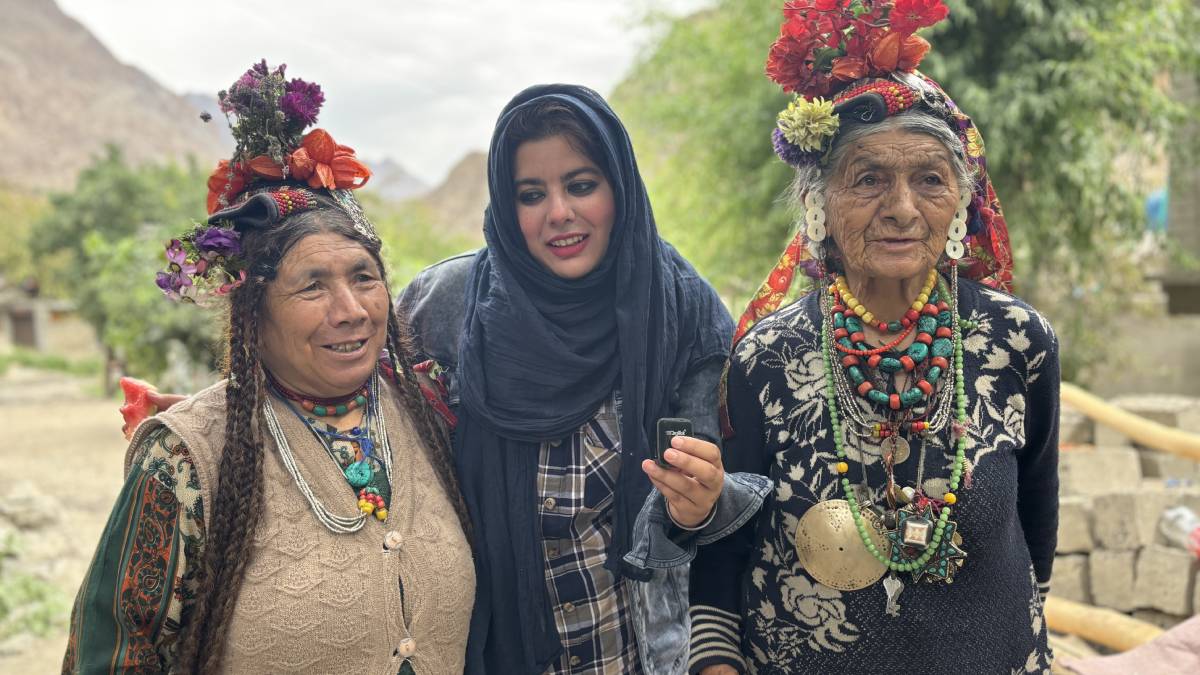
Yet, it is their headgear that truly sets them apart. Both men and women wear elaborate horn-shaped caps, adorned with coins, buttons, and fresh flowers, most notably the red Shoklo, harvested in summer, dried, and preserved for use throughout the year.
A symbol of happiness, “this flower is central to our identity,” said Aryan, a young resident from Darchik. “We replace it frequently to keep our headgear’s vibrancy alive. It marks both celebration and grief. It is an essential part of wedding attire for the bride and groom, but in mourning, we remove it. Relatives of the deceased refrain from wearing it for at least six months after their passing.”
The Ancestry
Ladakh’s population is a mosaic of three main ethnic groups: Tibetans, Dards, and Mons. Among them, the Brokpas of the Aryan Valley form a distinct subgroup of the Dards, tracing their lineage to the Gilgit region. The migration of Dardic tribes along the banks of the Indus River remains an enigma, with no definitive timeline. Yet, their folk songs preserve glimpses of their past, recounting the deeds of tribal leaders and heroes, the most renowned being Kaiser.
Historical references place the Dards in this region since antiquity. The Greek historian Herodotus alluded to a gold-producing people, believed by some scholars to be the Dards. Pliny explicitly named them, describing their land as rich in gold. Ptolemy, too, mentioned Kaspeiria, a region between “Kylindrine” (Kulu) and “Daradrai” (Dardistan), and referred to the Baltis as “Byltae.”
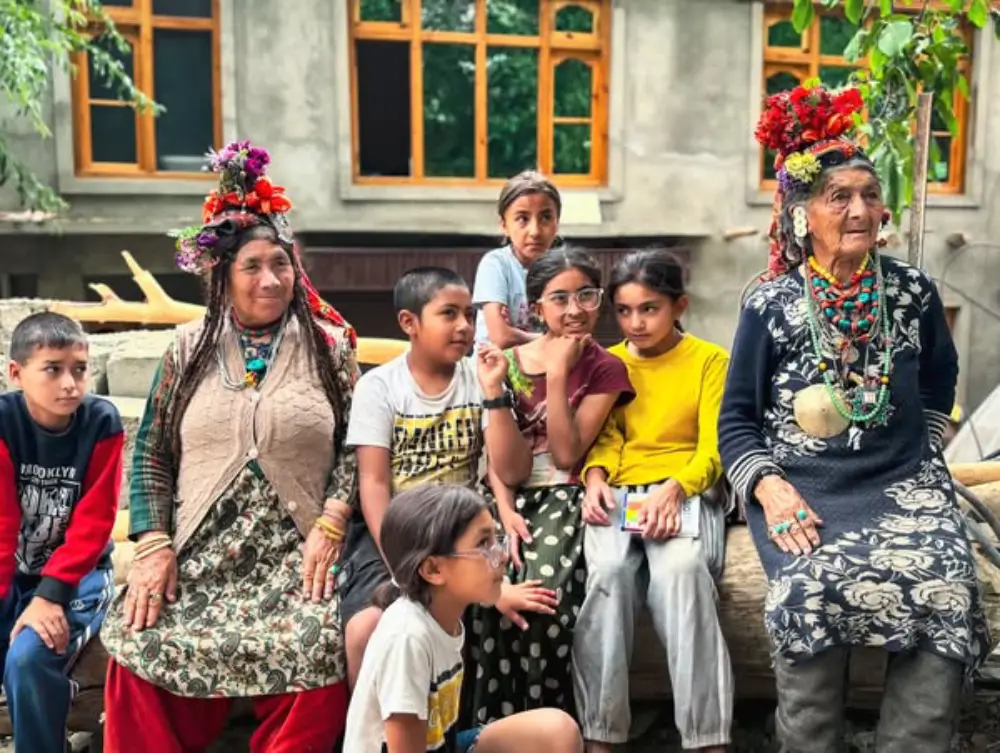
The Brokpas have long intrigued outsiders, particularly tourists from North America, Germany, and Israel, drawn by the community’s enigmatic heritage. In the 1980s, sensational reports surfaced about three German neo-Nazi women attending a Brokpa festival in hopes of being impregnated by what they believed to be “pure Aryans,” further fuelling media fascination. Over time, some Brokpas began embracing the notion of descent from Alexander’s army. While many dismiss this as mere folklore, others insist on its truth, citing physical features and oral traditions as evidence.
Mona Bhan, associate professor of anthropology at DePauw University, Indiana, who has spent over a decade documenting the Brogpa community, traces the roots of Aryan identity to British “colonial racial classifications” that conflated language with race. While tourism has brought new opportunities, she notes that the Brogpas disassociate their Aryan self-image from its violent legacy in Nazi Germany. However, she observes a deeper, unsettling trend, an attempt to “reclaim nationalist pride and masculinity” by using Brogpa bodies to symbolise the supposed superiority of Indian genes.
Customs Rooted in Isolation
Despite the passage of centuries, the customs and traditions of the Brokpas have remained largely intact. Each village, though bound by a shared ancestry, nurtures its distinct cultural practices, making the valley a rich tapestry of tradition.
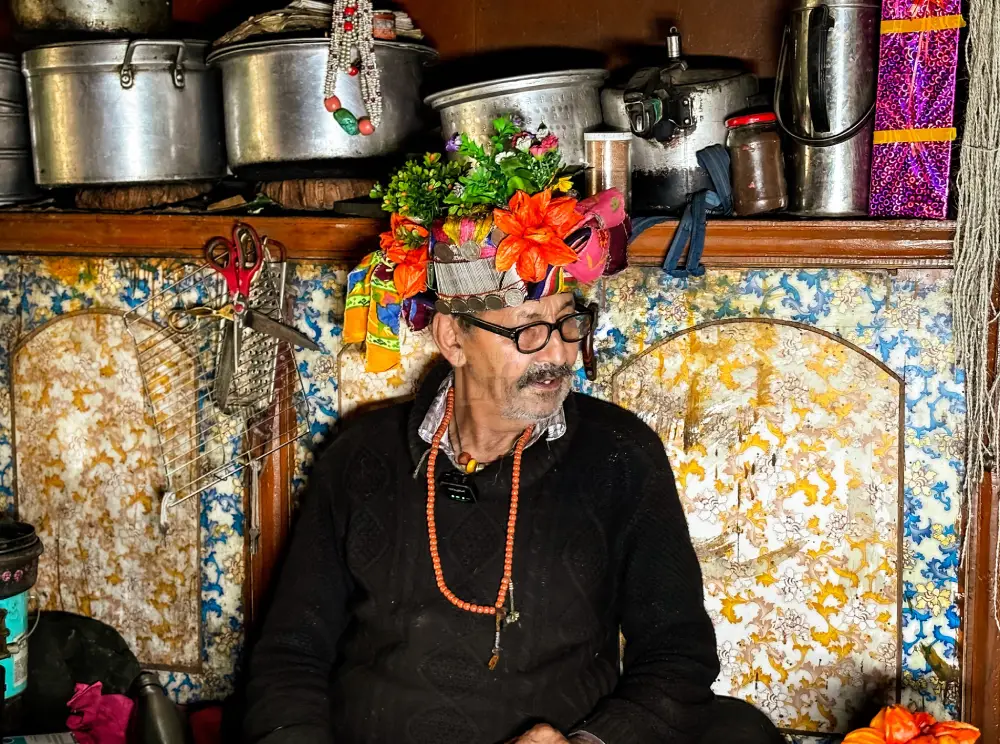
Historically, the Brokpas refrained from bathing or washing with water, adhering instead to a unique form of hygiene, massaging their bodies with a fine herbal powder derived from burnt lavender dust. While largely abandoned, the practice persists among a handful of villagers, including Sonam Norphel, a 70-year-old resident of Da. His home, thick with years, perhaps decades, of accumulated grime, exudes a stifling, pungent odour. Soot and dust coat the walls, furniture, and every object, glistening under the dim light. It is as if water has long been exiled from this place. Dressed in a traditional cap adorned with lantern flowers and heavy beaded necklaces, Norphel sits beside a mortar, pounding cooked meat into a paste. Flies swarm in thick clouds, crawling over his hands and the minced meat, undisturbed and barefoot, as though they belong there.
“I have lost all my teeth, so I mince the meat to make it easier to digest,” he said, scooping up a handful with his bare fingers.
Burials, Cremation
In the past, the Brokpas buried their dead along with personal belongings, ornaments, clothing, weapons like bows and arrows, and even their pets, believing these items would safeguard them in the afterlife. Over time, cremation has become the preferred practice.
“We once worshipped stones as deities,” Norphel recalled. “Every household had a large sacred stone in the kitchen, where we offered prayers. My father told me our ancestors buried the dead with their essentials. After converting to Buddhism, we now cremate our dead.”
A Fragile Balance
The Indus River, a lifeline in this unforgiving landscape, winds through the valley, carving its path between sheer cliffs and rocky outcrops. Its glacial waters, flowing from Tibet’s distant ice fields, sustain the valley’s inhabitants and their ancient agricultural practices. Along its banks, apricot orchards thrive, their gnarled branches weighed down by golden fruit.
The villages of Dah, Hanu, and Garkun are known for their fertile soil, where walnut trees and grapevines flourish. Willow and poplar trees, their slender forms swaying in the mountain breeze, add to the valley’s rugged beauty. Fields of millet and wheat stretch across the slopes, sustaining the Brokpa people, for whom agriculture remains central to their way of life. Grapes and apricots hold particular significance, often exchanged as prized gifts in social and cultural gatherings.
For generations, the Brokpas have relied primarily on livestock for sustenance, rearing goats and sheep with meticulous care. Cows and poultry, once deemed sacred and offensive to their deities, were traditionally shunned. Milk, eggs, and fowl were strictly avoided. However, these customs are gradually shifting, as younger generations move away from rigid traditions.
“Two decades ago, no one in the valley would touch cow milk or poultry. It was considered a serious offence,” said Tsetan, an elder from Darchik. “But now, it has become normal, mainly because our younger generation has married outside the community, which has diluted our customs and traditions.”
Wine plays a central role in Brokpa culture, with locally brewed chhang, a fermented barley beer, alongside grape and apricot wines. Women can often be seen spreading grapes and apricots under the sun to dry, while men oversee the winemaking process, ensuring that this centuries-old craft endures.
Rituals of Dance and Devotion
Music and dance are central to Brokpa society, woven into the rhythms of daily life and the cycle of the seasons. In each village, a designated circular arena, shaded by walnut trees, serves as the gathering place for celebrations. The most significant festival coincides with the harvest season, marked by elaborate rituals and performances.
At the heart of the festival are twenty-three traditional hymns, sung in unison to the accompaniment of rhythmic music. A young boy, chosen as the symbolic deity of the occasion, leads a procession of men and women, each carrying an incense pot filled with smouldering cedar. The main dance unfolds in the arena, where participants form a semi-circle, swaying in synchrony to the beats of their heritage.
Fertility is a recurring theme in Brokpa festivities, and their harvest celebrations are a tribute to abundance. Traditional food and drink are central to these gatherings, with chhang, a locally brewed alcoholic beverage, flowing freely.
Shifting Spirituality
The religious traditions of the Brokpa people remain a subject of scholarly debate. Some anthropologists classify them as nature worshippers, pointing to their deep reverence for celestial bodies such as the Sun and stars. Others suggest that their early beliefs were rooted in animism, as evidenced by ancient places of worship marked by skulls, horns, and animal bones beneath overhanging rocks.

The Sun occupies a sacred place in Brokpa cosmology, symbolising warmth, prosperity, vegetation, and health, a force of radiance and victory. The Moon, by contrast, is associated with wisdom, beauty, and tranquillity, its soft glow reflecting the contemplative nature of Brokpa spirituality.
Today, however, the majority of Brokpas identify as Buddhists. Prayer wheels spin rhythmically in village homes, their hum blending with the sounds of daily life. Small temples, once absent from their landscape, now stand as markers of their adopted faith. Across the hills and bridges, vibrant prayer flags flutter in the wind, a testament to Buddhism’s deep integration into Brokpa culture. Though it was not always their tradition, it has become an inextricable part of their present.
(Author directed the Kashmir Life Kashmir: Silk Route Tales (first season) that Iqra Akhoon presented)