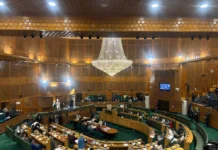
As the top BJP leader resorted to derogatory remarks against the 1931 martyrs, the Jammu Kashmir assembly’s motion of thanks on LG’s address got converted into a long history class, a subject the party wishes the erstwhile state to forget, reports Masood Hussain
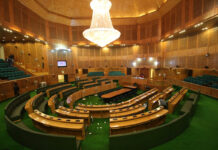
It was the same old story. Setting the tone for the subsequent sessions, the Jammu and Kashmir assembly focused heavily on history and politics, while governance – received only fleeting mentions. The debate on Lt Governor, Manoj Sinha’s address (a speech delivered on behalf of the cabinet), seemed like a battle against memory and a fight against enforcing a reinvented history. The lawmakers, unhappy and angry, retold the same old story of Kashmir’s battle for rights, preferring secularism over theocracy, ensuring the protection of identity and resources, yet ultimately finding themselves powerless despite having legitimacy.
It was an interesting mix of priorities. The Kashmir-based parties, the PDP, Peoples Conference and Awami Itehad Party – a total of five lawmakers, focussed on targeting their rival, the ruling JKNC, by leveraging the speech delivered by Sinha. The BJP also expanded considerable effort criticising the JKNC by asserting the historic intervention that “changed” Jammu and Kashmir and integrated it with the rest of the country. Aside from governance issues raised during question and zero hours, the BJP was particularly critical in outlining the interventions that have complicated the governance structure. Rather than attacking the notion of “change”, they voiced concerns regarding several new regulations and corruption within various departments, a point that Chief Minister, Omar Abdullah enjoyed and acknowledged.
The debate could have been better had the right-wing BJP leader Sunil Sharma avoided hitting the very basic landmarks in Kashmir history – the Martyrs Day, the July 13 massacre in 1931, which marked the beginning of Kashmir’s political awakening and the end of exploitative family rule. By labelling the slain as “traitors,” he provoked widespread outrage among the lawmakers.
A Cool Speech
Debutant Waheed Para delivered a well-crafted speech that focused on the overwhelming situation on the ground and concluded with a suggestion that Omar Abdullah must take the house on board and start implementing his manifesto. He suggested that the house has an overwhelming mandate and warned that if it adheres to the “limitations” imposed by the post-2019 set-up, it will never be able to achieve anything. The disempowerment, he said, will not merely evaporate on its own but the political class will have to work on it. As a starting point, he suggested that the Omar government must restore the public holidays that were dropped by the governor’s administration – Martyrs Day (July 13) and the birth anniversary of Sheikh Mohammad Abdullah (December 5).
“This day is not communal in any manner but represents a moment in India’s democratic history,” Para said. “It was a day of resistance against monarchy and lives were sacrificed for that cause.” He described the day as a landmark event in Kashmir’s struggle for its rights and democracy.
As the House was in pin-drop silence, BJP legislative party leader, Sunil Sharma reacted to the suggestions. Taking his argument to the next level, he referred to the slain as “rebels” and “traitors”. Talking within and outside the assembly, he maintained that they were not martyrs at all and drew parallels between the events of 1931 and the unrest of 2010 and 2016, during which JKNC and PDP were responsible for the death of 125 and 116 individuals respectively. “We are proud of our ideology as well as our Maharaja and any voice of rebellion against the great Maharaja would never be recognised as a martyr,” he said. He asserted that public holidays on July 13 would never be restored in Jammu and Kashmir.
Of late, the BJP has been maintaining the Maharaja as the sole binding figure of its vote bank. It is over-asserting Jammu Kashmir being a “Dogra state” and insisting the Treaty of Amritsar was not a sale deed but an “indemnity payment.”
An Uproar
His assertions triggered a pandemonium. The treasury and the opposition benches were on their toes. When Speaker Abdul Rahim Rather finally cooled the tempers, he permitted lawmakers to voice their concerns. Sharma’s remarks were termed “humiliating and divisive”, an insult to “sacrifices”, “outrageous” and “harmful.” Several lawmakers sought an apology from Sharma. Finally, CPIM lawmaker Yusuf Tarigami suggested that the derogatory words must be expunged from the records of the House, which was accepted by Rather. This led the BJP, which has 28 members in the House, to walk out in protest. Outside, it was the same commentary getting relayed.
As soon as the BJP MLAs walked out, Sajjad Lone urged the House to pass a resolution restoring public holidays on July 13 and December 5 to honour the 1931 martyrs and Sheikh Mohammad Abdullah. Though the Speaker ignored his appeal, Lone asked members to show support by raising their hands, and most NC MLAs responded.
Sharma’s statement also drew reactions outside the assembly. “These martyrs, revered by one and all in Jammu and Kashmir, are part of our collective memory of the great sacrifices made by the people of Kashmir for their rights,” Mirwaiz Umer Farooq said in Srinagar, within minutes after the assembly showdown. “Any attempt to malign them will be firmly resisted.”
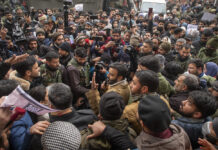
A day later, PDP in Srinagar protested and set afire Sharma’s effigies. “We will not accept any insult to our martyrs who fought against an oppressive, autocratic rule under the Maharaja and galvanised a political movement and consciousness,” stated PDP leader Iltja Mufti, who led the protest.“Attempts to erase our collective history and memory are unacceptable.”
History Classes
Sharma set the tone for the next day too. Tarigami, Javed Baig and many others delivered lengthy speeches revisiting the evolution of Kashmir as a state. Lawmakers noted that the creation of Jammu and Kashmir was the outcome of the East India Company’s mechanisation and so was the Maharaja. They insisted that while Hari Singh is being projected as a huge figure, the fact was that he actually dithered on accession to India for over two months and wished to stay independent.
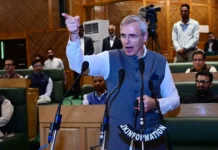
The real checkmate came from Omar Abdullah. Criticising the BJP with a simple argument, Omar stated that the house views the “Dogra State” as a legacy from the Maharaja, who deserves respect. He pointed out Srinagar’s Partap Park, SMHS Hospital, and Jammu’s SMGS Hospital are still in his name. “But what you did to the legacy?” he asked. “But tell me, when we talk about the legacy of Maharaja Hari Singh, what is the biggest thing? One was Jammu and Kashmir State. That State is gone now. Where is the State? What have you done to that State? Tell me. This is something to be said.”
He continued, “One portion is with Pakistan, but another is with China—why doesn’t anyone talk about that? Who has stopped you from taking it back?” He said he has no issues in retaking the PoK but questioned the BJP over what they did to what was left of Jammu and Kashmir. “You dismembered it. Why did you separate Ladakh? And you are saying that the people of Ladakh wanted this. Did you ever ask them? Did you ever consult them? From the first day, the people there were not with this decision.”
Referring to state subject laws, Omar highlighted their importance in protecting the rights of the people. “What did the Maharaja leave for us apart from the geography of this region? State subject laws—our land was ours; our jobs were ours. Where are those laws now? What right do you have over your land today? Anyone can take it from you at any time. What right do we have over our jobs?”
Drawing a comparison with neighbouring Himachal Pradesh, Omar stated, “If there is a factory, legally 70 per cent of the employees are from Himachal. If there is a hotel, then 70 per cent of the employees are from Himachal. What kind of law is now prevailing here?”
BJP’s Armoury
Confused, the BJP talked too much but lacked substance. Its lawmakers exhibited part ruling style and part victims but ensured that Prime Minister Modi and Article 370 are mentioned in every second sentence. Every speaker highlighted developmental projects that came up or are in various stages of implementation. Omar hit at them saying he felt as if the BJP was reacting to the President’s address in the Lok Sabha and not the LG address in the Jammu Kashmir assembly. Interestingly, they would stay silent, every time they were asked to talk about the issues of the people they represent. They deconstructed the Article 370 abrogation in many ways and linked it to the “change” that Jammu Kashmir underwent in the last five years.
Omar asked a simple question: While most of these projects were initiated before 2014, which of these projects could not have come up if Article 370 survived? “What miracle happened after the abrogation of Article 370?” he asked.
Shakti Raj Parihar (BJP) talked about ending nepotism, corruption and terrorism while the Leader of the Opposition Sunil Sharma blamed Pakistan for terrorism. Who is right,” Omar asked. “If Pakistan is behind terrorism, then why blame Article 370? If Article 370 was responsible, then why did terrorism spread to the Jammu region after its abrogation, areas which were declared terrorism-free during my (previous)tenure?”
Sharma had talked about the government not releasing any of the 500-odd troublemakers who are behind bars under the Jammu Kashmir Public Safety Act because they were creating trouble. Law and order, forming part of the home department is being overseen by the Home Ministry and the Raj Bhawan. Omar said Sharma is coming laced with data that usually used to be with the Chief Minister.
“If PSA is your weapon, then your case is weak,” Omar told Sharma, noting that PSA is invoked when there is no formal offence against a person. “If you keep these people in jail for years and do not prosecute them, it means you do not have a case against them. You just want to keep them in jail. If you say that they are stone throwers, they are OGWs, then why do you need preventive detention? Preventive detention is needed where you cannot make any other case. You filed a PSA against me because you did not have anything else to detain me.”
Misgovernance
At the same time, however, the BJP recorded its scathing criticism of corruption and bureaucratic misrule. Several members accused the government of mismanagement in the implementation of the Jal Jeevan Mission and demanded a House Committee to investigate alleged irregularities. Minister for Jal Shakti, Javed Rana assured the House that action would be taken against officials who provided misleading responses and announced an inquiry into an alleged nexus between contractors and the department in a specific constituency.
BJP lawmakers also opposed certain rule that extends beyond cities to peripheries. “What are these rules about? Who did it,” BJP lawmaker Sham Lal Sharma shouted. “These rules are for people and we represent the people. We will undo all these rules.” As Sharma was delivering this fiery address, treasury benches were thumping with joy. He asked the government to take time and manage the revenue issues linked to GhairMumkin Khud a classification of the land that is troubling the people. “Entire Jammu is GhairMumkin Khud,” he said and the response came from the Speaker that the issue would be discussed once the question came up.
Omar Priorities
Speeches apart, Omar and his team are not thinking differently from other lawmakers as far as the dual structure of the governance goes. He told the House about his protocol and the tensions in bureaucracy about which direction to go. He mentioned that the business rules have finally been drafted after more than four months and sent to Raj Bhawan, hoping for better progress in the coming days. The Rules have defined the powers of the Chief Minister, the Cabinet, Ministers and Administrative Secretaries. As for the LG’s powers, his role is already defined as he holds charge of law and order, public order and All India Services.
In their speeches Para stated that the LG speech lacked the JKNC manifesto and Sajad Lone dubbed it a “love letter to BJP”. They alleged that Omar’s soft attitude towards his crisis as Chief Minister can be normalised if he does not start the process of undoing it.
Omar responded that all LG addresses are supposed to be different but that never means the party has given up on what it has promised.
However, Omar gave a hint that even he is not supportive of a public holiday in Sheikh’s name. “Ask Salathia and Sharma (who are now with BJP),” he said. “I once told them that Jammu Kashmir has too many holidays. I wanted to reduce it, starting with the holiday in my grandfather’s name”.