In Dapaan: Tales from Kashmir’s Conflict, Ipsita Chakravarty draws on the oral traditions of a fractured land to tell intimate stories shaped by loss and memory, writes Syed Shadab Ali Gillani
Ipsita Chakravarty’s Dapaan: Tales from Kashmir’s Conflict is a timely exploration of the stories that have shaped the daily lives of Kashmiri communities through more than three decades of conflict. An award-winning journalist with a decade of experience reporting on politics and Kashmir, Chakravarty delivers a 344-page paperback published in March 2025 by Hurst & Company, London and in India by Context in July 2025.
From the beginning, she anchors the narrative in the oral traditions of Kashmiri storytelling by invoking the idea of dapaan, a Kashmiri word meaning “it is said,” which merges myth, rumour, and memory to express the complex haalaat, or “conditions,” that shape life in Kashmir.
Zulm
Chakravarty introduces zulm, or oppression, as the defining structure of Kashmiri political experience. Chakravarty explains that Kashmiris have suffered five centuries of subjugation under successive external rulers. Within this framework, she introduces the concept of dapaan, which marks the beginning of folktales and oral histories. These narratives combine myth and memory, lending an air of authenticity while allowing storytellers to avoid direct responsibility for their truth, a necessary caution in the dangerous haalaat that followed 1989.

These conditions altered everyday life, rendering simple exchanges potentially fatal. In response, dapaan accounts emerged as a vital means of assembling communal knowledge, part fact, part rumour, part dream. The chapter also explores how satire and folk performance traditions, such as bhand paether and ladi shah, have long served as vehicles of resistance. These forms allowed performers to voice dissent that could be dismissed as harmless humour if challenged. The subtlety of these critiques often went unnoticed by those in power, particularly when performers used phir kath, a deliberately inverted language that conveyed meaning only to those familiar with its codes.
Crackdown Paether
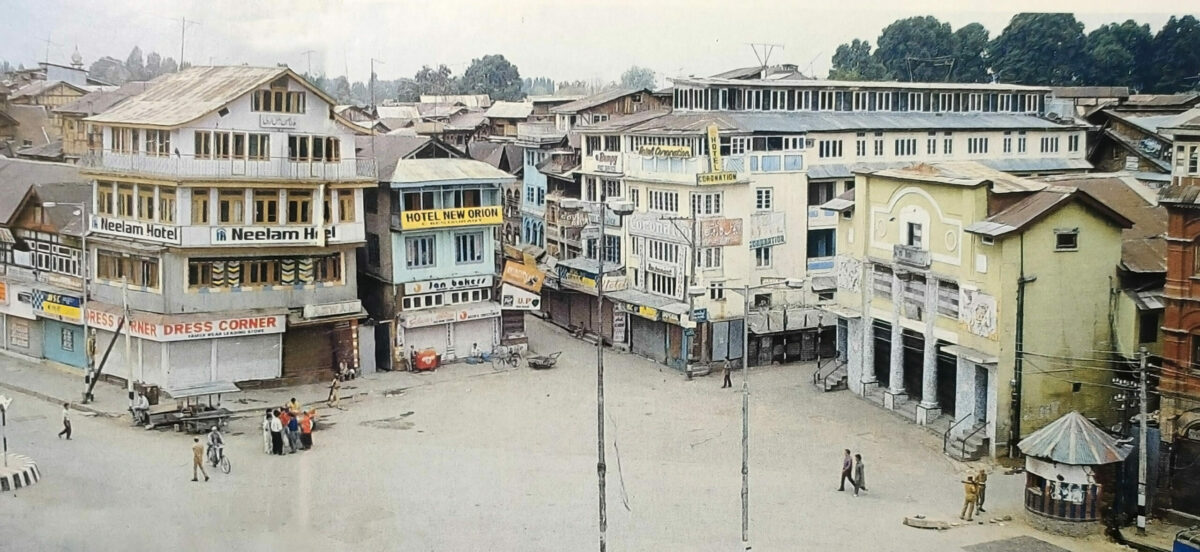
The book examines the intensification of surveillance and control during the haalaat. Chakravarty describes how, under such pressure, even the most ordinary language or gesture became exaggerated, charged with meaning, and carried the weight of danger. Crackdowns, marked by cordons and constant watch, turned life into a theatre of fear, comparable to both a panopticon and Dante’s inferno.
Folk theatre, too, evolved in this setting. The Wathora Bhands adapted by inserting veiled critiques into their performances. One such element, the Gun Kak joke, mocked the ubiquitous security grid. The humour was carefully crafted to pass over the heads of officials from Delhi who did not understand the language. The term Gun Saebs (gentlemen with guns) emerged to describe these figures, while inquiries about militants were coded as questions about whether “Gun Saeb was keeping well”. The chapter captures how speech and silence alike became sites of negotiation under an all-seeing gaze, with ordinary communication laced with hidden meanings and risks.
You May Be Turned Into a Cat
Chakravarty focuses on the figure of the “cat”, a term that entered the conflict’s lexicon to describe informants or ‘reformed’ militants turned collaborators. The term carried layers of significance that were invisible to outsiders. Chakravarty traces the roots of this surveillance culture to the Dogra era, observing that although royal spies may have disappeared after 1947, successive governments continued to monitor signs of dissent. Bakshi Ghulam Muhammad, for example, employed vigilantes to patrol neighbourhoods by night.
The fate of “cats” was unpredictable. Some were broken under interrogation, but later recounted their experiences with grim humour, insisting they had not betrayed anyone. Others were murdered by militants, regardless of whether their betrayal came under duress, as the Tehreek demanded an uncompromising loyalty. The chapter presents the story of AB, a young militant who was captured and tortured. Electric shocks to his fingers and toes caused pain so intense that it made him recall “drinking [his] mother’s milk”. Under pressure, he was forced to help identify fellow militants and weapon sites. His punishment for failure was further beatings.
The narrative reaches a moment of stillness when, in the middle of a betrayal, a fugitive warlord’s quiet smile disarms AB, prompting him to withhold information despite the consequences. This moment becomes a striking instance of resistance within the coercive machinery of the conflict.
The Buffoon King
The Buffoon King employs political satire through the figure of Ahad Raaz, an actor cast as king for his gaunt frame and startled expression. The improvised drama critiques power and absurdity, depicting a monarch beholden to an “emperor” (Raaz) while his kingdom drowns in debt and hunger. Tensions unfold between the king, his ministers, and the emperor’s demands for accountability.
The satire echoes Sheikh Abdullah, the Sher-e-Kashmir, whose shifting alliances and eventual pact with Delhi reshaped his legacy, rendering him fall in the popularity graph despite earlier reverence.
Chakravarty examines Hazaar Dastaan, a television serial whose sharp political satire drew such crowds that streets emptied during broadcasts. Pressure forced its removal, and its original episodes, stored in obsolete formats, now languish lost, mirroring Srinagar’s vanishing public archives. A brief exploration of the Sher-Bakra rivalry, the decades-long feud between Sheikh Abdullah’s followers and the Mirwaiz’s, underscores the region’s fraught political history.
Raantas
The book imagines the raantas, a demonic woman from Kashmiri folklore, as a metaphor for the Valley’s militarisation. In conflict-scarred places, ghosts emerge from a “blurring of time,” manifesting as silence, absence, and linguistic shifts. The Valley itself becomes haunted, its old names repurposed for new terrors, ones that “press on windows, enter homes, bodies and minds,” erasing distinctions between external and internal threats.
Raantas tales, often recounted by women to children at bedtime, serve as warnings: “do not stray.” Like djinns in Islamic lore, raantas are wind, slipping through nature and flesh, breeding the fear that one “could turn into the thing you fear.” One account describes a fisherman seized by a raantas, their struggle ravaging the forest before he was hospitalised for months. Another tells of a man escaping by lifting a comb, which magically rolled back a boulder sealing a cave.
The book dissects the mass panic of 1993, when the haalaat, the political climate post-1989, assumed the form of a daen, a witch. Rumours spread of these demons stalking neighbourhoods, attacking indiscriminately, their presence soon tied to military vehicles. ZM, then twelve, recalls a “robotic noise, something like a mechanical roar” outside his Dalgate home. He saw a “black shape,” akin to “Batman” leap onto a neighbour’s window before vanishing. In those days, he notes, “no one laughed” at such horrors.
A journalist covering the hauntings reveals an unsettling official dimension: statements emphasised “night domination” to suppress militant activity. With thousands of insurgents in the Valley, conventional checkpoints proved inadequate. A former officer implies the daen was “sent to do battle,” a fabricated spectre to control after dark. Historical precedent exists: the trounz of the 1960s, a creature blamed for burning haystacks, was allegedly a ploy to turn rural Kashmiris against the government. Yet while local press documented the daen panic, public broadcaster officials now claim no memory of it, exposing institutional amnesia.
The Braid Choppers
Chakravarty examines the wave of braid-chopping attacks that terrorised Kashmir. HB, a victim in 2017 Srinagar, recounts two men accosting her, spraying a substance, and her awakening to find her thick braid severed. The phenomenon first surfaced in Rajasthan, attributed to a churail (witch). Witnesses describe “three masked figures in black” on rooftops, wielding scissors and spray, clad in “spring boots.”
Initially vocal, women like HB soon faced scepticism, their assailants morphing into “men in burqas, black shapes, shadows.” As weeks passed, the narrative shifted, the attacks seemed a derangement from within, as if “three decades of disturbance have finally moved into the bodies of women, symptom bearers of the haalaat.”
Chakravarty traces the enduring presence of Kashmir’s disappeared. “Ghosts walked in the mountains of Anantnag,” particularly in Panchanthal and Brariangan, where they were called bhoot (ghost) or tasarruf (possession). These spectres belong to the thousands vanished since 1989, taken during crackdowns, summoned to camps, or lost on their way to work. Many reports suggest that, lie in unmarked graves, labelled as foreign militants. The chapter notes Kalaroos, once known only for its caves, and Lashtiyal’s Satbaran, seven purposeless stone doorways on a mountainside, emblems of Kashmir’s unresolved past. The land itself, heavy with unburied memory, haunts the living.
Singing Bodies
Singing Bodies centres on wanvun, a traditional Kashmiri form of folk singing performed by women, which has assumed a new role amid the conflict. Chakravarty presents wanvun as a ritual of mourning that has evolved into an expression of political grief. It is most often used to lament the disappeared, those taken but who never returned, or those who simply vanished. In such cases, the absence of a body prevents burial rites, resulting in what Chakravarty calls “unburial”. The grief that follows cannot be resolved through customary mourning and is instead suspended, becoming political by its very nature.
These songs are performed not only within families but also across neighbourhoods, connecting women through shared pain. In singing for one family, women sing for many others. This network of grief becomes a community of suffering, a bond forged not by personal loss alone but by recognition of a shared condition. The title Singing Bodies suggests that although the bodies of the disappeared are missing, they remain vocally and emotionally present through the bodies of the women who mourn them. Their voices carry the absent, turning mourning into a collective act of resistance.
Chakravarty provides a striking example from a depleted wedding gathering during a shutdown. Women sang of desolation, addressing the groom: “You are a lonely groom, Leaving at a time when the streets are empty”. The lament described isolation but created unity. In contrast, militant funerals often became public spectacles, almost celebratory, where the dead were sent off as bridegrooms. Their bodies were covered in rose petals, their hands painted with mehndi. Despite the different forms, both rituals focused on the beauty of lost bodies. Death, whether mourned or glorified, was made visible and memorable through song and ceremony.
Melancholia
Melancholia moves from shared, vocal expressions of grief to an inward, enduring form of sorrow. Chakravarty introduces TK, a woman who filled her notebook with poems at the peak of the 2016 unrest. In these verses, Kashmir appears as a land permanently etched by loss. TK chooses to remain within a state of melancholia, which Chakravarty interprets as a political decision, not merely an emotional condition. It signals an insistence on remembering, a refusal to detach from past suffering.
Chakravarty references Freud’s definition of melancholia as “mourning gone wrong, turned inwards, born of the mind’s inability to detach itself from the object of its loss”. This concept applies not only to TK but to Kashmir as a whole. The chapter frames this psychological condition as a collective experience. The population carries an unresolved grief, one not permitted to follow the usual path of mourning, due to the absence of acknowledgement, restitution, or closure.
Firdous Cinema
Firdous Cinema stands as a symbol within the turmoil, its trajectory from cultural hub to casualty reflecting the erosion of normalcy under the haalaat. Though the precise details of its fate remain unstated, its placement in a chapter titled Blood Maps implies decline, abandonment, or repurposing. Cinemas across Kashmir shuttered during the militancy, whether by decree or collective fear. Firdous Cinema thus embodies lost innocence, the collapse of public life, and the destruction of spaces once reserved for respite. Its story mirrors the wider attrition of cultural landmarks and the constriction of mundane freedoms under violence.
The author probes the duality of the Kashmir conflict, a realm where boundaries blur and clarity recede. It addresses both the literal and metaphorical: the darkness of curfews and power cuts that strangle daily rhythms, and the moral obscurity of violence, concealed truths, and despair. Against this, fleeting resistance or human connection may pierce the gloom. The narrative likely dissects how propaganda distorts perception, while defiance or revelation offers shards of light. Here, hope and desolation exist in uneasy tandem, a testament to the conflict’s corrosive grip on truth and lived experience.
Land in Kashmir is not a passive stage but an entity transformed by conflict. This chapter traces displacement, where severed ties to ancestral soil redefine belonging. The earth itself becomes an archive, holding mass graves, bunkers, and the imprints of razed villages. The term afterlives signals permanence; the land’s contours and ownership bear the scars of militarisation and geopolitical strife. Even in stillness, it shapes those who remain and those exiled, ensuring the conflict’s endurance beyond active warfare.
The conclusion frames Kashmir’s fragmentation through the metaphor of dismemberment, physical, political, and psychological. Beyond the literal severing of bodies lies the splintering of the region: its territorial division, the exodus of Pandits, and the ideological rifts fracturing society. It synthesises the book’s themes of loss and spectral memory, underscoring how Kashmir has been cleaved in identity, history, and future. The result is a collective wound, raw and unresolved, where cohesion remains a casualty of protracted strife.
Cover
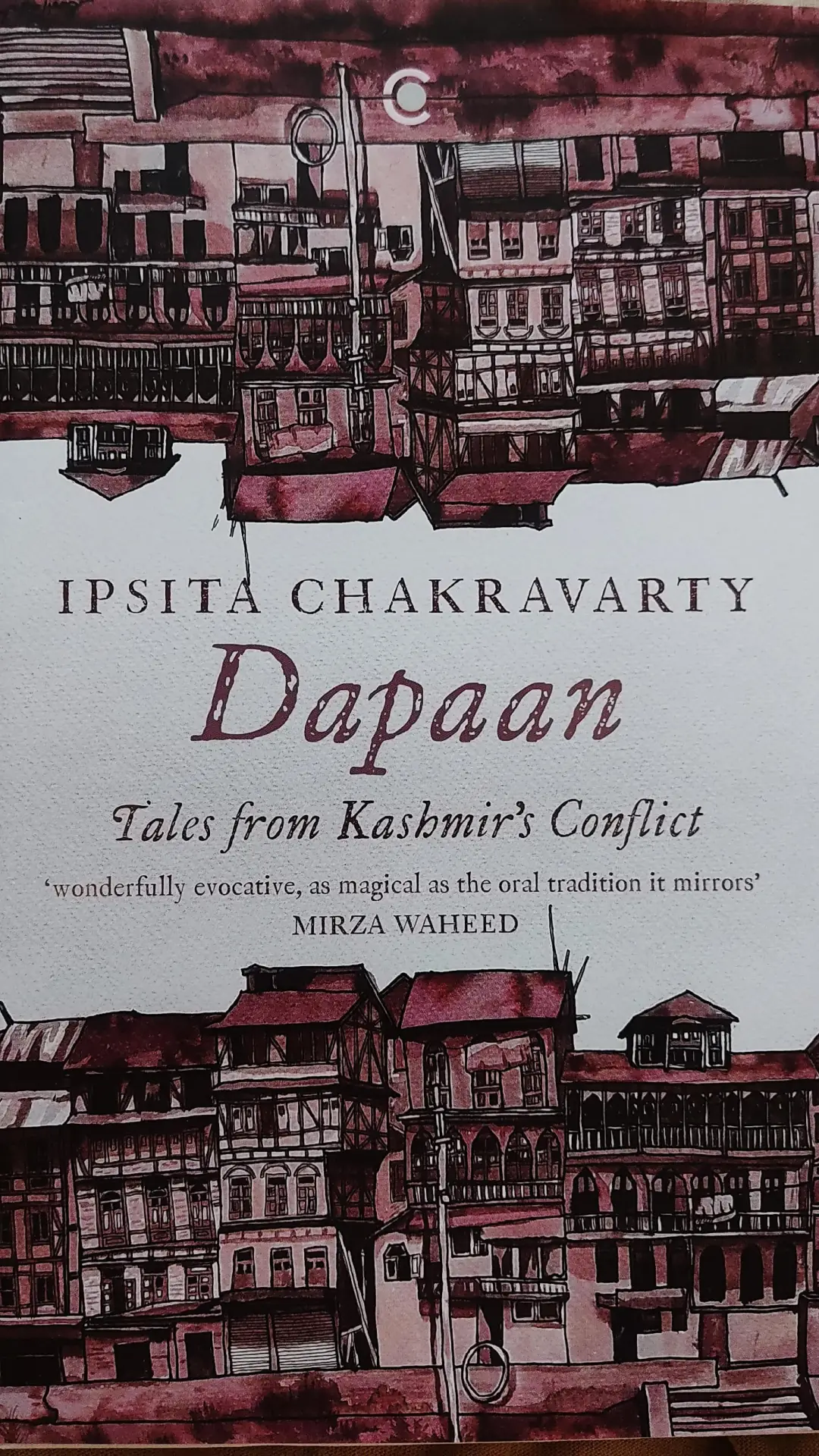
The cover illustration of Dapaan, created by Basita Shah, presents a layered cityscape of traditional Kashmiri architecture rendered in stark, blood-tinged hues of maroon and black, evoking a mood of grief and unresolved tension. The clustered wooden houses, some with lattice windows and steep roofs, appear suspended and mirrored, suggesting both reflection and fragmentation, much like the oral narratives the book captures.
The cover hints at the ruptured realities of a region caught between memory and violence. Basita, known for her evocative visual language in works such as Mehak Jamal’s Loal Kashmir, Muhammad Nadeem’s The Mattress, and Samia Mehraj’s Stained White Curtain, uses the dense, layered architecture to mirror the collective claustrophobia and haunted inheritance of conflict, while the pale foreground invites the viewer to listen to what dapaan “it is said” might reveal.