Amid a charged Parliament session dominated by political posturing and nationalist rhetoric, the April 22 Pahalgam massacre and subsequent Operation Sindoor became the centre of fierce debate, reports Syed Shadab Ali Gillani
In the afternoon of April 22, 2025, Pahalgam’s idyllic Baisaran witnessed a bloodbath. Militants killed 26 tourists and injured more than 20. What followed were whispers of retribution, an unexpected call from the Pakistani military, and, reportedly, a ceasefire negotiated through third-party mediation. Operation Sindoor would emerge as India’s most expansive military response in the post-Article 370 era, and one of its most politically contested.
Pahalgam to Parliament
By evening, Home Minister Amit Shah had arrived in Srinagar. On April 23, he chaired a security review meeting with representatives from the Army, CRPF, BSF, and Jammu and Kashmir Police. In Delhi, Prime Minister Modi presided over a Cabinet Committee on Security (CCS) meeting, during which, in addition to a series of punitive actions against Pakistan, he selected ‘Operation Sindoor’ as the name for a strike on Pakistan.
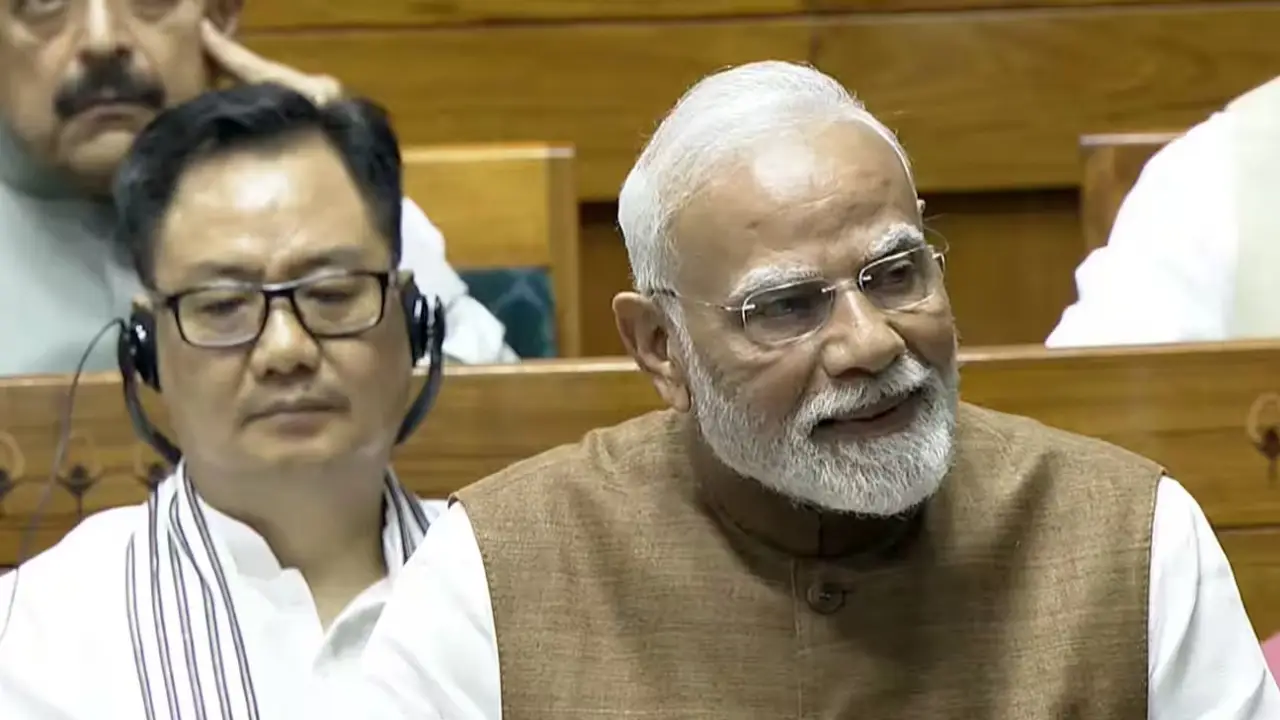
On May 7, India formally informed Pakistan’s Director General of Military Operations of its intent to carry out “self-defensive action.” Between May 8 and May 10, Indian Air Force jets reportedly crossed the Line of Control (LoC), striking up to nine terror launchpads, allegedly as deep as 100 km inside. Shah later stated that over 100 militants were killed in the operation. In the ongoing Monsoon session of Parliament, Modi described it as a “victory celebration.” He said he had told the media the session was “a celebration of turning Pakistan’s terror headquarters to dust.”

The 3-day debate coincided with the killing of three militants on July 28, in Operation Mahadev in Srinagar outskirts, who, the security grid asserts, were the trio responsible for the massacre.
Amit Shah told the House that the trio were responsible for the Pahalgam massacre as well as earlier attacks in Baisaran and Gagangir. Intelligence inputs began arriving on May 22, he revealed. These leads were verified for two months using advanced signal-interception equipment. The operation that followed led to the successful neutralisation of the militants. Ballistics tests later confirmed that the rifles recovered from the Dachigam encounter matched those used in the Pahalgam attack. He said all three militants were Pakistani nationals, citing their voter identification numbers, chocolates manufactured in Pakistan, and weapons recovered from the site as evidence.
“Despite all this, the former Home Minister is giving a clean chit to Pakistan. Why?” Shah asked, asserting that the international community now acknowledged Pakistan’s role in the attack.
The Debate
In Lok Sabha, Shah described the operation as a “calibrated military response” and “not a war.” He criticised Congress, blaming it for a series of historic misjudgements, the 1948 Kashmir ceasefire, the Indus Water Treaty, and the return of Haji Pir. “What would India look like today if not for Nehru’s policies?”
Rahul Gandhi responded sharply, accusing the government of turning military operations into political theatre. He alleged that the armed forces were used as instruments of image management, not national defence. He claimed the forces were deliberately restricted from striking Pakistani military infrastructure.
Referring to a statement by Defence Attaché Captain Shiv Kumar, Gandhi said, “He may not agree with the number of aircraft lost, but he agrees some were lost, because of the political directive not to strike military targets.” He demanded that Modi refute Donald Trump’s repeated claim that he mediated the ceasefire. “Trump has said 29 times that he brokered it. If it is false, say: ‘Donald Trump, you are lying’,” Gandhi said.

Modi delivered a long speech. “No world leader asked India to stop. Even the US Vice President tried to reach me for an hour on the night of the 9th. When I called back, he warned of a major Pakistani retaliation. I told him, we will respond to bullets with bombs.”
External Affairs Minister S Jaishankar clarified in the Upper House that there had been no US mediation: “No such call was placed between Modi and Trump from April 22 to June 16.”
Ceasefire in Shadow
The ceasefire, achieved on May 10, provoked more questions than it settled. “Who requested it? Pakistan’s DGMO called us, saying, ‘Stop it, we have taken enough hits,’” Modi told Parliament, claiming this marked a shift in how the two nations understood each other’s limits.
However, it was Donald Trump’s cryptic tweet the next day that fuelled speculation. “Glad to see both sides stepping back. Dialogue is the future,” he wrote on May 11. The Ministry of External Affairs denied any foreign mediation, but opposition parties seized on the ambiguity.
Akhilesh Yadav of the Samajwadi Party remarked: “We had hoped that the government would take the lead in ceasefire negotiations, but it seems they asked their friends to make the announcement instead. Why did the government agree to a ceasefire through a third party? What pressure were they under?”
Tally of Ten Years
Shah defended the government’s handling of militancy by presenting comparative data. Between 2004 and 2014, there were 7217 violent incidents, resulting in 1770 civilian and 1,060 security personnel deaths. From 2015 to 2025, that number had dropped to 2150 incidents, with 357 civilians and 542 security personnel killed. “The number of terrorists neutralised has increased by 123 per cent,” he said.
He listed post-Article 370 actions, including banning Hurriyat factions, suspending licences of bar council members, arresting 702 SIM card sellers, and confiscating properties under the Unlawful Activities (Prevention) Act. “Terrorists are now buried where they fall. No funerals, no glorification,” he declared.
History Rewritten
Shah’s 75-minute speech doubled as a security review and a historical counter-narrative. He quoted from Nehru’s Selected Works (Volume 29), called the Indus Treaty an act of appeasement, and described the Shimla Agreement as a “strategic folly.”

Modi echoed the sentiment, accusing the Congress of weakening India’s resolve through performative gestures. “They hosted mushairas while we buried our dead,” he said.
Operation Sindoor revealed the face of India’s upgraded military apparatus. The operation saw the deployment of indigenous drones, long-range loitering munitions, and satellite-guided bombs. Modi credited domestic defence manufacturers, stating that “Make in India” units had delivered equipment that “crippled Pakistan’s airbases within hours.”
Rahul Gandhi countered with concerns over India’s foreign policy. He said the country’s failure was not in its military strategy but in its inability to keep Pakistan and China from aligning. “A few days ago, I said our biggest foreign policy challenge was to prevent a China-Pakistan alignment. But we failed,” he said.
In the Rajya Sabha, Jaishankar defended the government’s decision to suspend the Indus Water Treaty. He called it “a natural consequence” of Pakistan’s continued patronage of terrorism. “Blood and water cannot flow together,” he said.
Floor Voices
Srinagar MP, Aga Syed Ruhullah, raised grave concerns about the treatment of civilians in Jammu and Kashmir following the massacre in “disproportionate actions” by state institutions and agencies. Ordinary Kashmiris, he said, were subjected to routine checks, arbitrary detentions, and intensified scrutiny. He drew comparisons with past crackdowns following incidents in Pulwama and Uri. Citing figures, he claimed that nearly 2,000 individuals were detained and several homes were demolished without due legal process.
Agha expressed alarm over reports of harassment faced by Kashmiri students and businesspersons in other parts of India, including Uttar Pradesh, Punjab, Delhi, and Himachal Pradesh. He questioned whether such actions stemmed from the rule of law or were manifestations of bias, casting doubt on the constitutional promise of equal citizenship. Instead of focusing on external threats, he said some institutions had directed their actions inward, targeting civilians. “Instead of addressing the real source of terrorism, the response has turned inward toward innocent people,” he said.
This was even though the tragedy had provoked widespread condemnation across the region, where residents observed shutdowns, organised protests, and expressed collective solidarity with the victims.
In the same session, Baramulla MP Engineer Abdul Rashid condemned the April 22 Pahalgam attack, calling it “the murder of entire humanity” and urging both government and opposition leaders to initiate dialogue on Kashmir. Citing Islamic teachings, he said, “One who kills an innocent is like killing all humanity. What happened in Pahalgam was a murder of humanity.”
 Referring to the decades-long conflict, Rashid claimed over 80,000 lives had been lost since the late 1980s. “We have carried coffins for decades. We are tired of graveyards,” he said, calling for a shift from confrontation to compassion. “Let the talks not be for the government’s sake or political gains, but for the people of Kashmir,” he added, urging an honest and inclusive conversation.
Testimonies
Anantnag-Rajouri MP, Mian Altaf Ahmad, raised the issue of civilian suffering during the recent confrontation between India and Pakistan, demanding justice for those living near the LoC. Representing the constituency where the attack occurred, Altaf spoke of the deep sense of mourning that gripped the area.
He said that people had come out spontaneously to condemn the attack, describing scenes of households paralysed by grief.
“Nobody cooked that day, nobody ate,” he said, capturing the weight of sorrow that blanketed the region.
Altaf highlighted the severe impact of cross-border shelling from Pakistan on his constituency, reporting 17 civilian deaths in Poonch and Rajouri districts. He described Poonch town as devastated and nearly abandoned, while in Rajouri, three more civilians, including a government official assisting locals, were killed. The shelling damaged religious sites, homes, and businesses. Altaf urged that such suffering should not happen again and called for greater compensation for affected families.
Defiance and Justification
Jammu MP Jugal Kishore Sharma (BJP) said the Indian Army retaliated in a manner that had forced Pakistan to “taste dust.” He said, “Operation Sindoor was our response to acts of terrorism. The people of Jammu and Kashmir protested against all the acts of terrorism and gave a befitting reply to Pakistan.”
Sharma added that Modi had avenged the massacre through Operation Sindoor, “which destroyed the terrorist hideouts in Pakistan.” He also claimed that Pakistani drone and missile attacks in Jammu had been diffused by the Indian Army. The government, he said, had pledged compensation to the victims of these attacks.
What Next?
Defence Minister Rajnath Singh issued a stern warning to Pakistan. He said India would not hesitate to strike again if terror activities persisted and claimed that Indian forces were prepared to fight terrorism on both sides of the border.
“India wants an end to terrorism worldwide, including in Pakistan. If the neighbouring country is unable to act against terrorists, it should seek help from India. Our forces are capable of fighting terror on this side of the border and on the other side as well, which Operation Sindoor has already proven.”
In his closing remarks, Modi said, “This is New India. Terror has a price. And we will make sure they pay.”