Kashmir is witnessing an unsettling shift towards extravagant and ostentatious weddings reducing once-simple ceremonies to history books. Dictated by unreal soap shows on the two sides of the Redcliff divide, the grandiose spectacles are huge money guzzlers, reports Babra Wani, insisting the trend is widening the rich-poor gaps and compromising faith and tradition.
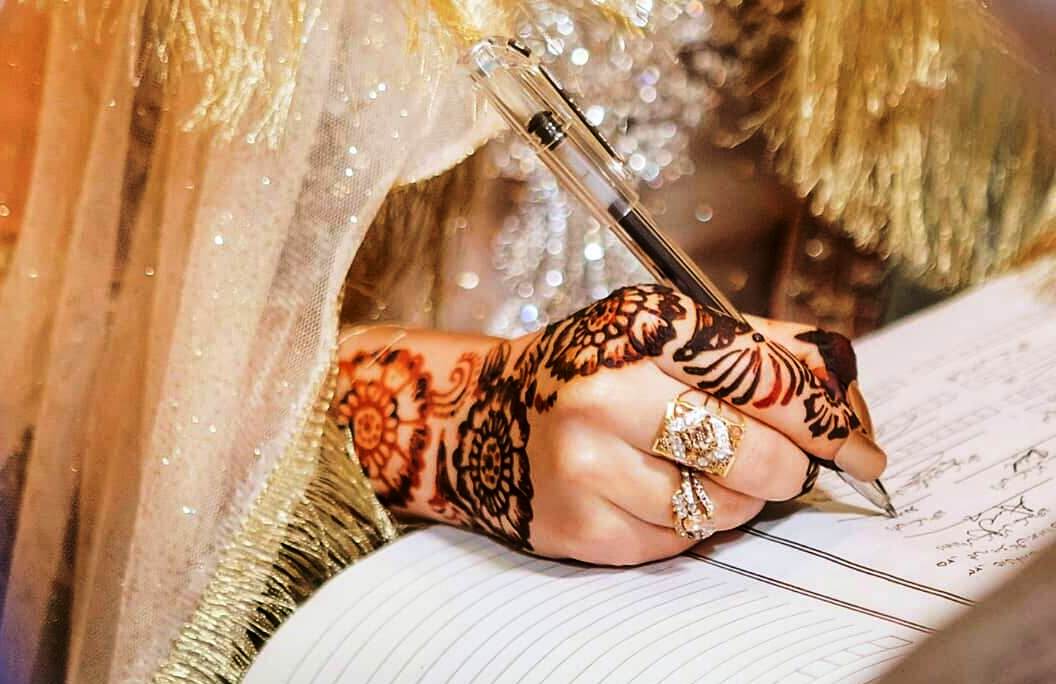
Amina was struck by the munificence of the wedding she attended with her mother: a large pandal, a stage adorned with flowers, and opulent decorations. However, it was the Rs 80 lakh bridal lehenga that lingered in her mind.
“I heard that the bride had purchased it for just one day. My eyes widened upon hearing the cost,” Amina said. “I mean, Rs 80 lakh is enormous. Ordinary people could have more than a dozen weddings with that amount.”
The Extravagance
Amina had eagerly anticipated attending the wedding for months, but her excitement turned to disappointment upon arrival.“I was dumbfounded when I heard the cost of the dress. They spent that kind of amount just for a day. She did not even wear it on her walima day; she chose a different dress, which also cost millions,” she said. This lehanga was just part of her trousseau.
“Not just that,” she continued, “everything at that wedding was extravagant. They wore high-end designers and extra jewellery. It was the epitome of extravagance. I wondered what kind of money-show it was.”
For the past six months, the Ambani wedding has made headlines, with reports estimating its cost of approximately Rs 4442 crore. While it attracted attention, many criticised the family for flaunting their wealth. Amina expressed similar sentiments about a wedding she attended, noting that despite not matching the Ambanis’ scale, the Kashmiri wedding was an excessive display of wealth.
Shabnam, a mother of two, lamented that Kashmiri weddings have become overly extravagant, focused on displays of wealth and status rather than the bride and groom. “When I got married twenty-nine years ago, our wedding ceremonies were very simple, without unnecessary pomp and show,” she recalled.
A wedding planner of three years, who wished to remain anonymous, corroborated Shabnam’s stance. “There is actual competition in holding wedding ceremonies. The wedding season is undoubtedly the best for us, but there is a lot of dekha-dekhi when planning a wedding. I was asked to manage a wedding in Anantnag, where they first showed us pictures and asked us to do better decorations. They were ready to spend any amount to make their wedding look better. People will go out of their way to spend on their weddings just to create an impression. Jis ke paas hota hai, wo dikhawa karta hai (those who have it, flaunt it).”
Another wedding planner highlighted the visible class system in Kashmir’s marriage ceremonies. “As wedding planners, we have the most inside information. Most of the time, weddings become a circus of money and extravagance to impress others or the attendees,” the planner said. “There are large numbers of guests, and at some weddings, we also provide catering services with staff who need to be properly dressed. Our packages are based on what is in demand.”
Money Guzzler
Many Kashmiri weddings cost over fifty lakhs, says a wedding photographer with five years of experience. “Families pay any amount to capture their extravagant weddings,” he noted, adding that high-profile cases can pay in lakhs for wedding shoots, films, and pre and post-wedding shoots.
Besides photography, people are splurging on designer dresses, high-end makeovers, spacious pandals, and elaborate decorations.
“People hire trained make-up artists for their weddings now,” said a make-up artist from Srinagar. “It is no longer about family members doing the make-up. We have different packages for the brides, and the make-up products we use must be up to the mark.”
Henna application, once part of the makeup process, is now a separate service, available online, says bride-to-be Rukhsana. “It is convenient but costly. I have already spent millions, and the main day is still pending. We have many plans and hope it goes well.”
Another significant expense is the cake-cutting ceremony. “It is futile to cut huge cakes, and most of it goes to waste because not everyone eats those cakes,” Rukhsana pointed out. “There are literal two-tier, three-tier cakes that are cut and wasted. These cakes, made to order, cost a lot. I asked my father not to include any cake. There should be no food wastage at my wedding at least.”
“I always believed in simple marriages, with no great feasts or extravagance,” she added. “But my family insists on making it better than other weddings that took place in the family.”
Rukhsana recalled her friend’s wedding as a brutal show-off, with a customised bridal dress, designer jewellery, and heels costing over Rs 30,000. She believes, “the cost of her (friend’s) trousseau alone would cover my entire wedding.”
The trend of organising wedding functions in hotels and marriage halls has also taken hold in Kashmir. “I wanted to hold the ceremony in the hotel because the flux of guests would have been hectic if it took place at home,” said a resident of Anantnag. “Even the engagement ceremony took place in a resort in Pahalgam. It is because we could afford the expenses, but I guess the hotels are more expensive than the normal pandals.”
Booking marriage halls for wedding ceremonies in and around Srinagar has become a significant expense. “We had to pay more than a tent would cost for a marriage ceremony in a marriage hall. I think we paid around Rs four lakhs because we lacked space at our home and vicinity,” said Ghulam Hassan, a resident of Bagh-i-Mehtab, Srinagar. His son got married last August. “Gone are those simple days when weddings did not look like circuses. Now everything is about showing off. We had to follow a theme that our wedding planners had chosen for us.”
Ghulam Hassan’s younger daughter described a recent lavish wedding. “It surpassed all expectations with a three-day affair: a dazzling Mehndi night with lights and music, and the Baraat day with two grooms arriving in luxury cars worth crores.”
“On Walima day, more than 500 guests attended. The brides were adorned in designer, customised gowns and vibrant jewellery. The hall was glowing with flowers, decorations, and lights, while aunties dispersed wartav and the music played incessantly. The food was extravagant, with new additions to the trami, such as double goshtaab, lemon chicken, and nader yakhn,” she said. “I was happy for them, but then someone remarked, Gareeb marreh tamah seeth (The poor will die of desire alone). This made me realise that the money spent on this single wedding could have significantly improved the lives of many other brides and grooms.”
An Evolving Wazwaan
A key highlight of Kashmiri wedding ceremonies has traditionally been the lavish seven-course meal, known as Wazwaan. However, Wazwaan has now expanded beyond its original format.
“There are new varieties that people are demanding these days,” said a waza (Kashmir tradition chef) who wished to remain anonymous. “Now they want a variety of vegetable dishes, multiple types of goshtaab, and chicken in the Wazwaan. It has become hectic and is getting more demanding by the day, sometimes even for us.”
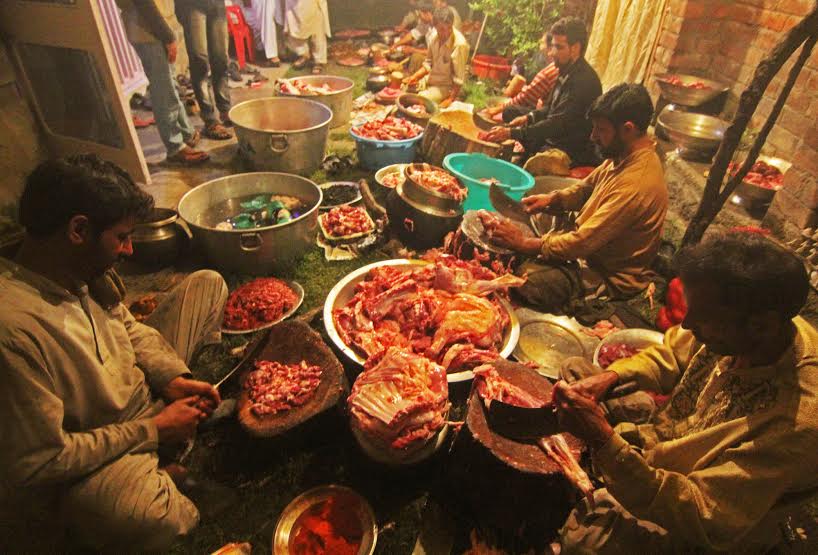
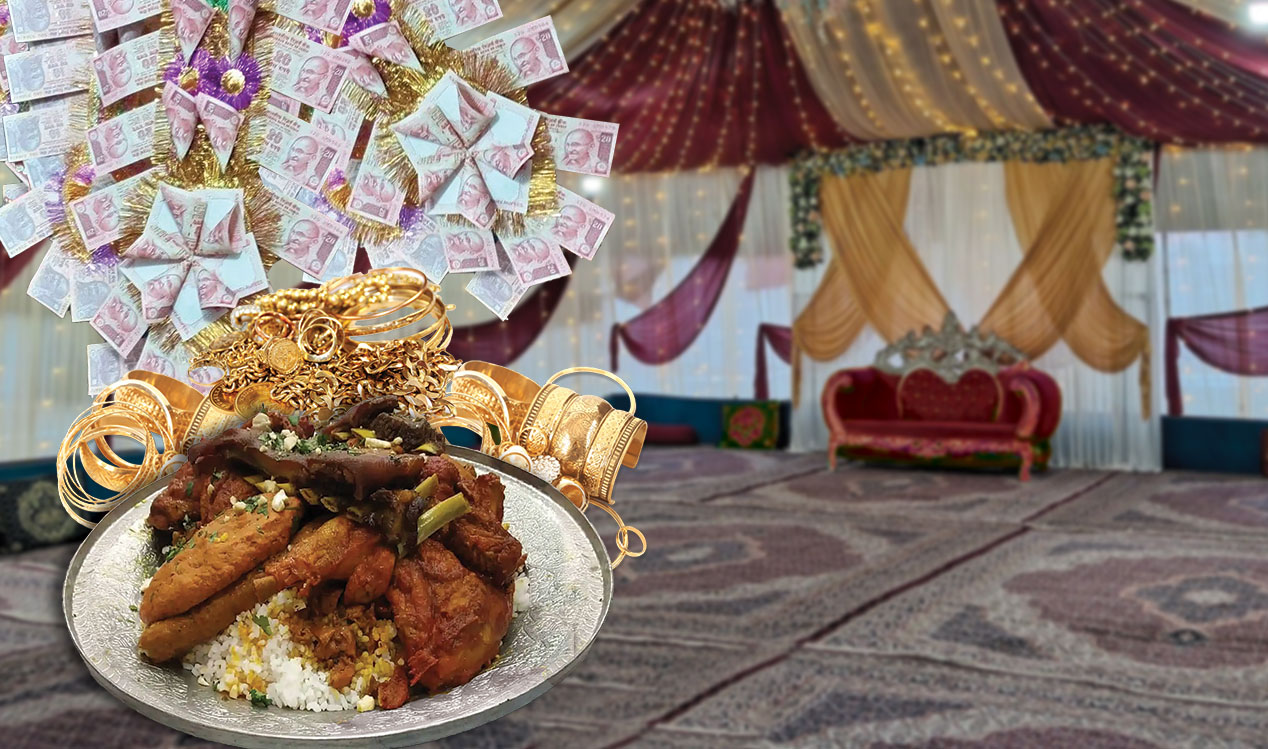
Social media often displays pictures and videos of elaborate Wazwaan spreads. “I once went to a wedding where they had different types of rista,” said Arooba. “I was surprised by the variety of meals they served. There was dessert at the end and a separate basket of cold drinks and other items for everyone. They even had dry fruit boxes with a Rs 50 note for each guest. For the baraat, they had Rs 500 notes for everyone, and for the groom, the box contained a substantial amount that nobody knows.”
Arooba expressed her concern about the impact of these lavish displays. “Do people ever think of others? Everyone attends a wedding ceremony—people from the lower middle class, the higher middle class, the elite, and the poor. Not everyone can afford these things. Would it not affect those who cannot afford such weddings?”
The Surging Expenses
Kashmiri wedding expenses have surged, partly due to the increase in the number of wedding functions. “In the past, a wedding used to be a three-day affair at most, followed by a fir saal,” said Shafiq Ahmed. “But now, weddings last for weeks. There is a Sangeet night, a Haldi night, a bachelor’s day, an all-female gathering to celebrate the bride, and various saals, like koari saal. These functions are all expensive. This trend is influenced by Pakistani and Indian TV series, which have significantly impacted Kashmiri culture. My daughter insists on a lehenga designed by a Pakistani brand”, referencing a dress worn by actress Hania Amir in a drama.
In Kashmir’s so-called elites, a new addition is very popular – Zanan-e-Baraat. It is a crowd of women coming from the groom’s side for a sumptuous feast, a day of the formal baraat. Usually, it is led by a band, which is non-local and untraditional.
Shafiq is concerned about his daughter’s wedding, scheduled for September, as her demands are extensive.
“I have hired wedding planners, caterers, and singers for the upcoming wedding. My daughter wanted a very famous singer for her wedding. I have even invested a lot in dry fruit boxes, which my daughter wanted covered in velvet,” he said.
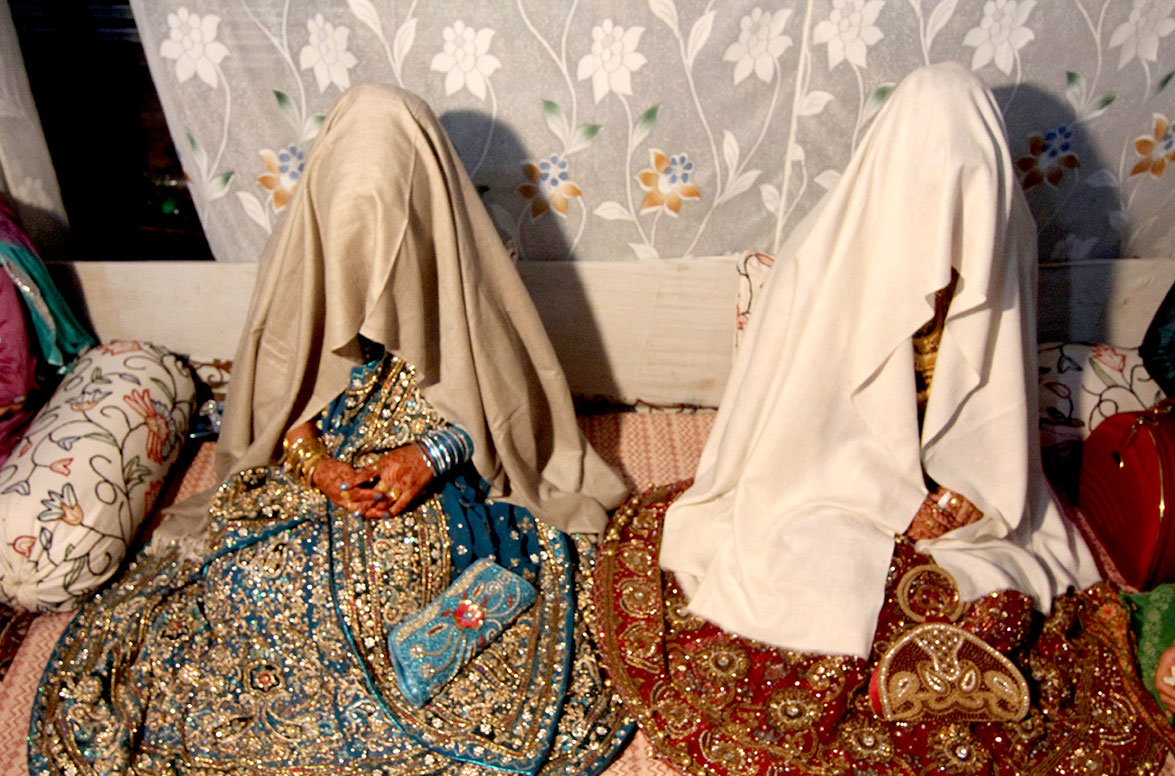
Shafiq estimates that the wedding will cost more than Rs 60 lakh. “I bought jewellery worth more than Rs 20 lakhs, given the high price of gold. We are also gifting gold to my daughter’s in-laws because, obviously, beti ka maamla hai.”
Waqar Khan, a renowned Kashmiri singer stated that it was from 2020 that he started doing live performances. “90 per cent of the ceremonies that I do in a year which number around 120 to 150, are the marriage and related ceremonies. The class we cater to are the ones who can afford it,” Khan said. “We mostly cater to sufi genre, the mehfil type you know. Usually, they are the ones who book us or like invite us and our performance hours range from four to five hours be it during the day or the evening. Annually we are able to touch around one crore rupees and this year we expect there will be a five per cent growth.”
A Cultural Shift
RJ Rafiq, a well-known radio jockey in Kashmir who also hosts wedding functions, commented on the significant changes in Kashmiri weddings. “These days, there are wedding planners who offer DJs, hosts, horses, and other amenities as part of the plan,” he said. “Mehandi raat has turned into Sangeet night, where both families gather and are entertained by an anchor or host who sets the mood. There are singers, and the host manages them, especially at destination weddings. Event management companies have driven this trend. There is a class in Kashmir that prefers these kinds of weddings, some even more elaborate. The traditional Kashmiri essence is missing. The wanwun and other cultural elements are being replaced, eroding our traditions.”
Mostly in urban and semi-urban spaces, the wedding has changed its colours. “In the not-so-distant past, youth groups from mohallas would come and serve at weddings, but now they are replaced by catering teams. Wanwun has been replaced by DJs. Koshur Khandar is missing. It is all about keeping up with others. Elements like the mehandi artist, photographer, videographer, and make-up artist have become more important than the main ceremony.”
Rafiq regrets the devolution of the basic human institution which unfortunately is being projected as modernity and evolution. “Nikkah, once the simplest activity, has taken a backseat to decorations, lighting, music, and make-up. This is why the number of unmarried youth is increasing. Extravagance is a contributing factor. Weddings are now about impressing others, and new standards are being set every day. To meet these standards, some families sell their land or houses and exhaust their savings. This has created a widening gap. On one hand, there are lavish weddings; on the other, people are suffering. It casts a long shadow.”
Memories of Regret
In 2018, Ahmed’s wedding was intended to be a grand affair, but it became memorable for the wrong reasons. As the firstborn in his family to marry, his parents wanted everything to be top-notch. They organised a two-pandal setup, bought expensive jewellery for the bride, and gave gifts to immediate family and friends, exhausting their lifetime savings.
“I had bought gifts for my family and my husband’s family, which we sent out with the invites,” Ahmed’s mother said. “At that moment, we did not realise that what we were doing was not a healthy practice. The wedding not only left our savings exhausted but also left us in debt. Both Ahmed and my husband are now working hard to clear the debts.”
Ahmed’s family is not alone; many families have become indebted due to extravagant wedding celebrations.
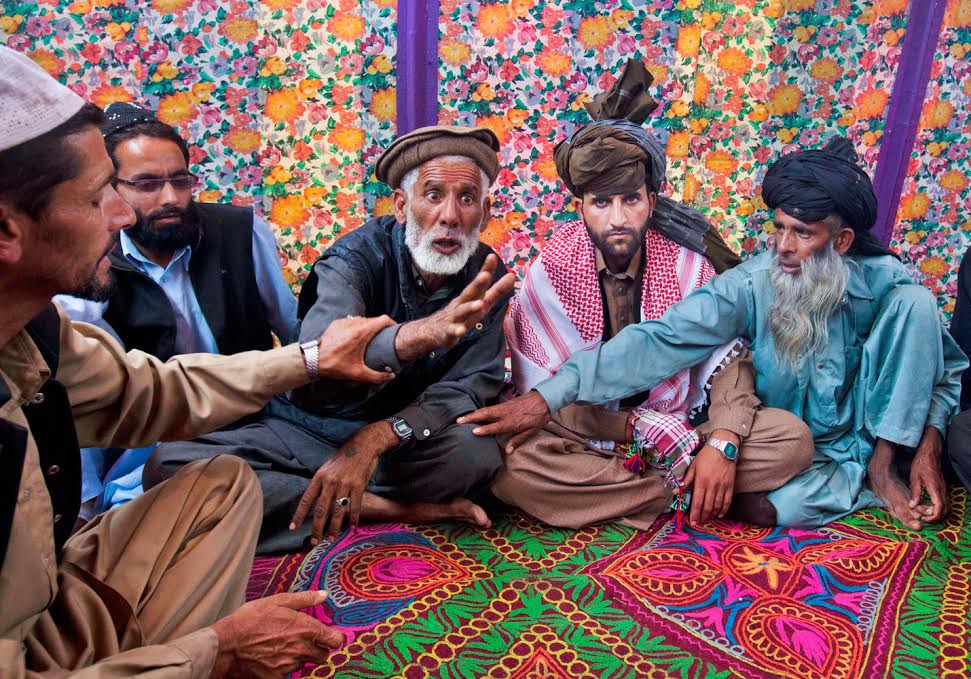
“When I decided to get my daughter married, I wanted everything to be very nice, cosy, and comfortable, so I did not compromise on anything,” said Ghulam Nabi, a North Kashmir resident.“I hired the best in business to make the wedding memorable. The waaza weal were from Srinagar, the caterers from a high-end institute, and we had the best tents, singers, and photographers. The expenses exceeded what I could afford, so I took a loan and sold a piece of our ancestral land.”
Ghulam Nabi regrets overspending on the wedding, selling his ancestral land, and still paying off a loan. Despite his daughter’s advice, he feels lost and burdened by this lasting regret.
Ahmed and Ghulam Nabi’s cases highlight a larger issue in Kashmir, where middle-class families spend loads on weddings, and the elite spend even more.
Another contributing factor is the number of guests. “When I got married, we had about three to four hundred guests, but now the number has increased to thousands, adding to the extra expenses,” said Mahira, a resident of Sopore. “Now when I attend weddings, I am often left dumbfounded by the spending.”
A Tragedy
Muhammad Sultan, like Shafiq, faced a similar crisis. His daughter’s wedding in 2022 involved significant expenditure, with the event held in a marriage hall.
“We tried to provide everything we could for the wedding because we have only one daughter. We gave her everything within our capacity, including gold ornaments for her in-laws and high-end services like the best make-up artists and wedding photographers. Unfortunately, it ended in a divorce. Her in-laws demanded more than we could provide, but our daughter did not inform us about these issues, leading to an unfortunate outcome. All our efforts were in vain,” he said. “We had purchased everything, and the gifts for the couple were lavish and high-end, but the marriage could not endure. What was the point of spending everything we had?”
Is There Hope?
In a notable development, the Auqaf Committee of Bangdara, Baramulla, has moved to curtail the culture of extravagant weddings by implementing a simplified marriage system. A recent joint meeting discussed measures to address excessive wedding expenditures.
“We have decided to simplify the Wazwaan menu to keep it modest, though we have not set a specific spending limit on weddings,” Abdul Majeed Khan, Chairman of the Auqaf Committee Bangdara Baramulla, said. He noted that the high costs of weddings have contributed to a rise in late marriages, a growing concern in the region.
Similar initiatives have previously been adopted by the Auqaf Committee in Warpora, Sopore, and other areas under their authority, including Seelo.
For more than 30 years, there has been a code of marriage conduct in place in Baba Wayil, a village almost 30 km from Srinagar in Ganderbal. This 1200-home village that survives on Pashmina weaving and walnut has drafted a document by consensus and it is part of the official records too. This has eradicated the dowry system and ostentatious weddings and replaced them with simple marriages.
(All names have been changed to protect the identities of those involved.)