Kashmir’s kitchens are in upheaval after authorities seized nearly 12 tons of rotten meat and dairy in recent raids. The full-blown crisis involving trust is unsettling one of the region’s largest meat-consuming societies, reports Babra Wani
It was a biting winter morning in 2013. Saima, 14, sat cross-legged before her grandfather, listening to a chilling legend. The tale spoke of a Kashmiri barbecue seller whose stall had become wildly popular until a horrifying truth surfaced: he had been serving human flesh to unsuspecting customers.
Twelve years later, on a blazing summer morning in 2025, Saima, now 26, sat by her grandfather’s bedside narrating a story of her own. This time, it was not folklore but breaking news. Several tons of rotten meat had been seized across Kashmir, and no one yet knew what kind it was.
Saima recalled how the legend had once left her shaken, unable to touch meat for months. Now it was her grandfather who refused to eat any, despite being an avid meat lover. “It is ironic, how we no longer know what we have been consuming,” she said.
Their unease was widely shared. Across Kashmir, one of the country’s largest meat-consuming regions, people began to eye their plates with suspicion. At weddings and family gatherings, food had become the dominant subject of whispered conversations.
The Crisis
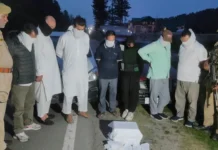
The Department of Drug and Food Administration reported seizure of about 11,668 kgs of meat products, including poultry, mutton, chicken, packed meats and fish. With dairy items included, the total reached nearly 12 tons.
The discovery plunged Kashmir into anxiety. People wondered aloud not only about the meat’s freshness but also about its nature. Rumours spread that the seizures involved non-Halal meat, an allegation which Commissioner of the department, Smitha Sethi, rejected outright.
Kashmir’s meat consumption has long been immense. A tourist place with a huge non-vegetarian population, Kashmir is the Wazwan country. The racket coincided with the wedding season, and it made people more cautious about what they cook and consume.
The administration responded by suspending Food Safety and Standards Authority of India licences of nine meat and sweet establishments during a special enforcement drive. The suspended businesses included Al-Taqwa Foods in Lasjan, Aarif Enterprises in Tengpora, Sunshine Foods in Zakura, Anmol Foods in Parimpora, and Jubilant Food Works Ltd, the franchise of Domino’s Pizza in Anantnag. Popular local outlets such as Shanu Shahi Biryani, Shan Fish Fry, Bismillah Sweets, and Khanday Poultry were also covered by the action.
The poultry industry, once supplying up to 85 per cent of local demand, was now struggling to meet even 20 per cent, sector insiders said. A document circulated by the poultry association said the ongoing crisis is driven by the unchecked influx of imported poultry, often outdated and unhygienic, entering without certification, cold-chain monitoring or labelling. The abolition of the Lakhanpur toll tax, it added, had worsened the problem by opening the gates to cheap, mass-produced and even rejected poultry that undercut local farmers.
The Mistrust
At a lunch gathering in Kulgam, Sameer, 27, noticed something unusual at his host’s party. Only two mutton dishes were served alongside six vegetable dishes. The host explained to the guests that he secured mutton from a trusted local butcher, while the vegetables were home-grown. Sameer said his own family had stopped eating chicken and meat altogether.
A few months earlier, he recalled his food poisoning episode, which, he now links with adulterated food. Another Srinagar resident spoke of imported poultry, alleging that much of it came from dead or sick birds bought cheaply from farms outside Kashmir. These birds, purchased for about Rs 10 a kg, were dressed, frozen and shipped to Srinagar. Fingers are being raised over the systems and methods of slaughter.
Residents argued that their health was being sacrificed for profit. They pointed to the availability of cheap dressed and boneless chicken as evidence of how the market had been distorted. A villager from South Kashmir recalled how the body of a cow, once buried after its death, mysteriously disappeared from the village periphery. On another occasion, he said, a load-carrier hauled away a cow carcass, but despite a chase, the villagers never discovered what happened to it.
An insider from Kashmir’s poultry industry described the unfolding crisis as a pattern of “slow poisoning”. He explained that Kashmir required about 8.5 million chickens every month. Six or seven years earlier, nearly 85 per cent of this need had been met locally, but now Kashmir produced only 15 per cent. The gap, he said, had become a major concern.
He said the abolition of the Lakhanpur toll, which once offered vital protection to local farmers, has opened the gates to unchecked imports.
Toll Plaza
The Lakhanpur Toll Plaza was abolished on December 31, 2019. Within hours, the government invoked Section 4 of the Jammu and Kashmir Levy of Tolls Act to notify that the post “shall cease to operate with effect from January 1, 2020.”
Lakhanpur had been more than a toll gate. Its political symbolism apart, it generated a revenue of Rs 644.64 crore in 2017–18, rising to nearly Rs 1,000 crore a year later. For poultry farmers, it had acted as a gateway of protection. “Since its abolition, this menace has entered our guts,” another insider remarked.
Business leaders echoed the demand for safeguards. Babar Chowdhary, Managing Director of Hattrick and President of the Jammu and Kashmir Hotels and Restaurant Association, called on the government to stop the entry of unbranded and unlabelled frozen meat. He welcomed the creation of two check posts, one at Lakhanpur and another at Qazigund, to intercept any product without proper labels.
Javid Ahmad Tenga, President of the Kashmir Chamber of Commerce and Industry, said poultry and sheep worth thousands of crores once passed through Lakhanpur, both live and dressed. Now, he argued, the entry of dressed meat had become so unregulated that “we do not even know how it comes, whether legal or illegal.” He said the rotten meat controversy had devastated businesses, with restaurant sales collapsing to as little as five to eight per cent. “We demand a ban on dressed meat until we have full facilities,” he said, adding that those responsible must be named and shamed.
Trust Deficit
Industry insiders urge the food department to intensify inspections and identify those distributing unfit meat.
Babar said he is shocked that boneless chicken was reaching Kashmir from outside at just Rs 160 per kilogram, when the local price was more than Rs 700. How do they recover the transportation costs, freezing costs and GST, he asked. “What exactly is being sold at such a low rate?” Tenga said that dressed chicken, if frozen and processed, must be valued at Rs 1,200. “So, what are we really consuming?” he asked.
Health experts in a press conference linked a basket of diseases in Kashmir, including vomiting, diarrhoea, food poisoning and even sudden deaths, to adulterated meat. They claimed formaldehyde was being added to extend shelf life, and stressed that the chemical was carcinogenic.
It has impacted livelihoods. Sales in some restaurants had fallen by 90 per cent. The massive influx of dressed chicken has impacted the local poultry farmers, who are out of competition. Tenga pointed to two grave mistakes: the import of unbranded, unlabelled frozen meat and the circulation of rotten meat, caused by broken cold chains.
An insider from Kashmir’s mutton industry explained that while it costs Rs 700 a kg, frozen meat from outside was selling at Rs 150 to Rs 160. He questioned how such prices were possible given transport and storage costs, suggesting the meat had to be substandard.
The Rotting Supply Lines
The insider claimed that at every livestock market, weak, sick, blind, or lame animals are sold cheaply and are slaughtered, frozen and supplied to markets like Kashmir at throwaway prices. Even hotels and restaurants in Delhi received such supplies, he added. “Discarded fats and offal are added and it is minced, frozen and sold in Kashmir,” he asserted.
In Delhi, livestock meat is sold at Rs 800 a kilo, though animals are smaller in size. In Kashmir, where animals were larger, transportation added Rs 55 to Rs 70 per kilogram. Prices fluctuated between Rs 650 and Rs 700 depending on supply, mortality, and demand. But the minced meat used in rista or kebabs increasingly contained discarded or fake material, from beef, chicken, and at times even fish.
The mutton trade insider emphasised that techniques used to ripen vegetables and fruits were now being applied to meat. Chemicals kept the discarded chicken and livestock meat from smelling. “When you see such cheap meat, you should understand it cannot be clean. It cannot be fresh. It is meat that others did not want, already spoiled, or from animals unfit for slaughter.” According to him, a mafia was running this business from Delhi.
Advocate Badrul Duja of the High Court of Jammu and Kashmir said that Kashmiris are consuming a really bad thing in the name of mutton. He recounted how his friend in Delhi, who once worked in the industry, had briefed him about the quality of “mutton” that went into the making of momos, pizzas, and other meaty eatables. “My friend left the industry after witnessing these practices,” he claimed. As a lawyer, he said he is aware of the kingpin of the racket, a wealthy and influential person in Srinagar whose name is nowhere in the public domain or public documents.
The Case in the Court
“All the food items, be it meat, dairy, sweets, or vegetables, that we have seized were not properly stored or labelled,” an official from the food safety department said. “The details remain under investigation, and the case is now with the High Court.”
The Jammu and Kashmir and Ladakh High Court has since taken up a public interest petition filed by advocate Mir Umar against the “rotten meat mafia.” The petition accused authorities of ignoring the unchecked sale of unhygienic and unsafe meat across Kashmir.
On August 20, 2025, a Division Bench led by Chief Justice Arun Palli and Justice Rajnesh Oswal noted that the petition aimed to highlight official negligence despite repeated government advisories. The order also referred to a newspaper exposé titled Meet the Meat Mafia, which alleged that the hidden cartel was feeding Kashmir with meat otherwise unfit for animals. The court directed that the Commissioner, Food Safety, and the Controller of the Drugs and Food Control Organisation be impleaded as parties. It warned that if objections were not filed before the next hearing on August 25, “appropriate orders shall follow.”