Two generations later, the Jammu and Kashmir National Conference (JKNC) has pledged to do away with the Jammu and Kashmir Public Safety Act it legislated to stop timber smuggling. The promise is part of the grand old party’s manifesto for the elections Jammu and Kashmir is witnessing a decade later, reports Babra Wani

The Jammu and Kashmir Public Safety Act (PSA) is once again in the headlines, this time for not the data the controversial law has been generating but for its possible repeal. Recently, the Jammu and Kashmir National Conference (JKNC) and Jammu and Kashmir Apni Party (JKAP) have both pledged in their manifestos to “repeal the PSA.” The law is unique to the erstwhile state of Jammu and Kashmir.
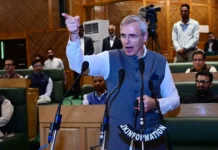
In the JKNC manifesto, a key highlight under the section titled Restoring Normalcy states: “PSA: We will repeal the PSA. Release of Political Prisoners: We will prioritise the release of political prisoners and youth unjustly detained in jails and not involved in serious crimes. We will also seek amnesty for all political prisoners.”
The Apni Party has also pledged to prioritise the release of detainees and withdrawal of cases against youths in their manifesto. As the situation normalises, the party vows to exhaust all avenues to secure the early release of detainees not involved in heinous crimes. To expedite this process, a fast-track board will be established to review and dispose of cases for individuals languishing in jails under the PSA despite completing their imprisonment terms.
Besides, cases against teenagers detained in the summer of 2016, now adults, will be withdrawn, enabling them to pursue government jobs without hindrance. The JKAP has also proposed a one-time amnesty for all detainees, with a cut-off date of August 2025, contingent upon the production of a court-sworn statement.
The Law Rises
The Jammu and Kashmir Public Safety Act, introduced in 1978, was said to be originally intended to target timber smugglers. However, by 1980, it was expanded to include anti-national activities, coinciding with the National Security Act (NSA) introduction. It is noteworthy that the PSA, which the JKNC now seeks to repeal, was first introduced in Jammu and Kashmir by Sheikh Muhammad Abdullah, the founder of JKNC.
After the abrogation of Article 370, Sheikh Abdullah’s son, Dr Farooq Abdullah (five time Chief Minister), and grandson, Omar Abdullah (former Chief Minister)m, were detained under the Public Safety Act (PSA) in 2019. The PSA empowers the administration to detain individuals for up to two years without trial.
In 2019, when the Jammu and Kashmir Reorganisation Act was implemented, many acts and laws were either amended or repealed, but the PSA survived. A total of 166 laws were retained from the old state constitution, including the PSA.
The Law
The Jammu and Kashmir Public Safety Act (PSA) of 1978 is a preventive detention law designed to detain individuals who are perceived to threaten “the security of the state or the maintenance of public order.” It closely resembles the National Security Act, used by other states for preventive detention. The PSA is enacted through an administrative order issued by the Divisional Commissioner or the District Magistrate, based on the dossiers generated by the Jammu and Kashmir Police (JKP).
The legislation of the law was initially justified by asserting that it is aimed at combating rampant timber smuggling in the region. Soon after, however, it evolved into a standard preventive detention law, allowing detainees to be held for two years without trial.
“The Public Safety Act (PSA) of 1978 has been a significant piece of legislation in the state, aimed at maintaining public order and preventing anti-national activities,” a former Law Secretary in the Jammu and Kashmir Government remarked. “Despite numerous amendments and changes in the legal landscape, the PSA remains a controversial and critical component of the state’s legal framework.”
The former officer said that initially, the law focused on forest smugglers and activities threatening the state’s sovereignty. “Over time, the scope of the PSA has expanded to encompass a broader range of activities deemed threats to national security and public order.”
The PSA allows authorities to detain individuals without formal charges for extended periods. “The Unlawful Activities (Prevention) Act (UAPA) operates under a different framework. Unlike the PSA, UAPA mandates that charges be filed within a specified period and provides a structured judicial process, including trials. This contrasts sharply with the PSA’s focus on preventive detention without immediate judicial oversight,” he noted. “Its application and implications have sparked considerable debate from time to time.”
The PSA has undergone various amendments over the years, with changes implemented in 1985, 1988, 2001, and 2012.
The Amendments
The lawless law, as Amnesty International once termed it, evolved with the dynamic situation in Jammu and Kashmir. It underwent a lot of amendments to suit the new challenges without changing its basic character. Some of the changes were dictated by the criticism that it triggered by people, human rights watchdogs and even the lawmakers of the erstwhile assembly in Jammu and Kashmir.
In October 2011, five amendments were made by the assembly. A change in its Section 8 ensured that the PSA would not be slapped on a state subject who has not attained the age of 18 years. Section 13 was amended to ensure that the grounds on which the order (of detention) has been made should be in the language understandable to the detainee. Change in Section 14 ruled that the Chairman and the members of the (advisory) Board shall hold the office for three years which will be extendable for two years. Section 16 was amended mandating the advisory board to take a call based on the material evidence placed before it (on detention) within six weeks and not eight weeks. Section 18 (a) the detention period was reduced from 12 months to three months. Section 18(b) started reading: “Six months (and not two years) in the first instance which may be extended up to two years from the date of detention in the case of persons acting in any manner prejudicial to the security of the State.” These changes were formally announced only in 2018.
Interestingly, however, the government did not delete section 10(a) which made the law wild. This section provides that the order of detention cannot be deemed to be invalid even if “the grounds of such detention are vague, non-existent, not relevant and not connected with the person to be detained.”
The Government of India approved an ordinance on March 31, 2020, that brought about key changes to this law. One major modification was made to Section 10, which deals with the locations and circumstances of detention. The government removed a provision that previously ensured permanent residents of Jammu and Kashmir could not be detained outside the former state.
With this restriction lifted, detainees from Jammu and Kashmir are now transferred to any location within the country. The ordinance also altered the composition of the Advisory Board established under Section 14, which was tasked with recommending modifications to the PSA.
Previously, the Board required a chairperson with a High Court judge background, accompanied by two other members with similar qualifications. The requirement for board members to have a judicial background was done away with. Instead, the government can make appointments in collaboration with a Search-and-Selection Committee of Administrative Secretaries. Consultation with the Chief Justice of the High Court is now required only if a judge is being considered for the role of chairperson.
PSA Detentions
According to a report by The Indian Express, 699 people were detained under the Public Safety Act (PSA) in 2019, and 160 in 2020. In 2021, 95 people were detained under PSA till July. In the first 30 days after Article 370 was revoked on August 5, 2019, at least 290 people were booked under this law including Omar Abdullah, Farooq Abdullah, and Mehbooba Mufti.
A document issued by the Home Department Jammu and Kashmir on August 31, 2023, revealed that 1122 individuals detained under the Public Safety Act (PSA) were transferred to jails outside Jammu and Kashmir since 2018. These included 44 in 2018, 295 in 2019, 146 in 2021, 585 in 2022, and 52 in 2023, up to August 1, 2023.
According to the documents, 408 PSA detainees, including 29 foreign nationals, are currently being held in jails outside Jammu and Kashmir. For the last few years, the PSA has been used against drug peddlers and smugglers as well.
Back In Debate
Even though the judiciary has been quashing almost 95 per cent of detentions under the impugned law, the political parties have started feeling the heat as well. Politicians and their workers also encountered strict and controversial law, the successive regimes have been used against people to keep them “out of circulation”. Seemingly, this has led to the inclusion of the relief in the manifesto, a promise they may or may not be able to keep.