For the first time in history, reservations are gradually becoming an electoral issue in Jammu and Kashmir, reports BabraWani
For Anantnag resident, Iqbal, his political inclination changed from one regional party to another, after their respective manifestoes were unveiled.
“It is all about the reservations,” Iqbal, who just like other aspirants and candidates from the Open Merit (OM) category, has been fighting past months against the new Reservation Policy, said, “Even if we are voting for somebody to represent us or to form the government, we want somebody who actually talks about us or like even considers our issues.”
Iqbal has been supporting a party for the upcoming Assembly Elections, being held after a break of almost a decade.
The reason for support stems from the party’s manifestoes, which were unveiled recently and included reservations.
It is not just Iqbal. Many aspirants like him believe that including reservations in the party manifestoes is starting conversations, which is a good start.
Manifestoes and Debates
The new Reservation Policy in Jammu and Kashmir has not received much attention in the manifesto of one of the major political parties, the People’s Democratic Party (PDP).
A few months ago JKPDP’s Waheed Parra tweeted in support of the OM candidates who have been fighting against the policy. “The new reservation policy undermines the merit and aspirations of countless intelligent students,” the tweet read. “Allocating 40 per cent of opportunities to 70 per cent of the students erodes meritocracy. Government must reconsider this and balance all stakeholders for equitable opportunities.”
After that tweet went viral, the party heads tweeted denouncing the party’s association with the tweet, prompting Parra to delete the tweet.
Unlike PDP, others are not silent. JKNC manifesto mentioned that the reservation policy will be reviewed and any injustice and imbalance will be corrected. The manifesto prompted Home Minister Amit Shah to raise ten questions, one of which was regarding the Policy. “The (JKNC-Congress) alliance has exposed the Congress party’s anti-reservation stance,” Shah’s question reads. “Does Congress support the JKNC’s promise to end reservations for Dalits, Gujjars, Bakarwals, and Pahadi communities, thereby inflicting injustice upon them?” He posed the question: “Does Rahul Gandhi support the JKNC manifesto, which calls for abolishing reservations for Dalits, Gujjars, Bakerwals, and Pahadis?”
JKNC MP, Aga Ruhullah Syed Mehdi termed the questions “lying and distorting the facts”. “No one among us is taking away the rights of any section of society,” Agha reacted. “We have promised to correct the imbalance. This means while continuing the reservations, the proportion of the population or implementation of -what the SC has also directed- a slab of 50 per cent on the reservations will be the guiding factor.”
The Reservation Policy?
The debate started in early 2024, when the central government passed the New Reservation Policy, granting 10 per cent extra reservation to some new sections under the Scheduled Tribes.
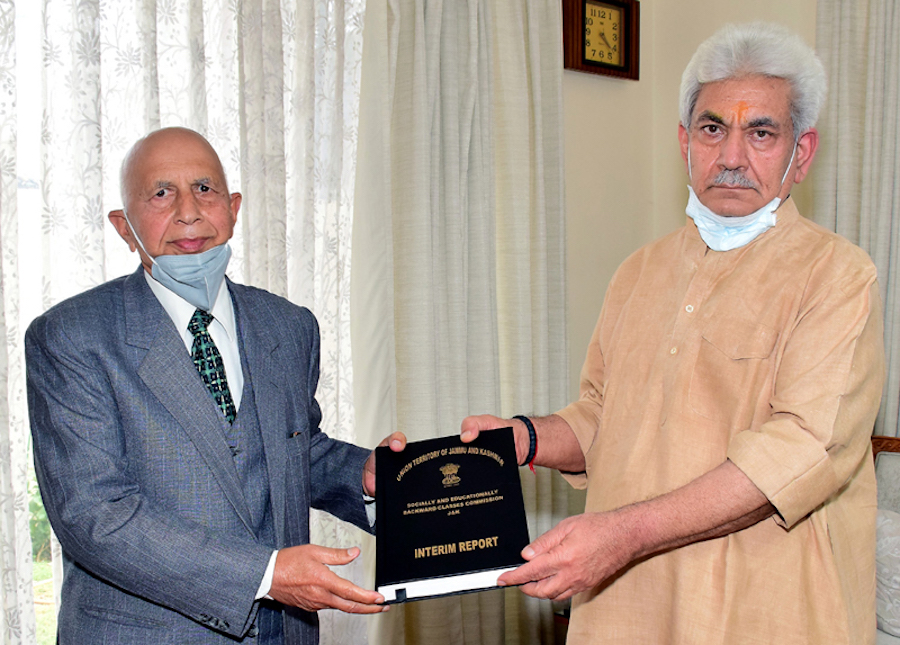
The original reservation act passed in 2005, was primarily concerned with giving Scheduled Tribes (ST), Scheduled Castes (SC), ALCs (Line of Actual Control), and RBAs (Residents of Backward Areas) special quotas. Since the name OBC, or Other Backward Classes, had not yet been created, these tribes were referred to as Socially and Economically Backward Classes.
In 2019, the Indian Constitution Amendment Act 103 was approved and a 10 per cent reservation was introduced for the Economically Weaker Sections (EWS) across India including Jammu and Kashmir after the abrogation of Article 370, amending Article 16. When the reservation was provided, it was an additional 10 per cent to the existing 50 per cent reservation of Scheduled Tribes, Scheduled Castes, and the Other Backward Classes, thus resulting in a 60 per cent total reservation. However, in Jammu and Kashmir, the reservation quota of EWS was added by reducing RBA’s reservation by 10 per cent.
After EWS was added, Paharis were added under the reservation quota too, resulting in widespread protests from the Gujjar Community as they thought their rights were being trampled upon. Many of the Gujjar leaders also called the move, “politically motivated.” After an additional quota of 10 per cent was set aside for Paharis from the overall opportunity basket, it is the Kashmiris who will be getting affected ultimately.
This reduced the OM category, reducing it to less than 40 per cent.
Reservation percentages under the system in vogue include eight per cent to SC, 20 per cent to ST, 10 per cent to EWS: 10 per cent, 10 per cent to RBA, eight per cent to OBC (including 15 new castes) and four per cent to ALC/IB, which makes 60 per cent of the opportunity basket. There is a further reduction in the quota for OM candidates when considering the horizontal reservations (3 per cent + 6 per cent). Besides, suppose any of the reserved category candidates jumps to the top of the merit. In that case, he automatically moves to the OM category and the resultant vacancy stays for the reserved category.
Before the new policy, Jammu and Kashmir had reservations of 8 per cent for SC, 10 per cent for STs, 4 per cent for OBCs, 4 per cent for people living along the Line of Actual Control/International Border, 10 per cent for residents of the Backward Area (RBA), and 10 per cent for Economically Weaker Sections (EWSs). It was only 46 per cent.
In anticipation of Pahari’s inclusion in the ST list, the PSPs were entitled to four per cent reservation in government jobs and admission to professional institutions. Besides, they were entitled to reservations for economically weaker sections (EWS), and residents of backward areas (RBA) as well as the quota for those living in border areas.
Ironically even though the new reservation inclusion was being seen as a measure of gaining the Rajouri-Poonch-Anantnag Lok Sabha in the 2024 elections, the results proved otherwise. JKNC’s Mian Altaf of the National Conference won the seat.
Now the reservation debate is open. Even though only a few parties are formally talking about it, everybody is concerned that the majority population of Jammu and Kashmir is being discriminated against with the sole purpose of dividing the people.