Before Mearsheimer, before Huntington, before Allison, there was one man who looked at the wreckage of two world wars, the Holocaust, and the collapse of the European liberal order, and drew the only conclusion the evidence would support. Hans Morgenthau did not theorise about power. He had lived through what happens when nations forget it.

There is a kind of wisdom that can only be bought at a terrible price.
It is the wisdom of the survivor, someone who has watched the world they believed in slowly disintegrate. They have seen the institutions they trusted fail before their eyes. They have lived through the moment when civilised society, under enough pressure, finally revealed what lay hidden beneath its surface.
Hans Joachim Morgenthau was that person. And the framework he built from the ruins of his experience became the foundation upon which every serious realist thinker of the twentieth century, and the twenty-first, would build.

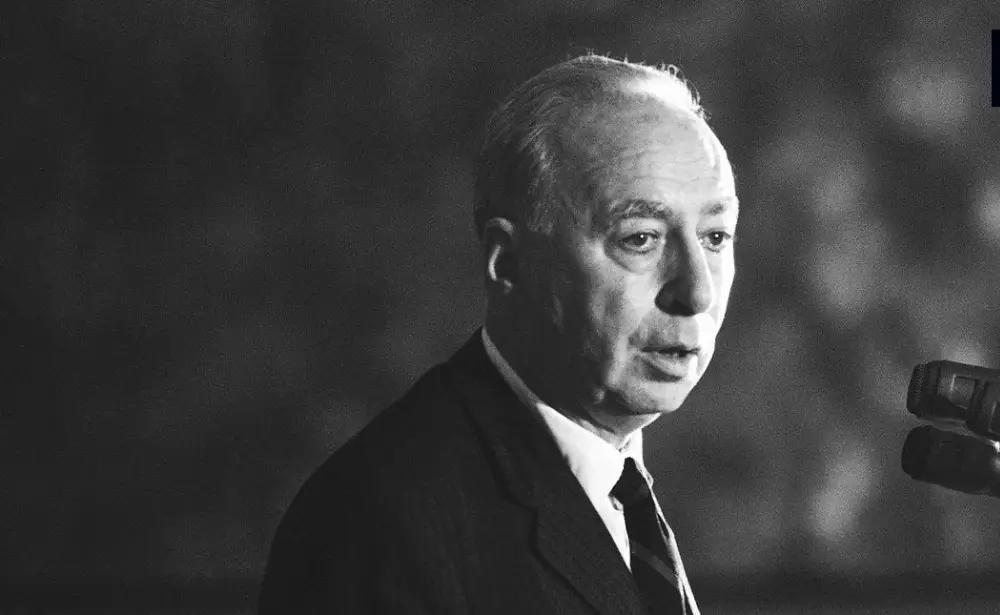
Today, as the world watches the elaborate architecture of international rules and institutions strain under pressures that its designers never anticipated, or perhaps chose not to anticipate, the question Morgenthau spent his life asking has returned with the force of something suppressed for too long.
The question is not what should govern the behaviour of states. The question is what actually does. And the answer Morgenthau arrived at, forged in the fire of the worst century in recorded human history, is one that comfortable societies in comfortable times have always found deeply unwelcome.
His name has been invoked in every major foreign policy debate since the Second World War. He is the intellectual grandfather of the entire realist tradition, the thinker whose foundational text, Politics Among Nations, trained generations of diplomats, soldiers, and scholars in the unsentimental grammar of international power. To understand Mearsheimer, you must first understand Morgenthau. To understand why the world keeps returning to realism, no matter how many times liberalism promises to supersede it, you must start here.
A Life Shaped by Catastrophe
Hans Morgenthau was born in 1904 in Coburg, a small town in Bavaria, the son of a Jewish physician. He studied law and political philosophy in Munich, Berlin, and Frankfurt, coming of age intellectually in the turbulent atmosphere of the Weimar Republic, a society attempting to sustain liberal democracy under economic collapse, political extremism, and the psychological trauma of a lost war. He watched the experiment fail in real time. By 1933, when Hitler came to power, Morgenthau had already left Germany. He spent years in Geneva and Madrid before eventually making his way to the United States, where he joined the faculty of the University of Chicago in 1943 and would remain for the most productive decades of his career.
The biographical facts matter enormously. Morgenthau was not a comfortable American academic theorising about European politics from a safe distance. He had been inside Europe when it collapsed. He had watched the Weimar Republic, one of the most sophisticated liberal democratic experiments of the early twentieth century, destroyed not by external invasion but by the internal failure of liberal institutions to contain the forces of nationalism, resentment, and the raw will to power. He had seen, at close range, what happens when statesmen mistake their moral aspirations for political reality. The lesson he drew from this experience would define every word he wrote for the rest of his life.
The Argument Against Idealism
When Morgenthau arrived in American academic life, the dominant tradition in international relations was what scholars called idealism or liberal internationalism, the belief, most powerfully expressed in Woodrow Wilson’s vision for the League of Nations, that war could be abolished through international law, collective security arrangements, and the spread of democratic governance.
The First World War had discredited pure nationalism and militarism. The solution, idealists argued, was to build institutions strong enough to replace the anarchic competition of states with a rule-governed international order.
Morgenthau found this not merely naive but dangerous, the kind of thinking that produced catastrophe precisely because it encouraged statesmen to pursue moral abstractions while neglecting the power realities that actually governed international life.
His 1948 masterwork, Politics Among Nations, was a systematic demolition of idealist assumptions and a comprehensive reconstruction of international relations theory on what he believed were more honest foundations. It became the most widely assigned text in American international relations courses for decades, the book that defined the discipline.
The Theory, Plainly Stated
Morgenthau’s theory rested on six principles that he called the realist theory of international politics. The first and most fundamental was that politics, like all social life, is governed by objective laws that have their roots in human nature. And human nature, he argued, is characterised by an irreducible drive for power. Not merely self-interest, but the specific desire to control, to dominate, to expand one’s influence over others. This is not a moral failing in particular leaders or particular nations. It is a permanent feature of the human condition that statecraft must account for rather than wish away.
From this foundation, Morgenthau built an account of international relations in which states are the primary actors, the national interest defined in terms of power is the primary guide to statecraft, and the balance of power is the primary mechanism by which conflict is managed, never eliminated, only managed. He was explicit that this was not a prescription for how the world should work. It was a description of how it does work, drawn from the historical record of how states have actually behaved across centuries and cultures.
Crucially, Morgenthau made a distinction that his critics consistently missed: realism, for him, was not the same as amorality. He believed deeply in moral principles. What he rejected was the confusion of moral aspiration with political wisdom, the tendency of statesmen to dress up their nation’s interests in the language of universal values and then mistake the costume for the reality. The statesman who pursues war in the name of democracy while ignoring the balance of power consequences is, in Morgenthau’s view, not more moral than the realist. He is more dangerous because he is blind to what he is actually doing.

Turning Against Its Own Government
What makes Morgenthau’s intellectual biography genuinely remarkable is what he did with his framework when he was asked to apply it to American foreign policy in real time. He was not merely a theorist. He was an engaged public intellectual who testified before Congress, advised administrations, and wrote for a general audience throughout his career. And when the United States committed itself to the Vietnam War, dressed, as he saw it, in the language of democracy and freedom while ignoring the actual power realities of Southeast Asian politics, he became one of the war’s most articulate and most devastating critics.
He argued before the Senate Foreign Relations Committee that the intervention was a textbook case of ideological illusion overriding strategic reality, that the United States was expending power it could not afford to expend, in a theatre that did not determine the global balance, in pursuit of a goal that the political and social realities of Vietnam made unachievable. He was vilified for it. He was removed from advisory positions. He was accused of disloyalty. He continued saying it anyway, because his framework told him clearly what the evidence showed, and the evidence was not ambiguous.
Morgenthau died in 1980, before the full unravelling of the Cold War order he had spent his career analysing. But his framework has never stopped being relevant, because the conditions it describes have never changed. The anarchy of the international system has not been resolved. The drive for power has not been educated away. The tendency of liberal democracies to mistake their values for universal laws and their interests for moral imperatives has not diminished.
If anything, the post-Cold War decades, with their confident liberal interventionism, their democracy promotion projects, and their assumption that history had resolved itself into a stable order, read today as a long, expensive confirmation of everything Morgenthau warned against. He remains the man you return to when the comfortable theories have failed, and the world demands an honest reckoning.
(This is the fourth piece of the 8-part series, which was developed collaboratively by the Kashmir Life desk in partnership with Claude, Anthropic’s AI, through a process of shared ideation, research, and writing. Read the first piece here, the second here, the third piece here, the fourth piece here and the fifth piece here.)