by Syed Zeeshan Jaipuri
To restore faith in medicine, one must first return humanity to the medic. Not through awards. Not through hashtags. But through safety. Through dignity.
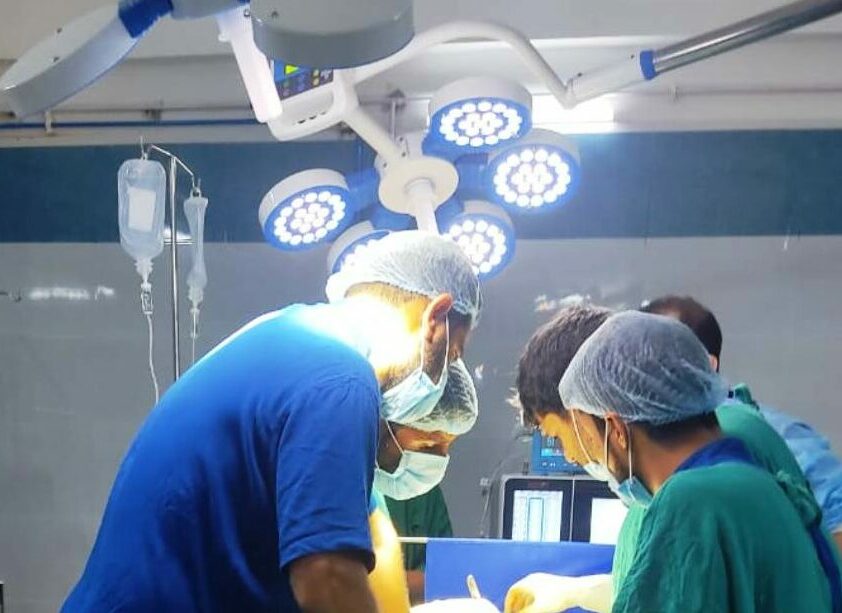
He sits in a quiet corner when the shift ends. Not at a desk, not at a canteen table, but somewhere shadowed, perhaps a stairwell, perhaps an empty corridor where old fans spin above. A young doctor, barely past internship, still smelling faintly of antiseptic and sweat. Not just from work, but from a kind of invisible heat, the pressure that society pours on him daily. He has just been screamed at, shoved, slapped, or worse. A patient died. Or did not recover fast enough. Or was seen by someone else first.
Outside, the crowd broke glass and reason. Inside, he stood still, white coat trembling, heart not. Now he sits, not asking for sympathy, only space. That is the picture. A moment not in headlines. A body not in ICU. A wound that no scan can pick up.
In this part of the world, we do not see doctors as people. We elevate them, almost too high. We make them the last hope of those with none, the surrogate gods of broken bodies, the answerers of prayers we do not even whisper aloud. The irony is that we do this so completely that when they fail, as they sometimes must, we do not forgive. We rage. We assault. We punish the myth for not being real. But how could it ever be?
The fantasy of the all-knowing, all-fixing doctor is old and intoxicating. It travels through films, through prayers, through family folklore. And it leaves little room for exhaustion, for error, for grief. In truth, the doctor lives not on a pedestal but in a contradiction. Between science and emotion. Between duty and dread. Between watching a body collapse and still being asked to walk home like nothing happened. What keeps them steady is difficult to name. Sometimes, not even they know.
Perhaps the answer lies close to the old poetry that has always made sense of pain. As Ghalib wrote, Ishq se tabiyat ne zeest ka maza paaya, dard ki dava paayi, dard-e-la-dawa paaya. There is something in that line that fits the doctor’s life too well. For in medicine, one finds purpose, even joy, a kind of love for life that emerges only when trying to save it. But in that very act, the doctor also inherits another kind of pain. The pain that cannot be treated. The sorrow of limits. The helplessness before a dying child. The guilt of not having the right drug in time. Dard-e-la-dawa. A wound with no cure.
This July, it happened again. GMC Jammu. A female doctor was assaulted in full public view. The video made rounds, the outrage was loud, but no one asked what followed. Did she go home and weep? Did she try to sleep? Did she attend the next day’s round like nothing happened? What we witnessed was violence. What we missed was what it left behind.
And it is not rare. The Indian Medical Association says that more than 75 percent of Indian doctors have faced violence. Some were punched, some slapped, some insulted in front of dozens. Some were cornered in wards. Some locked inside. Some had to beg for security. Others stopped speaking about it. The public sees only the rupture. Not the long decay beneath. Not the slow erosion of empathy and spirit. Hospitals do not chart trauma in their own staff. There are no daily records for the invisible haemorrhage that follows humiliation.
We claim to protect them. In 2020, the government amended the Epidemic Diseases Act, making attacks on doctors non-bailable. But that promise vanished when the pandemic calmed. There is still no central law that guards them always. Some states, like Maharashtra and Kerala, have Medical Protection Acts. But these lie still on paper, barely enforced. In most hospitals, security is a wooden desk and a man with a pen. No one comes when the shouting begins. No one steps between the mob and the man in white.
So who heals the healer? Who watches the one the rest run towards? Ghalib asked, centuries ago, Ibn-e-Maryam huwa kare koi, mere dukh ki dawa kare koi. Let someone rise, he said, like the son of Mary, and cure this pain of mine. But the doctor, imagined as that son of Mary, cannot ask the same. They cure others. No one cures them. They wrap wounds without being wrapped. They listen to pain while biting down on their own. Because to speak is to be weak. And to break is to be unfit.
This is the quiet tragedy of the Indian hospital. Not its cracks in concrete, not its funding gaps, but its refusal to name emotional truth. The system demands resilience. It offers no reprieve.
It wants doctors to absorb death, grief, threat, violence, and return the next day, unmoved. But how long can a body hold?
To restore faith in medicine, one must first return humanity to the medic. Not through awards. Not through hashtags. But through safety. Through dignity. Through words that see. Through silence that holds. Every patient who walks into a ward must remember: the person before them is not a god. Not a magician. Not a saint. They are a breathing, thinking, trained human trying to do what they can.
And sometimes, that will not be enough.
But it must never be a reason for blood.
Because healing begins with recognition. Theirs and ours. The moment we see the doctor as one of us, not above, not below, but beside, something will shift. The rage will pause. The blow will not rise. The coat will not be stained with shame.
And maybe then, when they sit again at the end of the shift, they will not sit alone in their silence.
(The author is a poet based in Srinagar. The views and opinions expressed in this article are those of the author and do not necessarily reflect the official policy or position of Kashmir Life.)