by Akhter Ruqaya
Despite rising demand and higher prices, Jammu and Kashmir’s egg production has stagnated for two decades, forcing heavy imports, draining the local economy, and exposing deep policy and infrastructure gaps.
Over the last two decades, India’s egg production story has been one of steady and often remarkable progress, while Jammu and Kashmir’s experience has remained a story of missed potential. Official data published by the Reserve Bank of India show that national egg production has more than tripled since 2004, driven largely by southern states such as Andhra Pradesh, Tamil Nadu, and Telangana. These states have transformed poultry into a modern, commercially viable sector. In contrast, Jammu and Kashmir’s production has grown only marginally, failing to keep pace with population growth, rising incomes, and increasing nutritional needs.
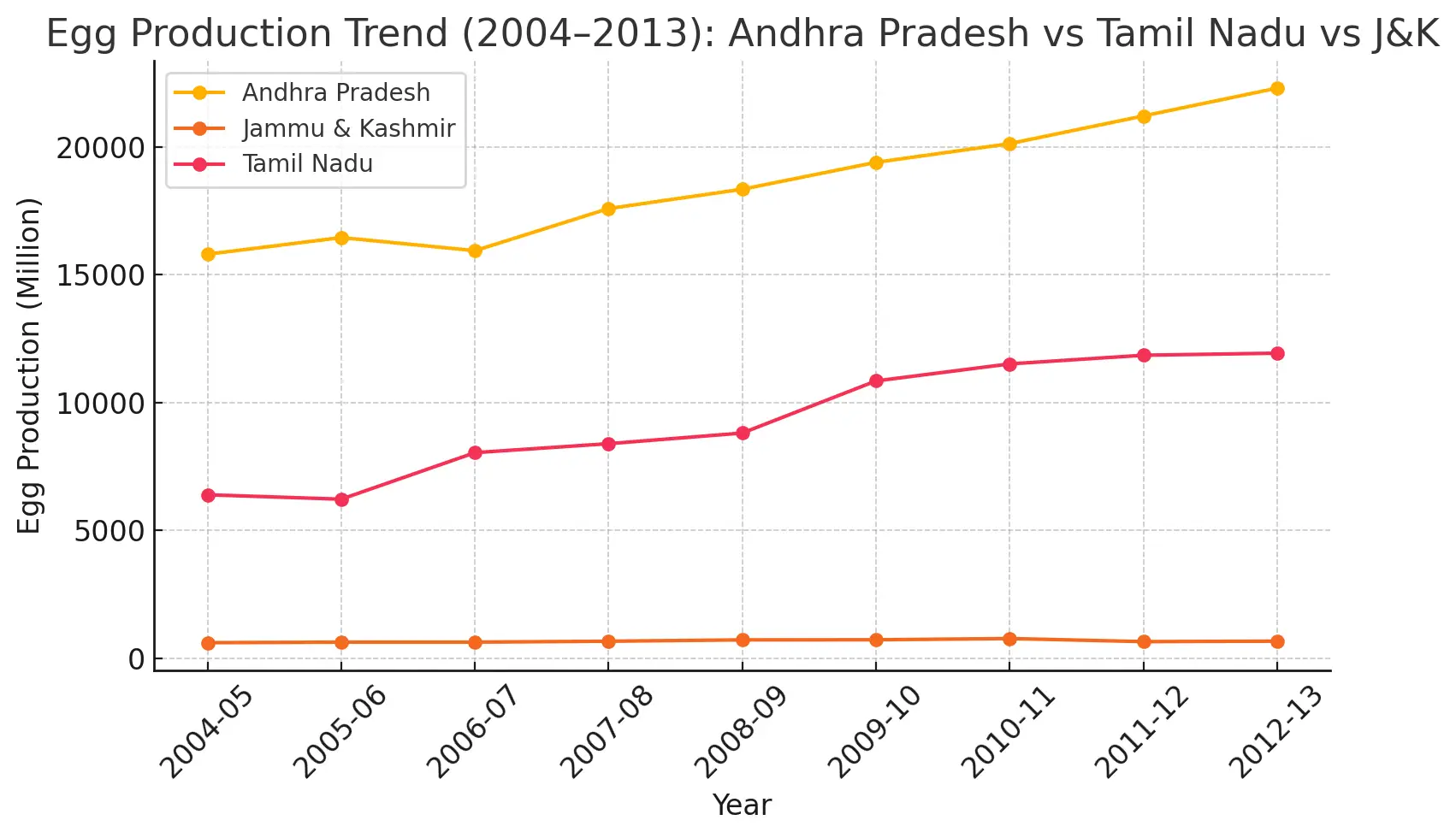
In 2004-05, Jammu and Kashmir produced roughly 610 lakh eggs. By 2022–23, production had increased to about 850 lakh eggs. Over nearly two decades, this represents only modest expansion. During the same period, Andhra Pradesh and Tamil Nadu recorded sustained, large-scale growth through commercial integration, improved feed systems, and institutional support.
A time-series comparison makes the contrast clear. While production curves for leading states show steep upward trajectories, Jammu and Kashmir’s trend line remains largely flat. This stagnation is not accidental. It reflects structural constraints that have remained largely unaddressed for decades.
The consequences of this limited growth are visible in the region’s heavy dependence on imports. Estimates suggest that more than 80 per cent of eggs consumed in Jammu and Kashmir are sourced from Punjab and Haryana. This translates into an annual outflow of roughly ₹600–700 crore from the local economy. For a region with significant agricultural land, a young workforce, and rising demand for affordable protein, this dependence raises serious policy concerns. Import reliance exposes consumers to price volatility, strains household budgets, and deprives local farmers of a potentially stable income source.
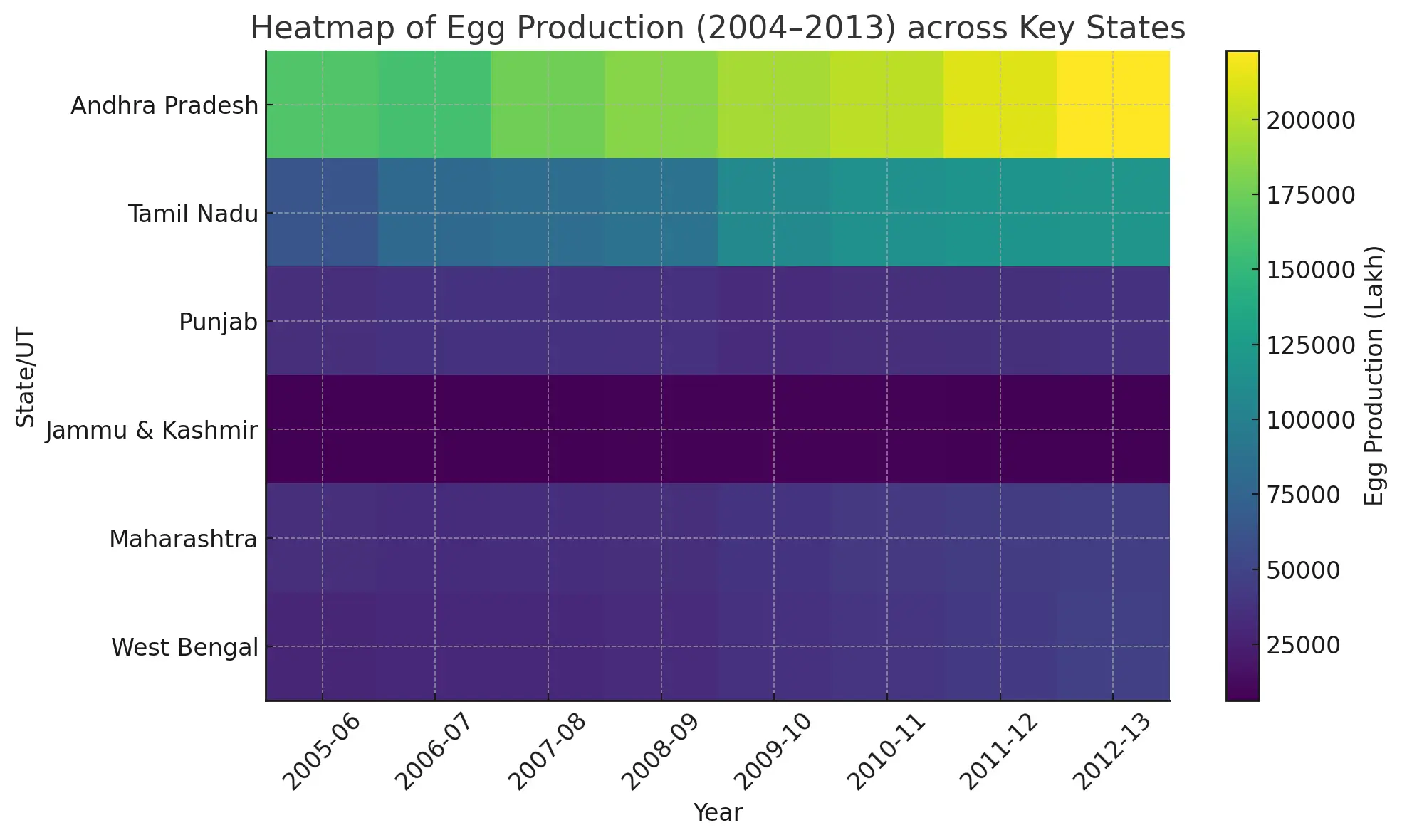
Visual comparisons between states further highlight this imbalance. Heatmap representations of egg production over time show Andhra Pradesh and Tamil Nadu consistently occupying the highest production bands, while Jammu and Kashmir remains in the lowest range throughout the 2004–2023 period. This gap is not merely statistical. It reflects decades of underinvestment in poultry infrastructure, weak extension services, and the absence of a coherent long-term strategy for the sector.
Poultry farming in Jammu and Kashmir continues to face multiple barriers. High feed costs due to transport dependence, inadequate veterinary coverage, limited cold-chain and storage facilities, and harsh winters that raise mortality and heating expenses all contribute to low productivity. Most poultry units remain small-scale backyard operations with limited access to credit, insurance, or organised markets.
These supply-side weaknesses directly affect prices. Data from the National Egg Coordination Committee indicate that average egg prices in major producing states like Andhra Pradesh and Tamil Nadu remain around ₹4.10–₹4.25 per egg, reflecting scale efficiencies and stable supply chains. In Punjab, prices average around ₹4.60. In Jammu and Kashmir, where local production meets less than one-fifth of demand, prices frequently exceed ₹6 per egg. Transport costs, feed imports, and multiple layers of intermediaries add to the final consumer price. For households, this means paying 30–40 per cent more for a basic source of nutrition. For local farmers, it represents a lost opportunity for income diversification and employment generation.
At a time when Jammu and Kashmir should be strengthening its poultry base, misinformation has emerged as a new and damaging obstacle. Recent social media posts and local rumours claimed that eggs available in the market cause cancer. The resulting panic led to a sudden drop in consumption across several districts. In response, the Food Safety and Standards Authority of India issued a clear clarification stating that there is no scientific evidence linking egg consumption with cancer or any other chronic illness, and that eggs sold in Indian markets are safe under the national food safety framework. Despite this, the correction travelled far more slowly than the rumour. Many small poultry farmers reported sharp declines in sales in the weeks following the controversy.
Such episodes expose the fragility of public trust in food systems. In regions where local production is already weak, misinformation can have outsized economic and nutritional consequences. It discourages consumption, undermines farmer confidence, and disrupts government nutrition programmes that rely on eggs as a cost-effective protein source. As one poultry cooperative member in Srinagar observed, a single false claim can undo months of effort in building consumer confidence. The incident also highlights the absence of rapid, localised communication mechanisms to counter misinformation before it spreads.
Eggs occupy a unique place in food security debates. They are affordable, nutritionally dense, easy to distribute, and widely used in public feeding programmes across India. In Jammu and Kashmir, where malnutrition and protein deficiency remain concerns in both rural and urban areas, strengthening local egg production is not merely an agricultural issue but a public health priority. The contrast between India’s leading poultry states and Jammu and Kashmir illustrates a broader policy failure. While southern states have treated poultry as an integrated agro-industrial sector, Jammu and Kashmir has largely confined it to subsistence-level activity.
Moving forward, policy must address both production and perception. On the supply side, Jammu and Kashmir needs targeted investment in poultry clusters adapted to cold climates, local feed production to reduce transport dependence, strengthened veterinary services, and access to affordable credit and insurance. Encouraging medium-scale commercial units alongside backyard farming can help build scale without displacing small producers. On the demand side, timely public communication, nutrition awareness campaigns, and stronger coordination between health, agriculture, and food safety departments are essential to counter misinformation and stabilise markets.
Eggs are more than a food item. They represent affordability, nutritional security, and trust in public institutions. The data make the picture clear. While India’s leading states have turned poultry into a growth engine, Jammu and Kashmir continues to be dependent on imports. The real risk does not lie in the egg itself, but in neglect, weak policy coordination, and the unchecked spread of misinformation. If Jammu and Kashmir is to move towards nutritional self-reliance, policy must act decisively, before rumours hatch faster than reform.
(The author is a Research Scholar at the Department of Economics, University of Kashir. Ideas are personal.)