Down South in Kashmir, Achabal captivates visitors with its ancient spring and meticulously designed terraced gardens, reflecting the grandeur of the Mughal era. Babra Wani highlights the leisure garden’s transformation into a celebrated tourist destination, rich in beauty and historical significance.

Under Mughal rule, Kashmir transformed into a realm of gardens. The era witnessed the creation of numerous exquisite gardens, including Shalimar, Nishat, and Achabal, alongside Verinag. Anantnag, a town of springs and gardens, has a fascinating garden of Achabal, barely eight km away.
The Garden
Famed for an ancient spring encircled by a terraced garden, meticulously developed by the Mughals, the small town is a tourist hub. The upper section of the Achabal garden, known as Bag-e-Begum Abad, was established by Malika Noor Jehan Begum in the 1600s and is also celebrated as Sahib Abad. Within this garden, there exists a Hamam, or water treasure, heated by a logical lamp, referred to as Tsong.
Mughal emperors engineered cascades and fountains throughout the landscape. A mosque within the garden is believed to have been constructed by Mughal Prince Dara Shikwah. Historically, Achabal served as a pleasure resort for Empress Noor Jehan. Nearby, one can find a trout hatchery, further enhancing the area’s appeal.
The garden lies beneath the Achabal-thung mountain, which translates to “mountain peak of Achabal” in the local dialect. Similar to other Mughal Char-bagh gardens, this garden features four terraces arranged in ascending order. The Achabal Garden is designed in the Persian Islamic Char-bagh style.
The garden is renowned for its spring, or stream. The spring water emerges from an opening measuring 18 inches high and 12 inches in diameter.
According to revenue records, the garden spans 62 kanals, measuring 247 meters in length and 155 meters in width.
Historical Importance
Achabal Garden is situated in the Shangus Tehsil of Anantnag, approximately eight kilometres southeast of the main town. Sir Walter Lawrence characterised Anantnag as a “city with numerous springs.”
In his book The Valley of Kashmir, Lawrence stated that the Achabal Garden, located on Sosaanwar Hill, is the most beautiful of all Mughal gardens. He noted that Jahangir used it for both beauty and pleasure. The Bringhi River, which vanishes into the limestone fissures of Dewalgam, serves as the primary source of the springs. The Achabal Garden stands as an important Persian-style Mughal pleasure garden.
Nila, the author of the Nilmat-purana, documented a spring at the present site of Achabal Garden, referred to as Achabal-naag. The former name of Achabal Garden was likely Akkshavalaa. During the Sultanate period, Achabal Bagh was a popular orchard garden in Kashmir. In the renowned historical text Rajtarangini, Pandit Kalhana mentioned Aksavalaa as the name of Achabal village, founded by the monarch Aksha.
Abul Fazal referenced a spring in his history of Emperor Akbar, Ain-I-Akbari. The fountain within the garden is reputed to possess such power that it can propel water to great heights. It is also celebrated for its cooling and refreshing properties. Historians describe the Achabal Garden as a site where prominent monarchs planted chinars, poplars, and flowers, reflecting its historical roots in Kashmir’s naga cult. In his writings, Abul Fazal remarked that “by drinking the water of Achabal, a sick person will feel fit.” Locals share this belief, with a resident of Shangus stating, “Yettikis aabas chu shifa” (the waters here have healing powers). He added, “yoad che doori doori peath lukh yiwan” (people come here from far-flung areas).
Historians have differing views on who constructed the garden. While the majority attribute its creation to Noor Jahan, some contend that it was the work of Jahangir.
Fida Hasnain, a noted author, proposes that Jahangir died in the Garden of Achabal, suggesting that Noor Jahan concealed his death by secretly removing his organs and burying them in Chingus, Rajouri, to preserve the body. His remains were subsequently interred in Lahore.
“The garden’s delicious and remarkable sight makes it worth visiting. It is a beautiful garden. I have never seen such a lovely camp that the Maharaja has placed for the enjoyment of Lord Minto. The waterfall and the running fountains create a special effect in the environment,” Sir Young Husband wrote in his book Kashmir Described.
During Shah Jahan’s reign, Mughal Prince Dara Shikoh constructed a mosque within the garden.
Lawrence noted that Kashmir is renowned for its numerous springs and traditional snake worship. These springs irrigate mountain streams and may serve as the sole water source in regions such as Achabal, Kokarnag, and Verinag in the south, and Arpal in the north. Research by Wilham Stuart suggests that Achabal was not only a significant site for the Naga people but also a charming location where rulers planted poplars and flowering plants.
Achabal is particularly noted for its high-quality springs, believed to originate from the Bringhii River. This river’s water vanishes through an opening beneath a hill in Waan-Dalgaam village. Local legend holds that an object thrown into the Bring River near Waan-Dalgaam led to the emergence of the Achabal spring.
The Structuring
The royal garden in Achabal is home to fruit and chinar trees and is currently managed by the Floriculture Department of Jammu and Kashmir. The garden features a variety of flowers and other trees. Spring water flows through a central channel measuring 60 feet in width, which divides into smaller canals, each six feet wide. The garden also includes two water tanks, each eight feet long and seventy-four feet broad. The central tank is complemented by a wooden pavilion measuring eighteen feet square, supported by a stone platform. The lower tank is approximately eighty feet in size.
The tanks and watercourses are lined with stones and support various fish, alongside several fountains.
In the Ain-i-Akbari, Abul-Fazl mentions the fountain, describing it as “a fountain that shoots up the height of a cubit and is scarcely equalled for its coldness, transparency, and refreshing qualities. Drinking its waters and staying in its course can help sick people recover.”
The Frenchman François Bernier praised the garden’s fountains, which create a network of 100 canals. He emphasised the fountain, noting it could be overlooked. He referred to it as a river rather than a fountain, as it appears to rise and bubble from the ground. He remarked that the water was exceptionally cold and refreshing.
CM Villiers Stuart, in his book Gardens of the Great Mughals, recounted, “Returning from Send-bray (Bawan), I turned a little from the high road to visit Achiavel (Achabal), formerly a country house of the Kings of Kashemire and now of the Great Mogol.” He stated that “what principally constitutes the beauty of this place is a fountain, whose waters disperse themselves into a hundred canals around the house, which is by no means unseemly, and throughout the gardens.”
He defined the spring, stating, “The spring gushes out of the earth with violence, as if it issued from the bottom of some well, and the water is so abundant that it ought rather to be called a river than a fountain. It is excellent water and as cold as ice.”
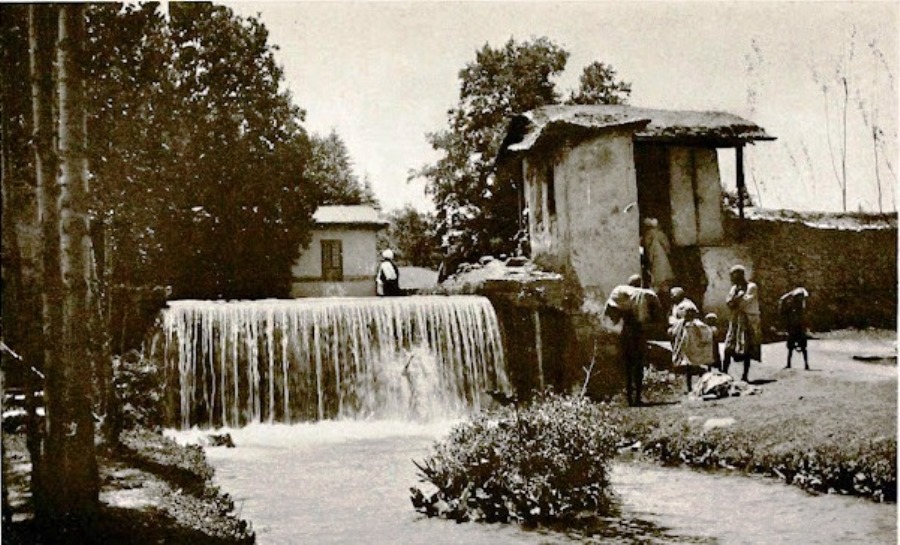
Stuart further described the structure of the garden, noting, “The garden is very handsome, laid out in regular walks and full of fruit trees—apple, pear, plum, apricot, and cherry. Jets d’eau in various forms and fish ponds are in great number, and there is a lofty cascade which, in its fall, takes the form and colour of a large sheet, thirty or forty paces in length, producing the finest effect imaginable; especially at night, when innumerable lamps, fixed in parts of the wall adapted for that purpose, are lighted under this sheet of water.”
As with nearly all the gardens in Kashmir, the lowest terrace of Achabal Bagh has been compromised by the highway, resulting in a garden considerably smaller than it was during the Mughal era. Stuart noted, “But nothing can spoil the natural loveliness of this river, gushing out of the honeycombed limestone cliff, just at the point where the mountains intrude farthest on the plains. It is an ideal site. If I were asked where the most perfect modern garden on a medium scale could be devised, I should answer without hesitation, Achabal. Nowhere else have I seen such possibilities for the combined appeal of a stately stone-bordered pleasance between ordered avenues of full-grown trees, and a natural rock and woodland upper garden with haunting, far-reaching views, where the white wild roses foam over the firs and the boulders, rivalling the ‘sheet of water’ Bernier praised.”
The garden is arranged in three terraces, with a central water stream flowing north-south and three fountain basins. There are walkways on each side of the axial water stream. Smaller channels to the east and west of the main stream collect water from an east-west stream on the third terrace. The northern end of the garden is accessible from the street level. The first terrace includes two modest pavilions, through which visitors enter. After passing through the gate, they arrive at a square pool featuring nine fountains.
The second terrace, accessible via two sets of stairs on either side of the axial stream, supplies water to this pool. It boasts a square pool with five fountains arranged in a five-by-five pattern, connected by an axial water stream. Chabutra, a garden feature, is visible from both the east and west sides of the second terrace. The water from the second pool flows beneath a two-story balahdari, or pavilion.
This balahdari displays three arches on the southern elevation and one on the northern side. Beyond it lies the third pool, which is rectangular. In the centre of this rectangle, a one-story balahdari and its pathways divide the pool into two squares, each containing a five-by-five fountain array.
The zenana, or women’s garden, represents the most private area of the garden, situated on the third terrace. This section features a rectangular water tank surrounded by two modest square pavilions.
Various historians indicate that this water tank served as a bathing pool for women. Noor Jahan is credited with developing the upper part of the garden, which is also referred to as Bagh-e-Begumabad. The garden contains the ruins of a hammam, or hot water bath, that was heated by a ‘logical lamp,’ known locally as tsong. Legend has it that this lamp was magically ignited but was switched off during maintenance.
Other Activities
Other tourist destinations along the route to Achabal include Kokernag, Daksum, and Verinag, each possessing significant tourist value. The optimal season to visit Achabal is autumn when the Chinar trees turn vibrant red, creating a picturesque landscape that serves as a muse for photographers.
Achabal is an ideal spot for a day picnic. While there are a few hotels nearby, notable options include Achabal Residency and the Jammu and Kashmir Tourism Development Corporation (JKTDC) Achabal Resort.
The area is well-suited for leisure activities such as exploration, photography, and fishing, as well as visits to historical sites. Medical facilities, including a government hospital, are available nearby.
Additionally, the region is renowned for its apple orchards. A resident, Sofiyah, stated that “the majority of the people in our area are educated and engaged in government jobs and other professional employments.” Many residents are involved in farming and the cultivation of orchards and other fruits.