

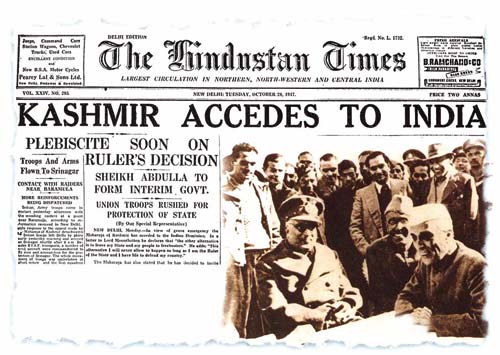
But, to Tassaduq Hussain, New Delhi has slowly and steadily extended its laws to the state. “80 percent of the central laws have been extended to the state of Jammu and Kashmir, and list one of the scheduled 7 of the constitution of India has been amended and Article 97(A) has been added authorizing the Parliament to make laws for the state of Jammu and Kashmir for reasons of security of state which is such an omnibus term that it encompasses a wide range of topics which parliament can legislate with respect to J&K state without invoking the mechanism of Article 370. The constitution of J&K has been amended and by including a provision for the appointment of the governor by the president of India has been instituted reducing Article 370 to a bare husk,” he said.
After the dismissal of late Sheikh Abdullah from the office of the prime minister of Jammu and Kashmir on August, 1953, Bakhshi Ghulam Mohammed, Sheikh’s deputy and successor managed states’ financial integration with the Union of India.
The change of guard was followed by the President’s Constitution Application (to J&K) Order in 1954 and Part XI of the constitution, overruling the 1950 order, extending with negligible modifications, a number of laws involving finance, administration, trade and supreme court.
Bakhshi’s “misrule” was supported by Delhi till his replacement by Shams-ud-Din was “manipulated” in 1963.
On February 28, 1964 the state came under the Congress (I) rule headed by Ghulam Mohammed Sadiq. Within a year in office, he made the crucial Sixth Amendment Act in the State Constitution that changed the nomenclature of the state, revoked the pre-requisite for Sadar-e-Reyasat to be a state subject, besides, changing the text of oath of affirmation for the elected representatives.
Sadiq, thus, became the last Prime Minister of the state as well as the first Chief Minister.
Despite the “Protest Day”, Kashmir observed on January 15, 1965 against the extension of Article 356 and 357, Sadiq managed eighth amendment in the State Constitution in 1967, extending the provisions of Election Commission of India and Comptroller and Auditor General to the state. This coincided with the administrative integration.
After Sadiq died in Punjab in December 1970, Mir Qasim became the Chief Minister. His rule ended when Sheikh Abdullah after “22 years of political wilderness” replaced him following 1975 Indira – Abdullah Accord.
The accord followed a series of meetings between Mirza Afzal Baig, Sheikh’s aide and G Parthasarthy, Indira Gandhi’s aide who made the blueprint of the agreement.
Sheikh, in fact constituted a three member committee comprising of his confidants D D Thakur, Ghulam Nabi Kochak and son-in-law Ghulam Mohammed Shah in 1977 to suggest the measures for restoration of eroded autonomy after reviewing the post-1952 era.
In May 1978, two reports were submitted to him. While Kochak – Shah report suggested the withdrawal of all the central laws extended to the state after Delhi agreement; Thakur proposed status quo with the contention that the extension of these laws has resulted in positive changes. The reports being highly contradictory, there was no follow up as Sheikh was not interested in confronting centre.
In the subsequent rule in eighties, Jagmohan extended Article 249, which shifted the legislative authority to the Parliament. Ironically no elected government till date mustered the courage to reverse the notification issued by Jagmohan.
Then came 1987 assembly election, which many believe were rigged to help New Delhi install a government of its choice in Kashmir. These elections were followed by large scale blood bath. People came out in large numbers to protest against New Delhi’s “high headedness.” The massive demonstrations were followed by the eruption of militancy and the demand for Azadi (Independence) got momentum.
At the moment there are more than 270 central laws extended to the state barring the three subjects of accession. These include the Central Navigation Act, though J&K has been only silting up lakes and not the seas.
Jammu and Kashmir is mentioned among the States of the Union in the First Schedule as Article 1 (2) requires. But Article 370 (1) (c) says: “The provisions of Article 1 and of this Article shall apply in relation to that State.”









why Omar is crying, this article 370 was finished by his grand father sheikh abdullah when he became chief Minister instead of prime Minister
Wt is there in Article 370; it is actually a bridge through which Endia travelled and established itself here, moreso, we actually misunderstand and relate it with State Subject Law!
Article 370 should be scrapped at the earliest so that non Kashmiris get an equal status in J&K as Kashmiris. This will bring about a greater integration of J&K with India and will end the terror problem forever.