Strong translation and heartfelt performances carry this Kashmiri film on Ghalib, but its Delhi-centred history and thin context leave the Kashmir connection incomplete, writes Maleeha Sofi
The poster of Aks e Ghalib: Dast e Shifa makes a striking promise. It reads, “If Ghalib were not an Urdu or Persian poet, he would certainly be a Kashmiri poet.” The film’s translations go some way to justify this. But more than the translations, Ghalib’s own connection to Kashmir supports the claim. Had the poet seen a film made about him in his mother tongue, he would perhaps have been elated.
Anyone unfamiliar with Ghalib’s life should study him before watching. The film offers no introduction to what follows. Shahid Gulfaam, playing Mirza Ghalib, reveals a great deal about the poet’s personality, yet the how, where and when are never explained.
Release Details
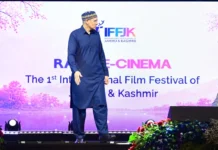
Aks e Ghalib: Dast e Shifa released on 1 September 2026, in Srinagar’s only functional cinema hall, INOX, a barely a week ahead of the International Film Festival that Jammu and Kashmir is hosting in Srinagar. Dr Showkat Shifa, a practising paediatrician, produced the musical film, Arshad Mushtaq directed it, and Kifayat Faheem composed the music. Shahid Gulfaam plays Mirza Ghalib, and Shaheena Mahajan plays his wife.
The film opens in a traditional setting: muddy walls, a narrow staircase, a small window, and men in pheran. Its first dialogue builds real suspense, drawing the viewer in to seek answers. Most dialogue is Ghalib’s own poetry, translated into Kashmiri by Dr Shifa, and this translation is easily the film’s strongest element. In all, Dr Shifa has rendered 154 of Ghalib’s poems into Kashmiri.
Setting a film about the 1797 born poet in Kashmir makes sense beyond his fame. Most probably, Kashmiri was Ghalib’s mother tongue. His mother, Izzat un Nisa Begum, was originally from Kashmir before moving to Agra. Another Kashmir link was Mufti Sadruddin Khan Aazurda. Altaf Husain Hali’s biography of Ghalib notes that Aazurda was the one figure towards whom Ghalib held genuine deference. Aazurda’s ancestor, Khwaja Bahauddin Khwarizmi Faruqi, had migrated from Kashmir to Delhi under Akbar’s reign.
Performances Shine
Beyond translation, the actors’ expressions stand out most. Shahid and Shaheena, as husband and wife, capture their roles well. Even a viewer unaware of the couple’s suffering will sense their pain through the intensity of the performances; their onscreen chemistry convincingly reads as marriage. One section shows the couple seeking spiritual help for their childless marriage, though the film never mentions that they eventually had seven children, all of whom died in infancy.
Every actor, lead and supporting, performs capably. The music, both sung and instrumental, is melodious, built around Santoor and Rabab, instruments that give it a distinctly Kashmiri character. If anything besides the translation feels purely Kashmiri, it is this music. Kifayat Faheem sings the songs, with Deepali Wattel providing the female voice.

Visual Craft
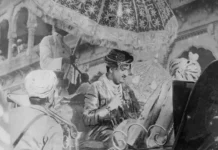
The chosen locations are aesthetically pleasing. Meeras Mahal, shown as Ghalib’s residence, suits his circumstances well. The walls, lighting and setting capture Kashmir in 1857 convincingly, and the Sepoy Mutiny runs through the film from start to end.
Even so, the film appears shot in only two or three locations. One scene shows poets such as Daagh Dehelvi discussing an invitation to Ghalib for a Mushaira. The next shows Ghalib discussing this with his wife, against the same windows and walls. The Mushaira itself then unfolds in the very spot where the poets first spoke. Wider exploration of locations would have strengthened the film.
The setting, lighting and camera work suit the period drama well, reinforcing the film’s intended message. Costumes fit the Kashmiri backdrop, though the makeup looks somewhat overdone. Mascara had not reached Kashmir in 1857, and Kashmiri women would have been better represented without such sharply defined eyelashes and eyebrows. Kashmir has been using Kajal (Surma) for centuries and it could have kept the Ghalib show on.
Missed Connection
Although centred on the 1857 uprising in Delhi, the film is set in Kashmir, and the two threads never quite meet. Had the makers chosen to present Ghalib as fully Kashmiri, his life could have been fictionalised accordingly, with Kashmir’s own historical backdrop, perhaps its story under Dogra rule, woven in more fully. The film misses that chance. Dr Shifa explains, “It was not possible to shift history from Delhi to Kashmir. So, we shifted Delhi (place) to Kashmir along with Ghalib. History automatically got relocated.”
The film also moves between two time periods, leaving viewers to work out which is which from the colour of Ghalib’s beard, with no clear signal offered either way.
Final Word
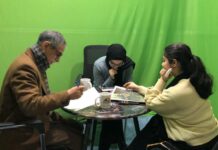
At the screening, director Arsh Mushtaq said he was not presenting Ghalib’s profile but his mindscape. On that measure, the film succeeds, creating a visual sense of what passed through the poet’s mind. It has its strengths and weaknesses, but there is no denying that a small group of Kashmiris, without large resources or a big team, brought it to the big screen.
Dr Shifa funded the entire project himself, and Arsh Mushtaq, working with his trainees, completed a film that can genuinely be called Kashmiri, a step Kashmiri cinema needs right now. It creates a great deal of hope and anticipation, and this one largely meets those expectations.