Believed by local legend to date back to the era of the Pandavas from the Mahabharata, the mysterious stone horsemen of Gool in Ramban may represent the last surviving physical traces of the ruthless Hephthalites, also known as the White Huns, who ravaged Buddhist Kashmir in the fifth century under the notorious warlord Mihirakula. This striking reinterpretation comes from a Russian archaeologist who conducted a detailed and modern study of the site in 2017, offering new insights into its forgotten past, reports HumairaNabi

High in Kashmir’s Pir Panjal range, known for its breathtaking vistas of lofty peaks, swift streams, and deep valleys, lies an extraordinary archaeological enigma: the Goda Gali, or the Horses Pass. Ramban, a remote area, is home to hundreds of undated, uncounted, and largely unstudied stone statues of horses, almost always bearing multiple riders. These enigmatic monuments, some towering over two meters, offer a captivating glimpse into a “dark” period of Kashmir’s history and hint at the enduring legacy of a powerful, yet mysterious, people.
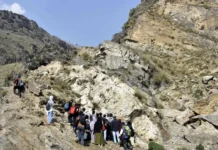
Located almost 50 km from Ramban, in Gool, the Ghora Gali has always been acknowledged as a remarkable ancient site of Kashmir’s sculptural heritage. Similar sculptural traces are found at Gadi Nalla, Nar (Gool), and Sildhar (Reasi); however, reaching them requires a challenging trek through hilly terrain. In Ramban and Reasi belts, these artistic remnants appear deeply tied to the region’s Kul Devta worship practices.
The story of these “riders lost in the Himalayas” began in 2013, when an archaeologist stumbled upon two peculiar stone horses with riders at the Sri Pratap Museum in Srinagar. Their unusual appearance and the complete lack of scholarly information about them sparked a quest that culminated in a Russian-Indian archaeological expedition in June 2017. Led by Dr Natalia V Polosmak, a Corresponding Member of the Russian Academy of Sciences and Chief Researcher, the person behind the project, the support came from the Gerda Henkel Foundation, which enabled bringing together researchers from the University of Kashmir, including Dr Mohammad Ajmal Shah and Yatoo Mumtaz Ahmad.
The Enigma
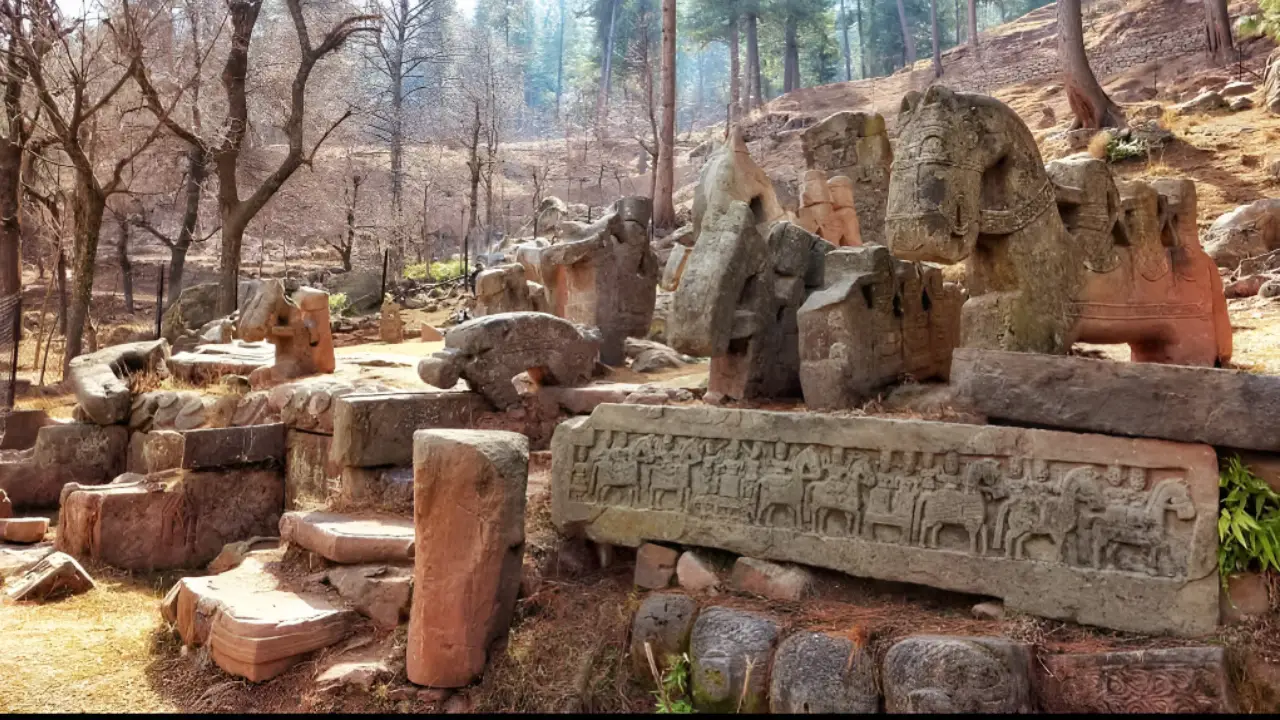
For generations, residents in the Gool belt have known about these horse statues. Many of these statues have been broken, their fragments repurposed as alleys, walling, or even benches. Some are found in streams, used for washing clothes. The residents, largely unaware of their origins, often view them as strange, alien objects, or even as ancient traffic signs for Mahabharata-era caravans, a notion far from the mark. Legends even link them to the Pandavas.
Despite their historical significance, these monuments of an unknown culture have remained unstudied. This oversight is partly due to their remote and difficult-to-access locations, and partly because their unique artistic style makes it challenging to attribute them to any known modern cultures or religions.
Using Cutting-Edge Technology
To overcome these challenges, the 2017 expedition employed advanced technology to record and describe the monuments. A team from Trimetary Consulting (St Petersburg), led by Mikhail Anikushkin, performed 3D surface laser scanning using a Leica ScanStation P20 scanner. This cutting-edge method, which generates a “point cloud” containing exhaustive geometric information, is crucial for documenting endangered cultural heritage sites.
The scanning focused on two clusters of sculptures, located at elevations of 1890 meters and 2030 meters above sea level, each covering an area of about a hectare. Besides, an airborne survey using a DJI Phantom 3 unmanned drone and survey photography with a digital single-lens reflex camera was conducted. The data collected was instrumental for scientific studies, excavation planning, and the creation of a virtual museum, making these unique artefacts accessible to a global audience.
Hephthalite Connection?
The expedition’s initial findings suggest a compelling hypothesis: these monuments likely date from the pre-Muslim period of the region and are neither Buddhist nor Hindu. Researchers believe they represent an entirely original cultural layer, potentially linked to the Hephthalite conquest and rule (5th to 7th centuries CE). The Hephthalites, also known as White Huns, were a powerful and enigmatic ethnicity whose origins are still debated by scholars, with theories ranging from Iranian-speaking Yuezhi descendants to ancient Mongols or Huns.

Historical sources indicate that the Hephthalite conquest of India began around 470 CE. Under the leadership of Toramana, they took advantage of the weakening Gupta Empire and vanquished territories formerly held by the Kushans. Toramana’s son, Mihirakula, a cruel ruler known for persecuting Buddhists, continued the rule until 537 CE, primarily in Kashmir and Punjab. Mihirakula returned to Kashmir after losing a few battles to tribal leaders. He ruled the region until 537 and died. His descendants continued to rule Kashmir and the greater part of Punjab for another 150 years. It is hypothesised that the name of the settlement Gool might even derive from Mihirakula’s name, specifically the gula suffix, which is believed to have meant “ruler-warrior.”
In Kashmir
The first Hunnic assault during the Gupta period was met with stiff resistance. Emperor Skandagupta repelled the incursions. But the threat returned with greater force when the White Hun ruler Toramana swept through the northwest, subduing Punjab, Rajputana, Malwa, and, significantly, Kashmir and the Doab. Toramana’s conquests in India, although brief, opened a path for his son Mihirakula, the most infamous of the Hun rulers, to establish a cruel dominion in Kashmir.
Though often remembered for their initial violence and destruction, the White Huns left a deeper legacy, particularly in Kashmir, where they not only conquered but gradually assimilated, becoming part of the ruling elite and leaving a lasting imprint on the region’s history and culture.
Driven out of mainland India after facing a united front of Indian powers, Mihirakula sought refuge in Kashmir. The prince of Kashmir, perhaps hoping to neutralise the Hun leader, offered him asylum. But Mihirakula was no ordinary exile. Through court intrigues and a ruthless grasp for power, he overthrew his host and claimed the throne for himself. His reign in Kashmir was marked by unrelenting cruelty. Rajatarangini, as translated by R S Pandit, records Mihirakula’s campaign of terror: the destruction of Buddhist monasteries, the slaughter of monks, and the execution of prisoners along the banks of the Indus River. His name evoked dread, and many historians have dubbed him the Indian Nero, a ruler so merciless that he was said never to have laughed, even in triumph.
Despite the brutal nature of his rule, Mihirakula represents a complex chapter in the story of the Huns in Kashmir. Some sources suggest he was a Shiva worshipper, while others claim he initially adopted Buddhism, only to later turn against it. His coins, found across Bactria, Afghanistan, and Kashmir, mirror Gupta designs, revealing an attempt to legitimise his rule through assimilation into Indian political and cultural traditions. Yet his legacy in Kashmir remains overwhelmingly one of blood and destruction.
Following Mihirakula’s death in 533 AD in Kashmir, his younger brother Pravarasena is said to have assumed the throne. He is credited with improving the city of Srinagar and re-establishing a degree of stability in the region. Though the Hunnic tide ebbed by the end of the 6th century, after devastating defeats at the hands of the Persians and the rising Turkic Khaganate, their impact on Kashmir’s history endured. The White Huns may have come as marauders, but some stayed on as kings, absorbed into the fabric of the land they once sought to dominate. Nothing much is on record as archaeological evidence till the Russian expert attempted to link Goda Gali with them.
The Stone Army
It is this era, lacking any physical remains anywhere in Kashmir, which is linked to the Goda Gali.
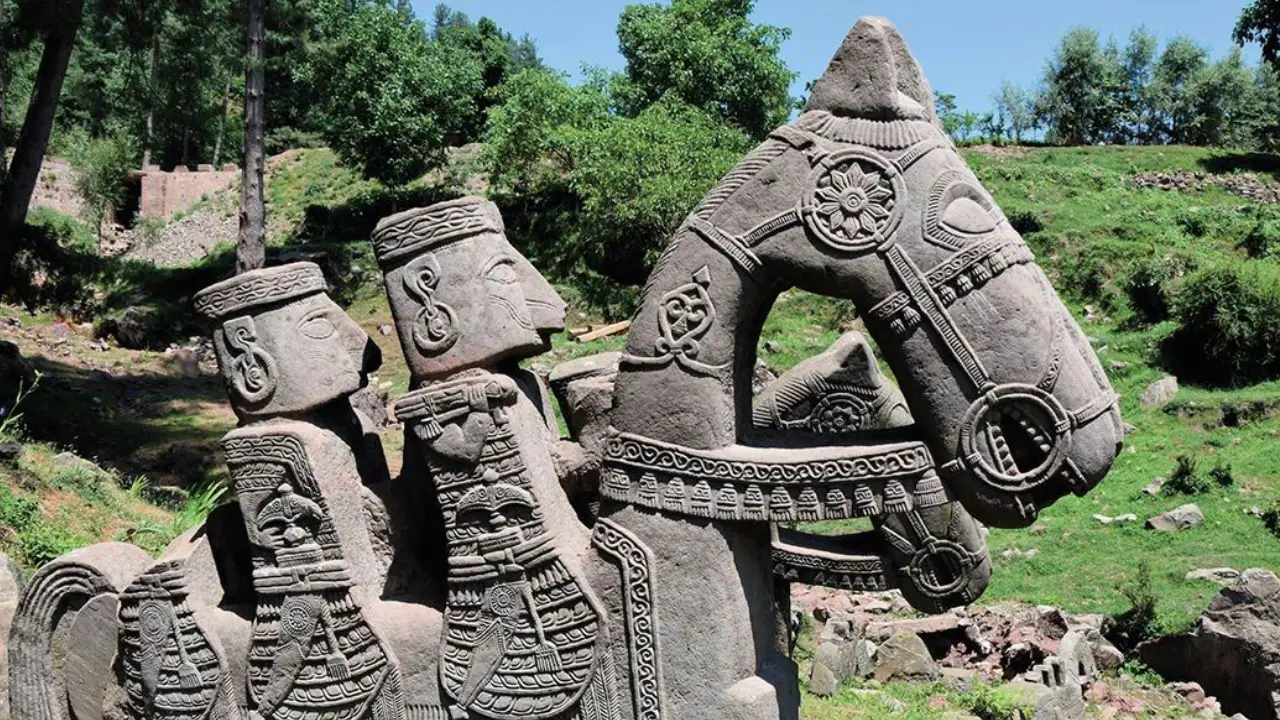
A striking feature of the stone riders is their uniformity: all riders have the same face, embodying a collective warrior host. A key anthropological detail is the flatly cut napes of the male figures, indicative of a ring, or fronto-occipital deformation of the skull. This artificial cranial deformation was characteristic of Central Asian peoples in the early 1st century and was spread by nomadic Huns. This distinct feature is also observed on coins of Hephthalite rulers, providing a significant link.
Further similarities between the stone horsemen and depictions on Hephthalite coins include big straight noses, handlebar moustaches, and large round earrings. Intriguingly, modern inhabitants of the Ramban district in Jammu bear a striking resemblance to these ancient stone riders, hinting at a direct ancestral connection, according to the study.
The horse harness on the statues features meticulously sculpted, good-sized round cheek-pieces and bridles and reins adorned with round brasses depicting a polypetalous flower, possibly a lotus. Analogues of these cheek-pieces have been found in 5th-century nomadic graves in the East European and Central Asian steppes, further supporting a Central Asian influence. The absence of saddles and stirrups, and the depiction of multiple riders (two, three, or even four) on a single horse, suggests a mythical or symbolic purpose rather than a literal representation of travel. These monuments are believed to be a memorial, signifying a deeper meaning.
The statues were carved from micaceous chloritic quartzite slate, a local rock that lends itself easily to carving, similar to the material used for the famous Gandhara art. Traces of red paint on some statues indicate they were once vibrantly coloured, a common practice in ancient stone sculpture across various cultures. This red colour, symbolising blood, was meant to “reanimate” the figures.
Arms and Attire
The stone riders are depicted as noble warriors, bearing richly adorned prestige weapons. Many carry both a dagger and a sword. The daggers, identified as chilanum, are a typical Indian type with distinct handles. Swords are depicted with a straight, broad blade and a large mushroom-shaped pommel. Small, segment-shaped bows with feathered arrows and oversized, socketed arrowheads with two barbs are also common.
The method of carrying scabbards on the back of the right shoulder, as seen in the Himalayan warriors, aligns with ancient Indian tradition, contrasting with the Central Asian practice of hanging them on the belt. Some warriors also carry battle axes or small, round, decorated shields. The overall weapon set depicted on the Pir Panchal statues demonstrates a wide chronological framework within Indian culture, suggesting that these warriors, whatever their origin, had become sufficiently Indianised in their weaponry and fighting styles.
Intriguingly, the study suggests that some statues include equestriennes, always positioned last in a row, often with long hair, diadems, and temple pendants, and notably, without weapons. Some even show a baby nestling behind them. These female figures, with their full skirts, broad cloth belts, and occasional bare feet, do not resemble traditional Indian sari attire but instead show similarities to the attire of Rajput women and nomadic female adornments found in Central Asian graves. Their presence, particularly with children, suggests a memorial purpose commemorating not just individual warriors, but the entire warrior host, including women and children. This could be linked to ancient Rajput customs like jauhar, the mass self-immolation of clan women, which would follow a catastrophic battle where no warriors were expected to survive.
Sacred Waters
Adding to the mystique, the stone horses are often found next to a cascade of small basins carved into the mountain slopes. These basins, likely intended for ritual ablutions, link the monuments to Hindu traditions. Many are walled with flagstones decorated with large rosettes resembling open lotuses or the Buddhist Dharma wheel, hinting at a blend of religious symbolism.
The lotus, a symbol of spiritual ascension in both Hindu and Buddhist cultures, suggests these water pools held a sacred significance, perhaps for purification or as a symbolic journey to enlightenment. This ritualistic connection is further supported by historical accounts of Rajputs performing horse-worshipping rites before battles, including leading horses to water reservoirs for washing.
The stone horses of Pir Panchal are unique in India, unlike other memorial stones found across western, central, and northern India. While memorial stone traditions are widespread, nothing else resembles these equestrian monuments.
The Analysis
The research suggests a strong link between these statues and the tribes that arrived with the Hephthalites, specifically pointing to the Rajputs, Gurjars (Gujjars), and Jats as potential descendants. The fierce Dogra people, still inhabiting Jammu and adjoining areas, are believed to be descendants of the belligerent Rajputs. The presence of both Hindu (Shaivism) and possibly pagan cult symbols on the statues aligns with the Hephthalites’ known practice of diverse religions.
The most profound aspect of this ongoing discovery, according to the study, is the realisation that the descendants of the very people who created these amazing statues continue to live in the region, unknowingly sharing their land with the stony memory of their ancestors and their past glory. The “riders lost in the Himalayas” stand as silent sentinels, waiting for their full story to be told.
Restoration Efforts
Though the official storyline about these sculptures also follows the Pandavas of the Mahabharata, a claim not established by the latest studies, the government has been making attempts to preserve the site and the artworks. Insider information suggested that the Jammu and Kashmir government’s Tourism department has initiated an Rs 77.81 crore project in 2022 for preservation of the site, of which the government has already spent Rs 32.38 crore. In fiscal 2024-25, the government has spent Rs 21.19 crore, and in fiscal 2025-26, the government plans to spend Rs 25 crore to complete the project. However, the implementing agencies are waiting for forest clearances, which involve almost half of the project development, sources added.