Kashmir’s Renowned Psychiatrist, Dr Mushtaq A Marghoob who oversaw the footfall flood seeking help for mental illness tells Kashmir Life Science Talks that PSTD cases in Kashmir respond differently to the set American protocols and that trauma is transmitted to the next generation as part of genetic makeup
KASHMIR LIFE (KL): Psychiatry is seen as a new science with Sigmund Freud being credited for founding it. The other narrative believes Abu Zaid al Balkhi immensely contributed to it in the tenth century. So how has this field evolved from Al-Balkhi’s era to the 21st century?
PROF DR MUSHTAQ A MARGOOB (MM): There has been a difference in the approach of Western, Oriental, and Islamic societies. The Western ideology has confined psychiatry to philosophy, stressing the behaviour regulated by the brain only and neglecting the spirituality aspect. This stems back to the dark age of 1500 years when they used to abandon mentally unwell to get eaten by animals in forests or deserts. Islam, however, emphasises Nafs and Qalb (heart).
These words are interlinked symbolically. Thus, the crux of the Islamic ideology puts the Qalb at centrality. Freud’s opinion and research (based on brain activity) are only a droplet in the ocean of knowledge that Islam provides. Modern science rules out the spiritual aspect and Islam emphasises it. Islam caters to all – social, psychological, and biological aspects. Making a presentation in Washington, I stressed the importance of spirituality in helping cope with the after-effects of disaster. I talked about Waltango Nar (in Qazigund that was buried by an avalanche), where all the males had died, leaving behind orphans and widows. A professor from New York praised it.
KL: Tell us very briefly about your journey.
MM: I have been lucky to find a healthy environment at home through my father and grandfather. At the medical college level, I had a good internship experience with Professor Jehan-Ara, Meharjdin, and GQ Alaqband. As I was nurtured with literature and ethics at home, my teachers developed compassion for me. Dr Jan stressed that I handle the psychiatry department, although I wanted to pursue dermatology. I joined psychiatry in 1980.
KL: All over the world, whether in oriental or western societies, mental patients were treated badly. So was the case in Kashmir. Can you tell us how it was?
MM: The British set up treatment places for mentally ill people in different parts of India, including Kashmir, as it was not feasible for them to take patients to England. In Kashmir and Agra, patients used to be dumped in different cells and were not treated as patients but rather as animals.
KL: When you joined the department, it was run primitively. Within a decade, the situation in Kashmir changed. What are your experiences of that phase?
MM: One thing is seeing that phase; another is experiencing it. I have felt that phase. In the early 1980s, there were a few psychoses and depression cases. By the mid-1980s, things started to change. A few elderly patients used to come out in the summers and start beating people, and in winter, they would get mood disorders. On July 11, 1984, we encountered the first case of a person consuming brown sugar.
In the 1990s, it was challenging, and textbook methods and protocols were unhelpful.
KL: In your science, data plays a vital role, as in any other field. Share your thoughts on that.
MM: Right now, doctors do not get promotions in our departments before producing a thesis. There is much stress on research and data collection. Back then, no baseline was set for data collection. From 1980, I documented things by registering every patient. There was no segregation of mentally ill patients into categories based on age, psychiatric disorder patterns, and other parameters. Although we had population-based patient data that could somehow represent the situation at that time, it was not enough to recognise issues at the community level given our facilities.
Regulating the community was my priority from the outset. I did that by involving stakeholders like community leaders and mosque imams, who helped patients affected by conflict cope. Around 2000, I felt the need to extensively change the data collection approach. Spiritual cognitive behaviour worked well when medicinal pills would not. Religious people would stand and recite a few verses, and it used to work even for families who had lost many loved ones.
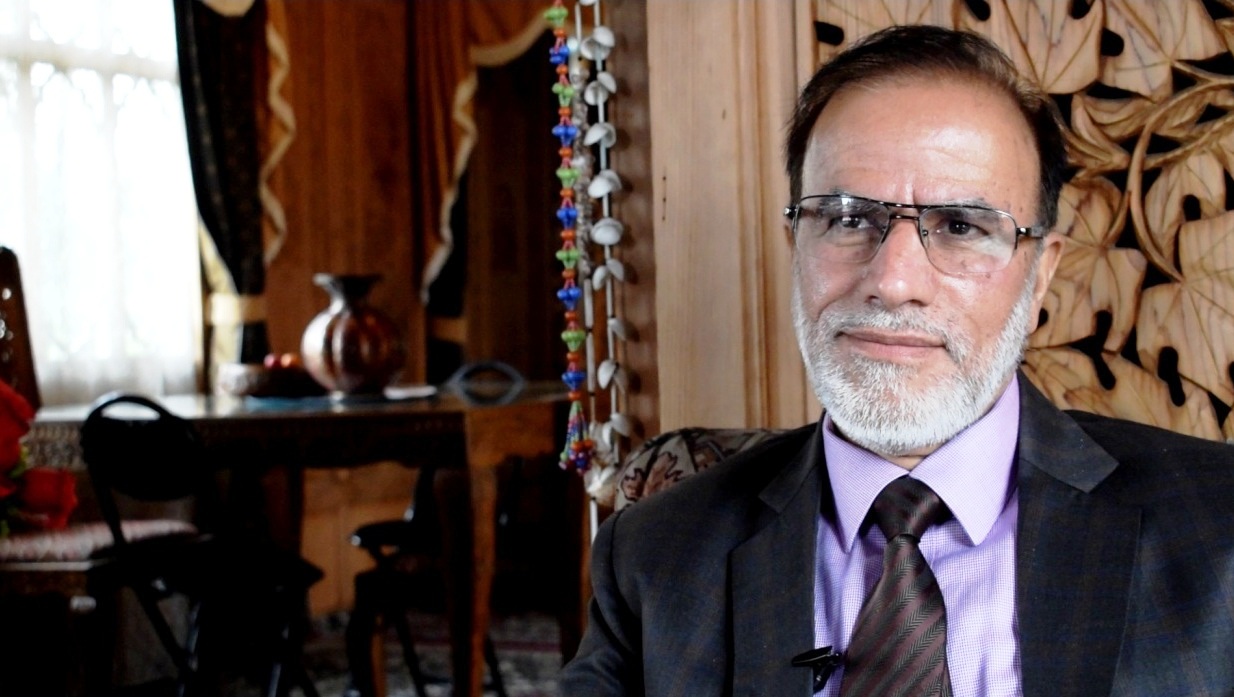
For the first fifteen years, I focused on why and how trauma affects people and documented that work, which was widely appreciated. In the last fifteen years, I found how resilience developed, and there is much to learn from it. Interacting with people rather than just writing in offices led to originality in my research. I have done over two dozen research on Kashmir as it is called the encyclopaedia of trauma in South Asia. Instead of foreign journals, I published in local journals and wanted policymakers, planners, service providers, and the common masses to know.
To me publishing a study is secondary. Despite that, the entire body of research was used globally and some helped develop protocols.
In Kashmir, there is a misconception among researchers and scholars that nothing like PTSD exists in Kashmir and it only happens to Americans. Contrary to this, if we analyse the America-Vietnam war, where almost 20 lakh Vietnamese died, nothing was mentioned about PTSD.
I coincidentally interacted with a professor from Vietnam who gave a presentation. I asked why she had not talked about PTSD. She replied they had not investigated it. On the other hand,17,000 American soldiers died, and those who went to war again still get shivers. They suffer from chronic PTSD.
Research published by the British Journal of Psychiatry 3-4 years ago mentions that when Vietnam witnessed a flood, 10 per cent of Vietnamese suffered from PTSD. In contrast, only 2.5 per cent of Sri Lankans faced PTSD despite the turmoil there. It implies a significant shortage of research, leaving the field very open. As I cited the Vietnam example, how can you get data if people are not asked? Comparatively, I am content with how we pursued research in Kashmir. Currently, we have progressed substantially in terms of facilities. Still, authentic research demands facing certain challenges and innovations.
In the first phase, there were constraints due to a lack of facilities – it was a building phase. Nationally and in South Asia, it was identified that our depression treatment approach was good. In this early phase, my options were limited – a burnt hospital building, a small room to track records, and an OPD room beside it where I would see 300-400 patients with minimal staff. I engaged at the community level.
After 9/11, the US said they did not have enough resources or manpower to assess the trauma impact in Manhattan. I did it here from 2003-05. I gathered trained and trainee psychiatrists, worked with them in turns, and got data from them. The data reflected 7 per cent of our population suffering from PTSD and 17 per cent with lifetime PTSD.
KL: Reports suggest that almost half the Kashmir population suffers from some psychiatric problem. There is a range, not just PTSD. In all these years, you must have developed processes and innovations that helped address issues here and outside.
MM: From the very start, I involved community stakeholders. In 1997, I urged involving mosque imams and it became national news. I did not say that blindly. I had experienced their involvement in helping fight psychiatric problems. I mentioned their role in handling PTSD. In the last ten years, I have seen them work well at the community level, like in Ganderbal.
You cannot imagine how miraculously it works – their preventive and therapeutic approach is excellent. It just needs workshops with them. My team is already working with them. A group of girls, who are consultants and registrar-rank doctors, are working round the clock and implementing the community models. They do it even in my absence.
This is saving people. In one instance, I let two doctors examine a 19-year-old hysteria patient, who would become unconscious frequently and was already checked at the sub-district hospital level and by a faith healer before being referred to us. They diagnosed the patient as febrile and she was admitted to the hospital, put on a ventilator for a few days and was ultimately saved. She was saved because she was referred to us by the faith healer. That is how the community network helps.
We must address the basic issue – the gap between the patient population and the number of doctors. Across the world, there are fewer specialists than patients. India should have at least 1.75 lakh psychiatrists but has only 12,000. In Kashmir, a similar pattern was seen in the past and continues today in terms of numbers. Earlier, only three psychiatrists were here, then in 2013 sixteen, and 2016, two international organizations – MSF and Action Aid – along with Kashmir University’s Sociology and Psychology departments conducted a survey showing only 6 per cent of the population could access professional treatment.
Right now, there is not much lacking at the institutional level. Credit goes to the involvement of youth who connect with professionals. After a 15-day assessment, the community model’s effectiveness became evident.
Canada’s Douglas University in Montreal, which works on the city’s mental health, approached me. It is one of the world’s most renowned community psychiatry institutes. Grand Challenges Canada took six projects from areas like AIDS, mental health, childhood diarrhoea, and tuberculosis. They considered our model innovative, especially for turbulent, disaster-prone places. They monitored it and adopted it given its efficacy despite lower costs.
They made a short film Rainbow in Haze: From Kashmir to Canada and published two research papers. I felt content that it was accepted elsewhere but disturbed it could not be implemented here despite much talk. In contrast, in Canada, it was accepted as scalable. The most developed nation has adopted this model, but unfortunately, it was not accepted here when it should have been. With our current professionals, we can handle only 6 per cent of patients and the model could multiply the help.
ICMR published six papers on PTSD research I did in 2014. We studied patient brains, examining parts like the hypothalamus only studied in America. Studies there showed PTSD caused the hypothalamus to shrink but improved with treatment over time. Here it was different – it did not improve, so I stopped publishing as it demanded more research. We have followed such cases for ten years now. Comparing our studies, American trauma was simpler – soldiers were affected in one way, with other things intact.
Our perpetual trauma scene is different and could explain why the hypothalamus did not improve. Apart from that neuro-imaging and studying how trauma chemicals affect the body by examining oxidative stress offers research potential. We had PTSD patients who reacted differently to the standard protocol – some responded, others did not. This was disturbing, keeping me up at night, especially considering the severe PTSD even among youth at professional colleges and its grave psychological and physical impact.
There were two first-time creations in the world of trauma literature. Along with neuroscientists, we built a team and worked on genetic profiling, giving SSRIs to patients and studying a particular serotonin transportation gene. We documented which alleles like short versus long gave more side effects and poorer responses. This was one study.
Another involved hopeless PTSD patients who would come and go from our clinics, with some attempting suicide. In the past, PTSD was considered a regular anxiety disorder without a specific protocol. I tried electroconvulsive therapy (ECT) used for depression as I had no other options then. With Dr Rafiq’s help, I modified ECT, and thankfully, it worked. I then started collecting data that became the first prospective study on ECT and PTSD. Earlier studies only had available data. Anyone interested can find this study in the American Psychiatric Times. I used CAPS (clinician-administered PTSD scale); others just had routine approaches.
A new research interest is trans-generational trauma transmission. I am working on epigenetic DNA changes in children of trauma survivors. Let us see how far we can go.
KL: Abu Zaid Al Balkhi stressed balancing body and soul. What are the current challenges, and what are the solutions?
MM: As I said, patients are treated almost the same as in the West. I want us to not stop here but resurrect the system. Consider this a primitive model, work hard, create more models, and mobilise a community-based model. We cannot leave a void here – it is a continuous process. With the youth at the community level, training was supposed to be for six weeks but went on for six months.
We cannot just collect data and leave them, there must be continuous interaction. No model can be blindly copied from outside. We have to adapt what fits us well.
(The interview was processed by Gazanfar Ahmad)