Kaman Post is a roaring tourist spot. Closed for cross Line of Control (LoC) travel since late 2018, the spot was the major headline in 2005 when it was opened with an impressive fanfare as a major Kashmir CBM by the two neighbours. On its twentieth anniversary, Masood Hussain details the interesting story of the run-up to the formal opening
In 2003 summer, after six months of taking over as the Chief Minister, when Mufti Sayeed led the administration while doing the routine makeover of the roads and added the destination of Muzaffarabad on almost all the outdoor signage and landmarks starting from down south, people started cracking jokes. Targeted for ridicule and harshly commented on by newspapers, these signages were termed as theatrics. Muzaffarabad – 172 Kms was one of the road signs in the heart of the city. Then, for most people, it meant 172 years and not kilometres.
By April 7, 2005, the first cross-LoC bus crossed the Kaman Post, and a divide that had survived for 58 years was bridged in seven minutes. The opening of the historic Jhelum Valley Road (JVR) connecting Srinagar with the erstwhile Indian plains through Rawalpindi and Punjab was seen as the mother of all CBMs between India and Pakistan on the Kashmir front. The initiative, strongly opposed by rival security grids, survived till early 2019, when all windows for LoC travel and trade were closed. Since 2023, the Post has been a roaring tourist spot as part of the border tourism, with almost 40 thousand visitors recorded in the first year alone.
The bridge through which the Line of Control (LoC) passes now opens for exchanging corpses. The gates of the bridge opened for the first time in six years on March 23, 2025, when Pakistani soldiers brought the coffins of cousins – a 22-year-old man and a 19-year-old woman, who jumped into the Jhelum River and floated dead to the other side of Kashmir. They were fished out near Chinari, identified and eventually, their coffins were handed over to their parents using the Kaman connection.
Regardless of the success or failure of this initiative, the developments that led to its opening in 2005 were historic. Not much is known about how the two sides agreed to go for the opening of a hugely mined road at the peak of militancy, however, an unconfirmed but widely believed theory is that it was the outcome of US-UK suggestions that Islamabad and New Delhi reluctantly accepted, despite security grid resistance.
On the ground, however, the Congress-supported PDP regime had kept the opening of LoC in the news right from its takeover in Srinagar. The focus had created a situation in Uri to the extent that when the Agra Summit took place, the real estate costs on the road had appreciated hugely.
“You cannot imagine the expectations”, Abdul Aziz, a civil engineer, now retired, rang me up to say that costs are linked to mass expectation and not the real worth of the land. “One of my relatives had gone to purchase a piece of land to construct a shop in the township, and he was astonished to learn that the prices had gone up fivefold”.
The idea of the road reopening was something that suited all. Officials believed that travel would improve interactions and prick the Pakistani propaganda balloon that Kashmir is developmentally backward and lacks the right to faith. For separatists, it was an outcome of the ‘sacrifices’ and an effort to address the ‘injustice’. Even Prime Minister Dr Manmohan Singh termed it a “small step” on the “long journey”. All these helped create hype in the hinterland as the JVR has been the second major road access of Kashmir to the rest of the world, after the ancient Silk Route.
The Road
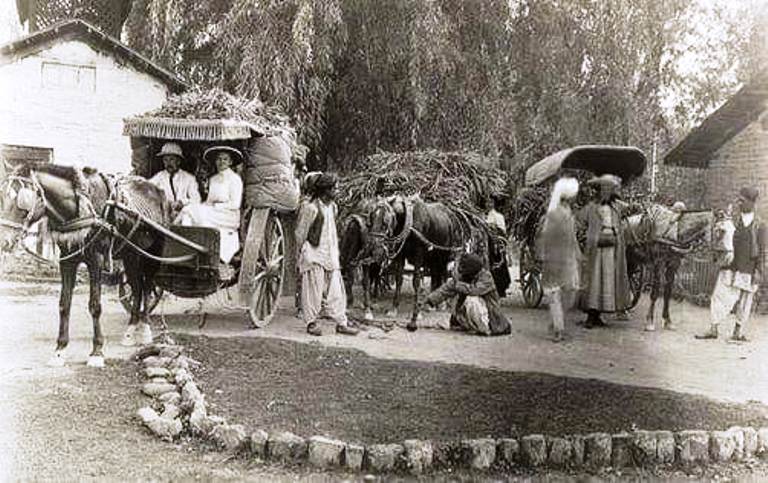
JVR’s significance as a historic first to end Kashmir’s century-old isolation and key to access the larger world never permitted it to go out of public discourse. This “wonderful mountain road” owes its existence to the British, who desperately needed a ‘convenient means’ for its military access to the Northern Areas, to check Russian expansionism.
By 1888, when Col Parry Nisbet was appointed British Resident, Maharaja Ranbir Singh’s Public Works Department led by Alkinson, another Briton, had spent five years in completing the road between Kohala – the last boundary post of the erstwhile Kashmir state, and Domel (a place where Jhelum and Kishanganga rivers join, now on the other side of LoC. Darbar said it would take another 12 years to complete the road up to Baramulla, something that was unacceptable to the British.
Nisbet fixed a two-year deadline and appointed M/S Speddings and Co as contractors. Capable engineers were brought in with hundreds of Pathan and Afghan coolies – including deserters from British regiments and several marauders who were hiding from the law. Around 74 people got killed, including 20 from snakebites, while laying this road. In 1890, Pratap Singh drove on the road from Kohala to Baramulla in a bull-driven cart. It cost the monarchy Rs 21,78,870. It was extended to Srinagar in 1895.
After the famous Tonga caravans, the wheeled carriage was replaced by vehicles, mostly 19-seater Fords and Chevrolets, for ferrying passengers. Three-fourths of the Kashmir trade, including 99 percent of exports, involved this road.
This ‘engineering feat’ had 22 bridges – eight wooden, three masonry arches and 11 steel girders – between Uri and Domel. Unlike all other similar routes, this road follows the Jhelum and does not go beyond an altitude of 5000 feet. Operational around the year, the road was a revolution. Within a year, the imports touched Rs 66,16,145 and exports Rs 65,05,088. Gradually, the road proved of logistical, infrastructural and economic value.
However, the prosperity proved short-lived. This trek has historically been used by preachers, traders and raiders. As India was partitioned, it was the turn of raiders to get in. The standstill agreement that Hari Singh signed with Lahore and New Delhi on August 15, 1947, showed clear signs of breakdown from the Rawalpindi side in late September as an acute scarcity of essential items hit Kashmir. Collections at the Domel toll post fell from Rs 3,000 a day to a few hundred bucks. Subsequently, accession was executed in October 1947.
Muzaffarabad fell on October 23, 1947 and Uri a day after. Eventually, the Pakistani regulars came out in the open to support raiders, and the Indian army dominated the scene from this side. Uri was recaptured on November 14. However, Udoosa, the last village on this side of the LoC, was captured in late May 1948 after a series of battles. On May 20, the troops started for Chakothi but a day after, they were halted and asked to hold before their diversion to Poonch. It was after a UN-declared ceasefire that the rival sides accepted the British Bailey Bridge over Khalias-de-Khan nulla as the LoC.
Conversion of the main route into a war zone prevented the routine activities. But evidences suggest the people who were not involved in the conflict used it till November 8, 1947. Perhaps the two convoys sent by NWFP governor George Cunningham to evacuate the trapped Europeans were the last civilian traffic that JVR had seen. It was this convoy that rescued Sydney Smith, the celebrated reporter of the Daily Express, London, who raiders had taken captive in Baramulla. Smith was the last journalist who trekked on this road before it was closed.
JVR, however, was open for very restricted traffic till 1956. Shortly after the Karachi agreement, the Sheikh Abdullah government issued Order No 912(C) on October 19, 1949, asking people to get a written permit from the Superintendent of Police of the Jammu and Kashmir government. This was termed as the Rehdari system. This permitted many to leave Kashmir forever.
At the same time, the road was conveniently used by the governments at Srinagar and Muzaffarabad to deport their political opponents. Khawaja Sanaullah Bhat (1922-2009), a renowned name in Kashmir’s vernacular press – perhaps the only journalist who travelled on this road after partition – was one of many such deportees who were arrested and sent marching towards Srinagar in March 1957.

Swelling Expectations
Partition, like in the rest of the country, divided lands and families. The governance structure on both sides recognised the desperation that such families have had. As many as 275 families were living literally on the LoC – 264 are in Mendar and Haveli (Rajouri-Poonch), where 17 villages have the LoC on their edge.
During the non-initiation of combat operation (NICO) of the Prime Minister Atal Behari Vajpayee (November 28, 2000 to May 21, 2001), some people who had migrated to the other side were permitted to return home. Such returns were reported from Lachipora, Gohalta, Nambla, Silikote and Kamalkote hamlets in the Uri belt.
From Keran, 1047 residents had fled. During NICO, the divided relatives would sit on the banks of Kishanganga (Neelam) and wave at each other. As a “rare goodwill gesture”, the border guards on either side allowed divided families to exchange greetings, mourning the deaths and sharing the grief.
As everybody started talking about peace-making, these divided families in 2003 summer started suggesting a ‘peace village’ where they would meet each other. The demand was louder from the other side, however.
Meek Admission
By November 2003, the Jammu and Kashmir government decided to upgrade the Srinagar Uri road (JVR) and sought the assistance of Rs 570 crore and the inclusion of this stretch in the 7,300-km long North-South Corridor. It was a follow-up to Vajpayee personally laying the foundation of the Rs 168 crore project envisaging widening of 18 km of the bypass on the Srinagar-Jammu highway.
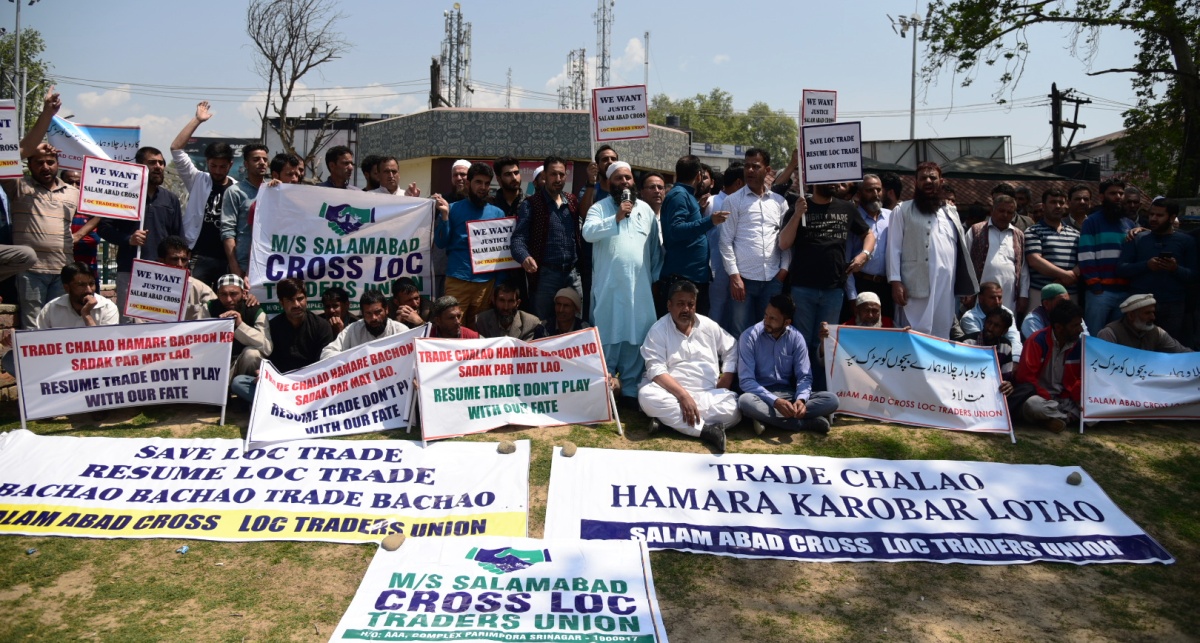
By 2004 summer, the idea of the road opening had reached a level that passport holders doubled. By the end of 1999, Kashmir had only 150 thousand passport holders.
By January 2005, the top officials started talking about it. “We have not started anything. However, the civil administration and the army has jointly set up a team to assess the requirements in case the government decides to re-open the road, we have sent an engineer as our representative”, A Mahadevan, the then Chief Engineer of BRO’s Beacon Project, told me in the first week of January.
He said the road needs repairs in just 17 km starting from Uri to the no-man’s land ahead of the weak bridge. “It would not take much time in case the government decides. In just one working season, will this get completed?” he added.
Announced
On February 16, 2005, India and Pakistan foreign ministers, K Natwar Singh and Khurshid Mehmood Kasuri, announced that they would start the Muzaffarabad-Srinagar bus service from April 7, 2005. It would require a special permit and not a passport, and would initially be available to families who have relations on the other side.
It was a huge morale booster for the Mufti regime. Instantly, Baramulla and Uri were illuminated. There were crackers in some parts of Srinagar city. “Sacrifices have not gone waste”, Muzaffar Hussain Beig, the then Finance Minister, who had survived wounded in the April 7, 2004, grenade attack along with Mehbooba Mufti in Uri, in which 13 civilians were killed, told me on phone from Jammu. The day for the historic bus ride was chosen to fall on the first death anniversary of the attack. “This is a step in the right direction, and this road will foster the friendship between the two people”.
People who cracked jokes started taking things seriously. “It is a small but significant step towards the right direction,” Prof Abdu Gani Bhat said. “ Both sides are serious and positive, and I see the ice melting. We should not expect leaps because that can break us”.
Race to Repair
Though Uri had played host to innumerable delegations from the Transport Ministry, Customs, and other security agencies in 2004, the April 7 announcement had come as a big surprise.. The newspaper commentaries suggested that the bilateral disagreements over the Baghlihar and the Kishanganga power projects have blighted the road reopening hopes. As the two countries announced the decision, they started racing against time to set up the infrastructure required on the frozen track.
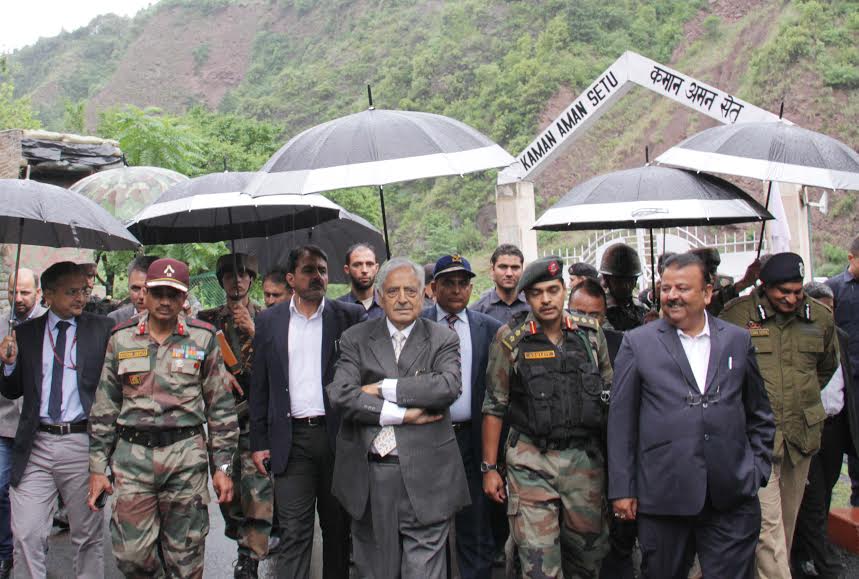
It was challenging to make the road reusable quickly. The tail end of the slightly more than 14 km road was frozen in time, especially between Adoosa, the last village of the trek on this side, and the Weak Bridge that was later renamed as Kaman AmanSetu. The only species using the trek were UNMOGIP observers who would move on foot for crossover.
The location of Adoosa was quite puzzling. Located on Jhelum banks and openly visible to Pakistani gunners on the other side of hills for almost 7 km – from Red Bridge to the village, they eventually built a 6-ft high stonewall for the entire length to stay safe.
“The army has commenced the process of de-mining the stretch close to the LoC to facilitate the timely opening of the Srinagar-Muzaffarabad Highway,” Col R K Sen, Defence Spokesman in Srinagar, told us on March 5, informally conveying that the stretch has been mined in all the wars from 1948 to 1971. Reports suggested a total of 80 mines need to be detected and neutralised before starting the repairs of the road after decades of neglect.
Army engineers, according to Col Sen, would repair and strengthen the existing piers and abutments of the bridge over Khalias-de-Khan nulla (rivulet), over which the Kaman Bridge exists. The BRO would take care of the road. The state government started purchasing the ‘peace buses’ as the RPO started distributing the application forms.
On March 14, 2005, I followed the cavalcade of Lt Gen Hari Prasad, perhaps the first 3-star General who visited the spot in too many years. It was my first ground visit too.
After decades, life is visibly thriving on the last six kilometres of the stretch from Uri town. The army has cut the fence and demolished a concrete wall near Weak Bridge and blasted hundreds of mines to reopen the run-down stretch of the road.
Peace has changed things altogether. With men and machinery working literally on war footing round the clock, the Jhelum River was no longer roaring in solitude. The residents in Sugna, Pahal and Udham – the three PoK hamlets overlooking this Indian position on the erstwhile JVR – or for that matter, Udoosa – the last habitation on this side, were seemingly bewildered. Mostly brought up under the shadows of the gun and roars of the mortars, this was their first introduction to peace. They disbelieved their eyes seeing rivals working in sync.

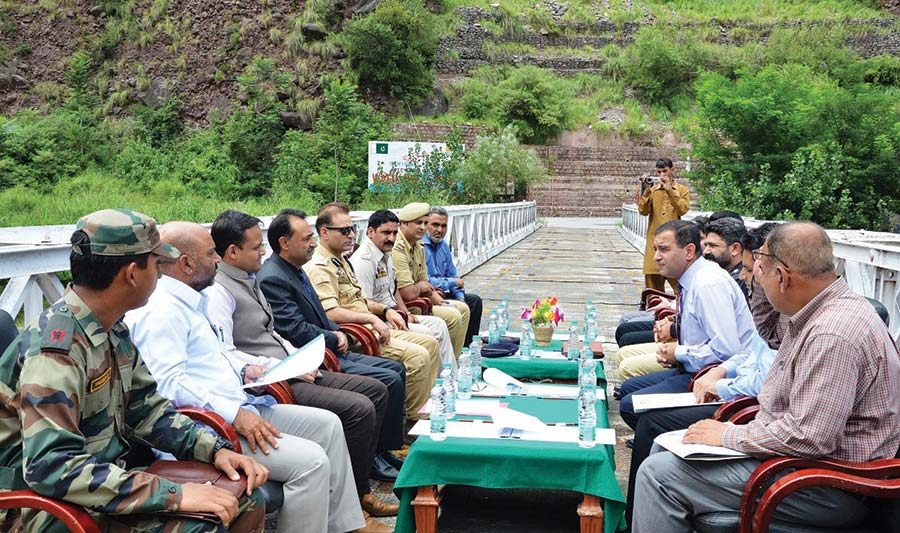
“I am meeting with my counterpart Brigadier Nazeeb of 10-Corps in the afternoon to finalise the details of repairing the rest of the Kaman Bridge”, I remember Brigadier Diwidi telling a huge battery of reporters. Though owned one-half each by both sides, it was Indian Army engineers repairing it since February 23. “We plan to start repairs of the bridge on March 21 and complete it in five days, he said. “We will give the best of the road by March 31”, BRO’s Brigadier S S Dasaka said.
As innumerable tents were pitched on the recently de-mined banks of the rivulet to house the workers, a group of masons from Baramulla said they do not have time to talk because they are supposed to raise as many as six buildings besides a huge gate ahead of the bridge. Workers who had a desire to visit their relatives on the other side were assured of help by Lt Gen Prasad.
On March 13, Chief Minister Mufti Sayeed visited the bridge. He was optimistic that the fortnightly bus would become a daily service soon, and trade would follow. By then, the army had de-mined almost 400 meters. On March 15, the army Chief General JJ Singh flew to the Bridge and reiterated that the bus was ‘the greatest CBM’.
Storytellers Reappear
With the CBM in sharp focus, all of a sudden focus shifted to people who knew the road. Nostalgia was page one. Amid age and ailments, they spared time to tell the stories of their frequent sojourns on the road that brought faiths, fortunes, and invaders to Kashmir.
Then, 69-year-old Ahmad-ud-Din said he was barely 11 when he travelled on the road on foot. “I still have my memories quite fresh”, I remember hearing him reveal. The bus service formally started on the road in 1937, and it would take two to three days for a bus to get passengers for all its benches (there were no seats like we have now). “Usually, it would be lunch break at Domail if the bus left Srinagar in the morning. At Kohala – the last post of the pre-partition Jammu Kashmir –the British would charge one paisa as toll tax”, Din remembered.
Unlike the Srinagar-Jammu highway, Din said, the Maharaja had fixed daytime for the movement of the buses and nighttime for the bullocks carrying merchandise and goods. “It is impossible to express how it looked when hundreds of bull-carts were moving in the night with traditional lanterns as the sole light for the bulls, horses and cart-drivers”, he added.
And the drivers who used to ply the 18-seater Ford and Chevrolet buses were thrilled. Then 80, Ghulam Qadir Chapri started as a driver on this road at the age of 22. “It was great fun. People would prefer to take dry fruits from here and get salt and tea at Muzaffarabad. I still remember the rush during the days of the Amarnath pilgrimage”, Chapri said. His brother lives in Lahore, and Chapri is keen to visit him. “But I would love to drive my jeep on this road”, he adds.
In Dalgate, Srinagar’s tourist hub, two taxi drivers – Gulam Nabi Bhat, then 76, and Haji Abdul Gani Mir, then 83, were in huge demand. Both of them would drive the buses on this road. They would carry the huge mailbags as well. Haji, paralyzed and seriously ailing, was the first driver who took a bus on this road as employee of the Allied Transport Co that owned the 10-bus fleet for this road. “It is good to hear that the road is opening. I hope there is peace and no war”, Mir said.
Unlike Haji, Bhat was found still driving his taxi and was keen to drive a bus on the same road. “It is a great road – no blocks, no slides, no snow, and no avalanches. It is an open road around the year”, Bhat said. Even after more than five decades, he still misses the tobacco from Peshawar and the movie that he would watch every time he parked his vehicle in Muzaffarabad.

The First Tension
By the end of March 2005, when the two sides exchanged the list of passengers, it was leaked. Both sides started blaming each other.
‘They (militants) failed to deter us in the past and will not succeed now either”, Mufti told the state legislature at Jammu, when the leakage and threat issue was raised by some members. “Our determination to bring down the walls of hatred is unshakable. Enemies of peace would have to be on the defensive as the forces of amity and friendship are on the offensive.” He said only one of the 30 potential passengers had received a threat call from London.
Mrs Gulam Fatima, a Srinagar resident, had publicly said that she was willing to take a bullet but not skip her Muzaffarabad visit. “At least my daughter would know that her mother was killed for trying to meet her”, the lady told reporters. Fatima’s daughter had married her cousin in 1988, and she was yet to see her grandchildren.
The government was busy celebrating the event. A Pandit trio – stage designer Bansi Koul, playwright Pran Kishore and theatre person M K Raina- were hired to manage the April 7 night. The twin 19-seaters that would carry the passengers were supposed to carry the inscription of a famous saying of Kashmir’s standard bearer saint Noor-ud-Din Noorani on their windscreens: Kartal Phetrim Ti Garmius Dreat (I broke the dagger to make sickles). A hoarding emerged in Srinagar carrying the photographs of Prime Minister Dr Manmohan Singh and Pakistani dictator Parvez Musharraf. By April 4, all passengers were in a security area.
A Visit to Kaman
With two days to go, on April 5, 2005, I joined of reporters to reach Kaman. It was completely changed. “Apart from abutments and piers, we erected the bridge within eight hours,” said Col G S Rawat of the Dogra Regiment. With worn-out railings of the damaged bridge hanging underneath, a couple of soldiers were busy painting it white, symbolising peace. Two army trucks carrying giant diesel generators were parked on the 220-foot bridge, earlier called the KDK bridge, to help 6-engineers weld the rods strongly.
Road reopening had changed this border stretch, that rarely witnessed peaceful life. As the peeping Bofors and the mortars had disappeared,d now one could rest in the best air-conditioned hall and talk to anywhere in the world at the Kaman Transit Point (KTP) completed in record time. Customs and immigration officers said they have access to all the modern facilities they have at other places..
The highway was decorated with billboards indicating information warfare. The first billboard that passengers from the other side would see would remind them of Allama Iqbal: Mazhab Nahi Sikhata Aapas Mein Bair Rakhna (Religion does not teach hatred).
A Militant Attack
On April 6, 2005, on the eve of the Prime Minister flying for the inauguration of the historic initiative, for which more than 500 journalists had flown to Srinagar, militants targeted the Tourist Reception Centre (TRC) housing 24 of the 29 passengers of the inaugural bus. Moments after the firing broke out, the wooden building was up in flames. Over 100 employees belonging to the Departments of Tourism, Wildlife, Fisheries, SRTC, JKTDC, IA, and Northern Railways, Post Office, SBI, JK Bank, and the people living in the TDC suites barely escaped. It did not change the script.
The next day, amid unprecedented security, the Prime Minister flagged off the humbly decorated two buses of the Karvan-e-Aman (the peace cavalcade) fleet, carrying 21 passengers, as a modest gathering braving threats and inclement weather. He termed it “a small step on a long road” and hoped it would help “solve difficult issues in an atmosphere of friendship and trust”.
It took exactly seven minutes for the Srinagar-bound passengers from ‘other Kashmir’ to cross the snow-white 220-foot peace bridge and enter Jammu and Kashmir at 1400 hours when the Chief Minister shook hands with the Muzaffarabad Collector Liyaqat Hussain, who led them to this side.
A soldier waved a white flag as a regimental band of the 10 Dogra did its best as the guests were being garlanded and offered sweets. Two young men from across bowed down and kissed the ground. At 1630 hours, the first of the 19 passengers from Jammu and Kashmir set foot on the other side. “From Home to Home – we extend a warm welcome to Kashmiri brethren”, read the huge green greeting billboard.