From the battlefield skirmishes of 1965 to the high-altitude conflict of Kargil and the nuclear brinkmanship that followed, Kashmir has shaped the subcontinent’s military landscape, reshaping alliances and deepening strategic divides, writes Humaira Nabi
During the intervening night of May 6–7, the residents of Kashmir were jolted awake by the sound of aircraft engines slicing through the midnight stillness. India had launched a series of coordinated missiles targeting nine sites within and outside the Pakistan mainland. The strikes, described by India’s Ministry of Defence as “precise and non-escalatory,” were carried out in retaliation for the April 22 attack in Pahalgam, where 26 tourists were massacred.
This marked the third cross-border operation ordered by Prime Minister Narendra Modi’s government. The first occurred on September 29, 2016, when specially trained soldiers crossed LoC for a hit to avenge the killing of 16 soldiers in Uri town. In 2019, following the February 14 Pulwama attack, in which a suicide bomber killed 40 personnel of the Central Reserve Police Force. On February 26, 2019, India launched airstrikes on a Jaish camp in Balakot, deep inside Pakistan. The operation, the first Indian airstrike on Pakistani soil since 1971, led to an aerial dogfight and the brief capture of Indian pilot Wing Commander Abhinandan Varthaman, who was subsequently released.
Since India and Pakistan came into being in 1947, Kashmir has remained a volatile flashpoint in South Asia. The region has ignited three of the four wars fought between the two neighbours.
The First War (1947–48)
The seeds of the conflict were sown during the partition when India and Pakistan came into being, with the Kashmir state initially not joining either of the two. It soon became a contested territory. Initially, Maharaja opted for independence. Pakistan, asserting that Kashmir’s Muslim demographic, sought to annexe the region, while India argued that strategic and historical ties justified Kashmir’s inclusion.

In late October 1947, tribal militias backed by Pakistani forces invaded Kashmir, aiming to capture it before the Maharaja could make a final decision. As the militias advanced toward Srinagar, the Maharaja sought India’s military assistance. On October 26, he signed the Instrument of Accession, formally joining India. Indian troops were airlifted to Srinagar, halting the advance, though Pakistani forces secured large parts of western Kashmir, part of the erstwhile state that is now under Pakistan’s control.
The war raged through 1948, with intense battles between the rival armies, interestingly led by the same British General. India retained control of the Kashmir Valley, Jammu, and Ladakh, while Pakistan held onto Gilgit-Baltistan and Mirpur. Under mounting international pressure, particularly from the United Nations, a ceasefire was declared on January 1, 1949. The UN established the ceasefire line but offered no permanent resolution.
The Second War (1965)
The Indo-Pakistani War of 1965 erupted in August, fuelled by Pakistan’s growing desire to seize control of Kashmir. The 17-day conflict significantly altered the strategic landscape of South Asia.

Earlier in the year, tensions had escalated in the Rann of Kutch, a disputed salt marsh in Gujarat. The brief skirmishes led to international arbitration in 1968, awarding Pakistan around 780 square kilometres of the contested area. Buoyed by the outcome and bolstered by over US$ 700 million in American military aid since 1954, Pakistan’s leadership believed India could be challenged more assertively, especially in Kashmir.
In August, Pakistan launched Operation Gibraltar, sending thousands of trained infiltrators into Kashmir to incite an uprising among the Muslim population. The anticipated rebellion, however, did not materialise. In response, Pakistan initiated Operation Grand Slam, a conventional military assault on the Chhamb sector, aimed at severing Indian supply lines.
India responded swiftly under Prime Minister Lal Bahadur Shastri and Army Chief General J N Chaudhuri. Indian forces crossed the international border, advancing deep into Pakistani territory and reaching the outskirts of Lahore and Sialkot. The conflict, which had begun with covert infiltration, escalated into a full-scale war, marked by some of the largest tank battles since World War II.
At the Battle of Asal Uttar, Indian troops, armed with British-made Centurion tanks, decimated Pakistan’s US-supplied Patton tanks. Indian forces pushed to the brink of Lahore, while the Pakistan Navy launched a symbolic shelling of the coastal town of Dwarka.
India deployed nine infantry divisions and three armoured brigades, mobilising 700,000 troops and approximately 700 aircraft. Pakistan fielded six infantry and two armoured divisions, deploying 260,000 troops and around 280 aircraft. In the air battles, Pakistani pilots claimed over 60 Indian aircraft while losing about 20 of their own.
As the fighting intensified, the United States and the United Kingdom imposed arms embargoes on both countries. The Soviet Union and the United States co-sponsored United Nations Security Council Resolution 211, calling for an immediate ceasefire. Hostilities ceased on September 23, 1965. In January 1966, Indian and Pakistani leaders met in Tashkent (then in the Soviet Union) and signed the Tashkent Agreement, pledging to restore the pre-war status quo.
The war reshaped regional alliances. India moved closer to the Soviet bloc, while Pakistan deepened its ties with China, setting the stage for a new era of strategic calculations in South Asia.
The Kargil War (1999)
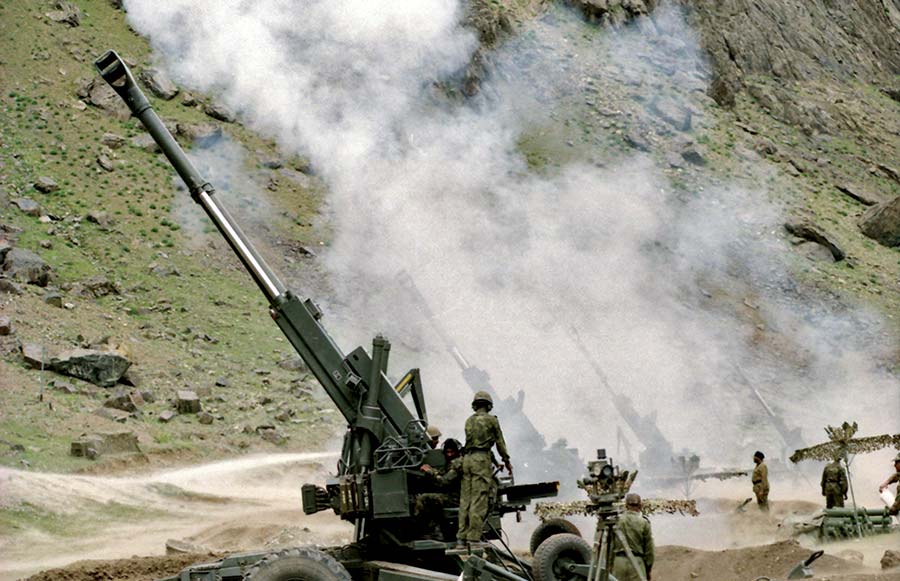
In 1999, Kashmir once again became the epicentre of military conflict as the Kargil War unfolded in the high-altitude terrain of Ladakh. The battlegrounds of Kargil, Dras, and Batalik became sites of intense fighting, drawing the world’s attention to the region.

Just months earlier, India and Pakistan had signed the Lahore Declaration, a peace initiative intended to ease tensions after their 1998 nuclear tests. However, in May 1999, Indian patrols discovered that Pakistani forces and militants had secretly occupied strategic peaks along the Line of Control (LoC), threatening National Highway 1A, India’s vital supply route to Ladakh.
India launched Operation Vijay, a comprehensive military campaign supported by the IAF under Operation Safed Sagar, aimed at dislodging the intruders. The conflict played out at altitudes exceeding 16,000 feet, where freezing temperatures and rugged terrain added to the operational challenges.
Initially, Pakistan claimed the intruders were Kashmiri insurgents, but intercepted communications and seized documents revealed the presence of regular troops from the Pakistan Army’s Northern Light Infantry. India insisted that the incursion was a premeditated military operation.
The global community closely monitored the conflict, given the nuclear status of both countries. Under mounting diplomatic pressure, particularly from the United States, Pakistani Prime Minister Nawaz Sharif travelled to Washington, where he agreed to a withdrawal on July 4, 1999. By the end of July, Indian forces had recaptured most of the occupied positions.
Nuclear Arsenals
India and Pakistan maintain nuclear arsenals that anchor their respective deterrence strategies. According to the Federation of American Scientists and the Arms Control Association, India possesses approximately 180 nuclear warheads as of 2024, surpassing Pakistan’s estimated 170 for the first time in over two decades.
India adheres to a No First Use (NFU) doctrine, declared after its 1998 nuclear tests, committing to nuclear retaliation only in response to a nuclear strike. Its doctrine emphasises “massive retaliation” to inflict unacceptable damage. However, in 2019, statements by Indian leaders suggested a potential review of this stance. The Agni-V missile, with a range of 5,000 to 8,000 km, can strike targets throughout Pakistan and parts of China. The upcoming Agni-VI is expected to extend beyond 6,000 km.
Pakistan does not follow an NFU policy. It adopts an asymmetric escalation strategy, reserving the right to use nuclear weapons first in response to conventional threats.
Conventional Military Balance
In conventional military terms, India ranks fourth globally in military strength, according to the 2024 Global Firepower Index, while Pakistan stands 12th. India’s 2024 defence budget was US$ 86 billion, nearly ten times Pakistan’s US$ 7.64 billion.
India maintains 1.46 million active personnel, including 1.24 million in the army, 149,900 in the air force, and 75,500 in the navy, supported by 11.5 million reservists. Pakistan’s active force comprises 654,000 personnel—560,000 in the army, 70,000 in the air force, and 30,000 in the navy, with five million reservists.

India’s air force operates 2,229 aircraft, including 36 Rafale jets armed with SCALP cruise missiles, 272 Su-30 MKIs, and MiG-29s. The country’s air defences are bolstered by Russian S-400 systems. Pakistan’s fleet of 1,399 aircraft includes F-16s, JF-17s, and Mirage fighters, with Chinese PL-15 missiles enhancing its air-to-air combat capabilities.
In terms of armour, India fields 4,201 tanks, including T-90s and Arjun MBTs, outnumbering Pakistan’s 2,627 tanks, primarily Al-Khalids and T-80s. India also deploys 702 rocket artillery systems, compared to Pakistan’s 602.
India’s naval strength is a major strategic advantage, with 293 naval assets, including two aircraft carriers (INS Vikrant and INS Vikramaditya), 16 destroyers, 16 frigates, 18 submarines (including nuclear-powered vessels), and 139 patrol boats. Pakistan’s navy comprises 121 assets, including eight submarines, 10 frigates, and 103 patrol boats.
Alliance Landscape
The rivalry over Kashmir, even after its full integration in 2019, continues to shape regional geopolitics, with India consolidating a broad and diverse network of alliances. Since being designated a Major Defence Partner by the United States in 2016, India has deepened its strategic and defence ties with Washington. Russia remains its largest arms supplier, while France and Israel have emerged as key partners in defence and intelligence sharing.
In the Gulf, Saudi Arabia and the UAE, once firm allies of Pakistan, now lean towards India, extending diplomatic and economic support. Japan and Australia, both wary of China’s assertiveness, have also strengthened ties with New Delhi. Even the Taliban regime in Afghanistan has indicated a preference for aligning more closely with India, leaving Pakistan further isolated on the diplomatic front.
Pakistan, grappling with economic and military constraints, has become increasingly dependent on China. Beijing continues to supply military hardware, diplomatic backing, and co-developed platforms such as the JF-17 fighter jet. Yet, China’s subdued response during the ongoing crisis suggests a cautious recalibration of its approach towards India.
Turkey remains one of Pakistan’s few vocal supporters, while Iran’s backing has been limited, focusing mainly on mediation rather than overt support. Pakistan’s once formidable alliance with the United States has eroded, while Russia has opted to maintain neutrality, balancing its ties with both South Asian rivals.
As tensions persist, India’s extensive alliance network bolsters its diplomatic and military clout. Pakistan’s narrowing partnerships and growing dependence on China offer limited strategic returns, amplifying its isolation in a region marked by shifting allegiances and escalating uncertainty.