As Jammu and Kashmir inches towards a possible return to statehood, a new political front led by Sajad Lone has emerged, challenging the dominant political narratives in a region still gripped by uncertainty, fractured authority, and deep distrust, Syed Shadab Ali Gillani writes
As speculation mounted that fresh assembly elections might precede the return of Jammu and Kashmir’s statehood, a new political front emerged in Srinagar. While it does not project electoral dominance, the coalition aims to reshape the political discourse.
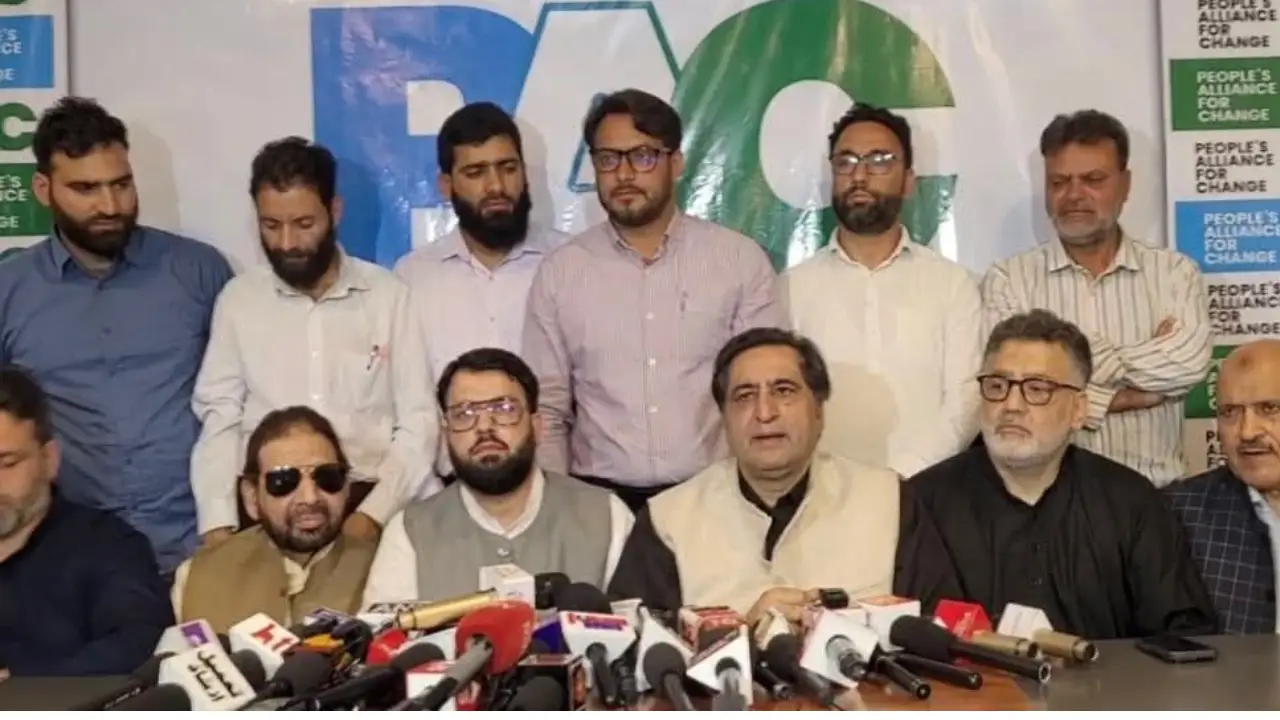
On June 30, the Jammu and Kashmir People’s Conference (JKPC), Hakeem Yaseen’s People’s Democratic Front (PDF), and the Justice and Development Front (JDF) came together to announce a joint platform. Named the People’s Alliance for Change (PAC), the announcement took place at the official residence of JKPC leader Sajad Lone. Others in attendance included Hakeem Yaseen, Shamim Ahmad Thokar, Abdul Gani Vakil, and Imran Ansari.
They released a joint document, Declaration of Change, which listed their shared demands: restoration of statehood, reversal of Article 370 and 35A abrogation, amnesty for political detainees and conflict-affected youth, reintegration of marginalised groups, and what they called an end to exclusionary politics.
Lone said the alliance was a response to the barrenness of Jammu and Kashmir’s current political landscape. He described it as an alternative electoral platform and stressed that they had suffered pain rather than inflicted it.
Shared Histories
The alliance does not present itself as a conventional electoral front. Rather, it seeks to express collective political memory and grievance. The leaders, shaped by three decades of conflict, brought diverse backgrounds to the table: some were former militants, others mainstream politicians, and a few had spent time in prison. Their bond, they said, was not ideological but experiential.
Lone described the alliance as a convergence of shared histories. Past disagreements, including with Jamaat-e-Islami, currently a banned political organisation, were acknowledged but dismissed as natural in any democratic setting. Political parties, he noted, are born of broken consensus, while alliances emerge from minimum common ground. For the PAC, that common ground is pain.
The idea of pain as political capital rather than victimhood dominated the narrative. Lone recalled that his father had spent ten years in prison, sometimes alongside the very leaders now in the alliance. He, too, had experienced interrogation and arrests. These shared trials, he said, created a deep political bond. In recent years, however, he noted that those responsible for inflicting pain had begun to claim the right to speak for those who had suffered. That, he argued, was not only unjust but unnatural.
The alliance, he insisted, was a step towards reclaiming that narrative and ensuring that those who endured history’s weight had the right to represent it.
Vacuum of Power
The alliance was launching itself into a fractured political landscape, where power had become diffuse. Although an assembly had been elected, the region remained under tight central administrative control. According to a political analyst in Srinagar who requested anonymity, governance had turned into a dual system, lacking direction.
The analyst observed that the issue was not merely a political absence but a deepening governance void. In the past, the Raj Bhawan had served as the sole authority in the absence of an elected government. Now, with an elected assembly in place, two parallel structures existed, neither functioning effectively. While the Jammu and Kashmir National Conference (JKNC) has repeatedly asserted that they are unable to deliver because they lack authority, even to transfer the officials, LG Manoj Sinha recently asserted that he is going strictly by the book: “I do not cross boundaries of governance, have got only police under control”.
It was in this environment, the analyst explained, that the PAC needed to be understood. Lone, despite having just one MLA, had initiated a conversation that others had avoided. The analyst pointed to the public expressions of frustration by leaders such as PDP’s Mehbooba Mufti and National Conference’s Aga Ruhullah. The vacuum, he said, had become visible. Whether the alliance would endure was uncertain, but it had already forced something onto the political agenda.
Another analyst who closely follows political developments in Kashmir viewed the alliance with scepticism. He acknowledged that Sajad Lone had emerged as a competent leader who raised public concerns. However, he believed Lone had miscalculated the potential benefits of the alliance. According to him, the move would likely damage Lone electorally and further strengthen the National Conference and the PDP. Voters in Kashmir, he argued, had become politically more conscious and now understood political manoeuvres better than many politicians did.
Politics of Pain
JDF leader Shamim Thokar echoed the alliance’s central idea: that those who had inflicted pain could not now claim to represent those who had endured it. He said they had come together because moving forward alone was no longer viable. Pain, he argued, was not a political currency to be traded, but something lived and endured.
PDF chairman Hakeem Yaseen framed the alliance as an effort to inject clarity into a region paralysed by contradiction. He stressed that the coalition would not engage in double-speak by tailoring its message differently for audiences in Kashmir, Jammu, or Delhi. Instead, it would advance a unified, people-centric agenda formed through consensus. The primary focus, he said, would remain on the vast majority who had suffered for decades.
Imran Reza Ansari, general secretary of the JKPC, described the PAC’s formation as a response to political abandonment. He said the rights of the people were being eroded and that if any previous or current government had genuinely addressed public grievances, such an alliance would not have been necessary. He added that those who dared to speak the truth were now being jailed.
A Foundation, Not a Fluke
Sajad Lone responded to criticisms that the alliance lacked electoral strength. He pointed out that the JKPC had contested only 14 constituencies but still secured over 1.07 lakh votes. With 10,000 more votes, he claimed, they could have won in Pattan, Langate, Karnah, and other segments. He rejected the notion of failure, describing the results as a foundation. This, he said, was the beginning of a process. With five years ahead, no one could predict who else might join the alliance.
In the last assembly elections, Sajad Lone fielded candidates in 14 Kashmir constituencies, while his party, the People’s Conference, garnered a total of 1,07,055 votes and managed to secure only one seat. Hakeem Yaseen contested the election for two seats and received 26,012 votes, but he did not win any seats.
Sheikh Imran, who also joined the People’s Conference, received 4,994 votes in the recent assembly election from the Khanyar constituency. A faction of Jammat also contested many seats.
He clarified that the PAC was not formed for immediate gains but for long-term political repositioning. The alliance, he said, was not just about opposition but also about offering alternatives. Whether the people accepted it or not was their choice, he added, but they believed they deserved a chance.
Political Pushback
The announcement drew swift responses from established parties. Tanvir Sadiq of the National Conference posted on X, referring to the alliance as the BJP’s loyal “B-Team,” rebranded as an alternative. In another post, he labelled the group “Party B Pro Max,” suggesting they had been rejected by voters but revived from behind the scenes.
The BJP’s Jammu and Kashmir general secretary, Ashok Koul, dismissed the alliance as “theatrical.” He described the demand to restore Article 370 as a fantasy, insisting that no power could bring it back. According to him, the leaders were misleading the public.
Senior PDP leader Naeem Akhtar, reflecting on the development, said it would not significantly affect the broader political landscape, which he described as marked by disempowerment and disappointment. However, he believed Lone was risking his party’s political capital by aligning with the current group.

Credibility Issues
Floating political parties and alliances have been a favourite pastime for the political class in Jammu and Kashmir. Most of the alliances, however, have had limited purposes and, by and large, all failed. In the 2024 JKNC-Congress alliance, it was Congress piggybacking on the JKNC to secure some of the berths that the JKNC would have otherwise held. The only alliance that was historic and substantial in Kashmir’s history was the Muslim United Front, which had challenged the JKNC-Congress alliance to the extent that the ruling alliance resorted to rigging, as a result of which militancy broke out.
“What happened to the Gupkar Alliance?” one commentator asked. “Why don’t you explore who created it, why and how it disintegrated? Did not that alliance say they will work to undo the August 5 decision-making?”
Post Script
Cracks were visible within a few days of the announcement of the alliance. Members of the banned Jamaat distanced themselves from the initiative.