A school teacher writes a book on the challenges the microscopic Sikh community faced in the vale post-partition and is an addition to the understanding of contemporary Kashmir, writes Syed Shadab Ali Gillani
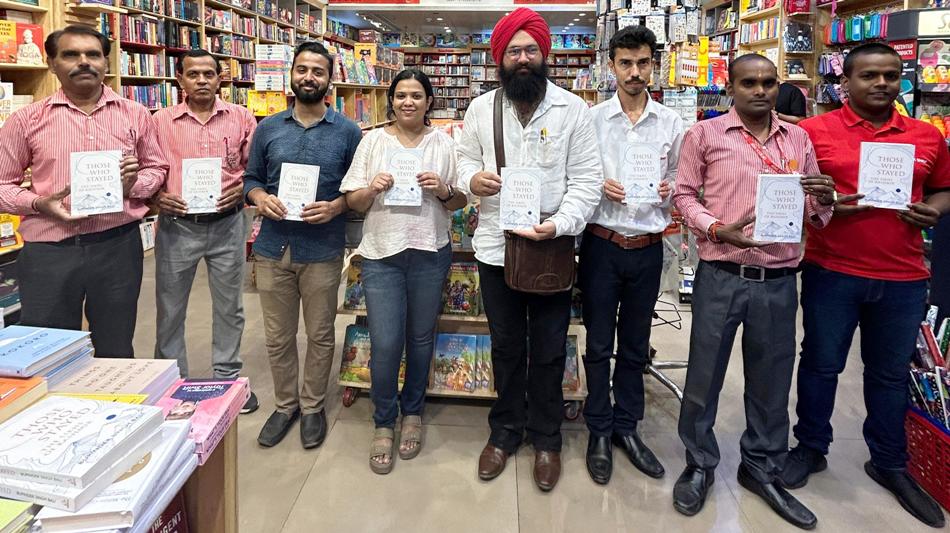
Those Who Stayed: The Sikhs of Kashmir by Bupinder Singh Bali is a compelling narrative that intricately explores the lives of the microscopic community in Kashmir. Bali’s work delves into the historical, social, and political dimensions of the Sikh existence in Kashmir, highlighting their struggles, resilience, and the complex interplay of identity, religion, and politics. Through personal anecdotes, historical recounting, and a nuanced portrayal of communal relationships, Bali presents an account that is both deeply personal and broadly informative.
The book introduces itself with an incident of October 8, 2021, where a Sikh school teacher was killed solely for being a Sikh. This he said has compelled him to write the book.
A Historical Background
Bali sets the stage by tracing the historical events that have shaped the current situation in Kashmir. He recounts the tumultuous period of 1947 when the subcontinent was partitioned, leading to mass migrations and violence. The tribal invasion of Kashmir, which led the Maharaja of Kashmir to accede to India, is described in vivid detail. This historical backdrop, the book asserts, is crucial for understanding the prolonged conflict between India and Pakistan over Kashmir and the subsequent impact on its inhabitants, particularly the Sikhs.
The author provides a comprehensive overview of the wars between India and Pakistan, the 1989 insurgency. This context is essential for readers to grasp the severity and complexity of the turmoil, which has claimed over 48,000 lives and left the region in a state of perpetual unrest.
The Experiences
Bali’s narrative shines in its detailed portrayal of his community’s experience, a “micro-minority” in a predominantly Muslim region, caught in the crossfire. The Sikhs’ plight is portrayed through personal stories, highlighting the unique challenges they face. For instance, the author recounts the Chattisinghpora Massacre, where 35 Sikhs were killed by unidentified gunmen, an incident that underscores the vulnerability and precarious position of the community.
Bali does not shy away from discussing the psychological and emotional toll of living in a conflict zone. He describes the constant fear and uncertainty that Sikhs live with, questioning their future in a land where they have deep historical roots. This sense of alienation is poignantly captured through the reflections of community members who feel like they are sailing in two boats, neither fully at home in Kashmir nor able to envision a future elsewhere.
The book addresses the heavy military presence and the implementation of laws like the Armed Forces Special Powers Act (AFSPA), which grants extensive powers to the military and has been criticised for human rights violations. The portrayal of these issues is balanced with personal anecdotes and interviews, providing a human face to the statistics and policies.
Accommodating Voices
Bali’s reflections and the voices of community members add depth and authenticity to the narrative. The author shares his conflicted feelings about the killings, providing a candid look at the moral and ethical dilemmas faced by those living in Kashmir. This introspective approach allows readers to connect with the emotional and psychological dimensions of the Sikh experience in Kashmir.
Interviews with Sikhs who have chosen to stay put in Kashmir despite the dangers and uncertainties reveal a strong sense of attachment to their homeland and a resilient spirit. These stories of bravery, faith, and determination offer a powerful counter-narrative to the prevailing discourse of fear and victimhood. They highlight the agency and resilience of a community that, despite being marginalised, continues to assert its identity and rights.
Bali’s work is a valuable contribution to contemporary Kashmir history as it offers a unique perspective that highlights the intersectionality of the region’s turmoil. It challenges readers to reconsider their understanding of the crisis and to recognise the diverse experiences and aspirations of its people. For those interested in the human dimensions of political conflicts and the resilience of marginalised communities, Singh’s book is an essential read to understand the mindset of Kashmiri Sikhs.